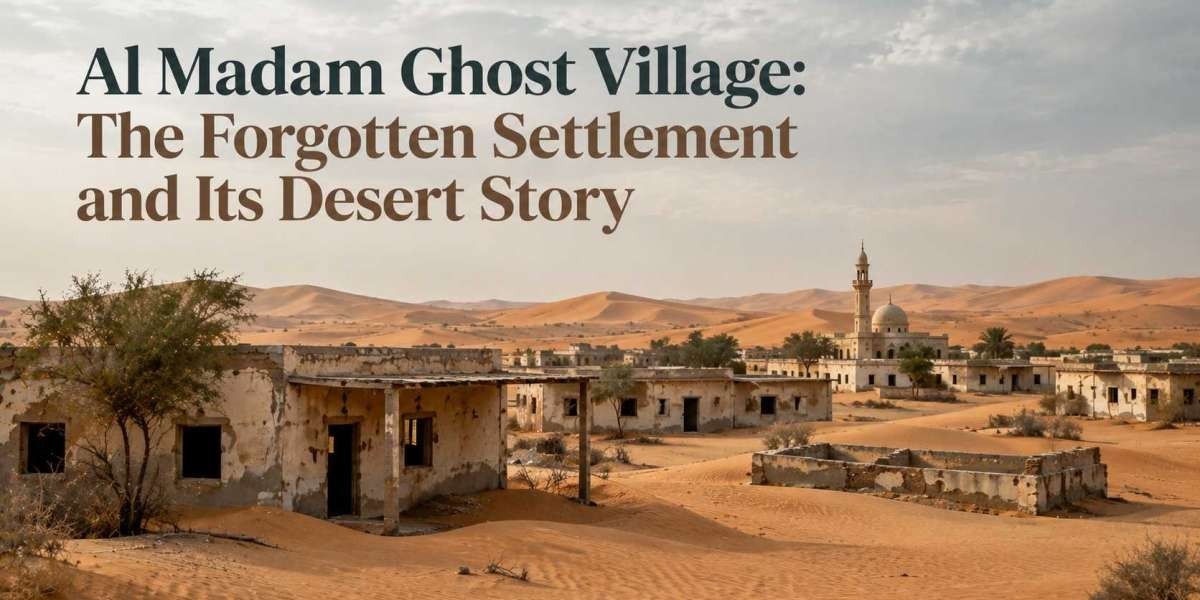

the desert landscape of Sharjah, a group of abandoned houses offers a different perspective on the United Arab Emirates. The buildings are partly covered by drifting sand, empty rooms face the open desert, and a nearby mosque adds to the unusual appearance of the settlement. There are no busy streets or modern shops here. Instead, visitors encounter a place where changing environmental conditions and the passage of time have reshaped a community.
The story of Al Madam Ghost Village history is closely connected to the development of modern housing in the UAE and the challenges of maintaining settlements in a demanding desert environment. Commonly known as the Buried Village, the site is located near Al Madam in Sharjah's Central Region. Its abandoned buildings have attracted photographers, travelers and people interested in architecture and local heritage.
Although the village is sometimes presented online as a mysterious place with supernatural stories, its real historical context is more valuable than rumours. Understanding why the settlement was built, how people lived there and why it was eventually abandoned helps visitors appreciate the site beyond its unusual appearance.
The village also raises an important question for the UAE's tourism sector: how can a place associated with abandonment become an opportunity for education, cultural interpretation and responsible travel without losing its historical meaning?
Where Is the Buried Village Located?
The settlement lies in the Al Madam area of the Emirate of Sharjah, away from the dense urban development associated with Dubai and Sharjah city. The surrounding landscape is characterized by desert terrain, shifting dunes and open views that change with the light and weather.
Its relative isolation is part of its appeal. Visitors arriving from more developed areas encounter a setting that feels very different from the UAE's commercial districts, shopping centers and high-rise neighborhoods.
The abandoned houses are the main attraction, but the broader landscape is equally important. Sand has accumulated around buildings and entered some of their interiors, creating a visible relationship between human construction and natural forces. This is not simply a collection of old structures; it is a place where environmental change can be observed directly.
Sharjah's official tourism website describes the site as a village gradually being overtaken by desert sand. It also explains that the settlement was developed as part of a public housing project following the formation of the UAE in 1971. The homes accommodated members of a Bedouin community whose way of life had previously involved a more semi-nomadic pattern of living.
This background places the village within a wider period of social and economic change, rather than treating it as an unexplained collection of ruins.
How the Village Was Established
The UAE experienced significant transformation during the decades following the discovery and development of oil resources. Infrastructure, public services and housing projects changed how many communities lived and worked. Sharjah, like other emirates, experienced changes in settlement patterns as new facilities and opportunities developed.
The Buried Village is associated with this period of change. Public housing was intended to provide permanent homes for residents who had traditionally lived with a greater degree of mobility. The project reflected an effort to improve residential stability while supporting the transition towards modern community life.
A permanent house, however, does not guarantee that a location will remain practical over time. Access to services, travel distances, environmental conditions and the suitability of the surrounding landscape all affect whether a settlement can support everyday needs.
The village illustrates the complexity of that transition. A housing project may be designed to meet the needs of a community at a particular moment, but the long-term success of a settlement depends on much more than the construction of its buildings.
The official tourism account indicates that the village's residents had left by roughly two decades after its establishment. It attributes the departure commonly to difficult natural conditions, desert winds and long journeys. The available public descriptions provide a broad explanation, although they do not establish every household's individual experience or the precise circumstances behind each departure.
For this reason, the village is best understood through documented information and cautious interpretation, rather than a single dramatic explanation.
Why Did Residents Leave?
One of the most frequently asked questions about the site concerns the reason it became abandoned. The short answer is that environmental difficulties and the practical demands of daily life are widely cited as important factors.
Desert environments can place considerable pressure on buildings, roads and residential infrastructure. Wind moves sand across the landscape, sometimes covering access routes and gathering around walls and entrances. Over time, repeated exposure can make buildings more difficult to maintain and surrounding areas harder to use.
Daily life also depends on access to employment, schools, healthcare, shops and transport. If a settlement becomes inconveniently located in relation to these services, residents may prefer to move to a more suitable area. Such decisions are usually shaped by several connected factors rather than one isolated event.
The village's abandonment is often described online through stories involving mysterious forces or supernatural activity. These stories contribute to the location's reputation, but they should not be treated as established historical evidence. Sharjah's tourism account offers a more practical explanation, pointing towards natural conditions and commuting difficulties.
It is also important to avoid assuming that every resident left for exactly the same reason. Different households can experience the same environment in different ways, depending on their work, family responsibilities, resources and access to alternatives.
A responsible historical account recognizes what is known, distinguishes it from local legend and leaves room for details that have not been conclusively documented.
What the Architecture Reveals
The remaining buildings provide clues about the settlement's original residential purpose. The houses were intended for everyday domestic use rather than for visitors or commercial activity. Their simple appearance reflects a functional approach to housing, while the mosque indicates that community life included a place for religious practice.
Today, the buildings are viewed through a different lens. Empty rooms, exposed walls and sand-covered entrances make the site visually striking, especially when sunlight creates long shadows across the structures.
Yet the ruins should not be judged only by their photographic appeal. Their value also lies in what they can tell future generations about housing, community planning and the social changes that occurred during the UAE's development.
Architecture becomes particularly informative when it is considered alongside its original purpose. A house is not merely a shape made from building materials. It is a setting for family life, routine, privacy, hospitality and community relationships. When a home is abandoned, those everyday experiences may disappear from view, even while parts of the physical structure remain.
The village offers an opportunity to interpret this ordinary residential history. It can help visitors understand that heritage includes not only palaces, forts and ancient monuments, but also relatively recent places connected to the lives of ordinary residents.
The Desert as an Active Force
Sand is the defining visual feature of the settlement today. In some places, it gathers around exterior walls; elsewhere, it enters buildings and changes the appearance of rooms and entrances. The effect can make the site appear frozen in time, but the landscape itself remains dynamic.
Wind-driven sand movement is a natural process in desert environments. Its effects depend on wind direction, dune movement, vegetation, local topography and the presence of obstacles. Buildings can interrupt the movement of sand, causing deposits to accumulate in particular places.
Once a structure is abandoned, routine maintenance no longer keeps entrances clear, repairs damaged sections or manages the surrounding ground. Small changes can accumulate over time. A damaged roof or wall may deteriorate further, while sand and weather gradually alter the remaining structure.
This relationship between environment and architecture gives the village wider relevance. It illustrates why building design, maintenance planning and location matter in arid regions. Modern development must account for environmental conditions rather than assuming that infrastructure will remain unaffected after construction.
The site should not, however, be interpreted as proof that desert conditions alone explain every aspect of its abandonment. The available information points to a combination of environmental pressures and practical difficulties, and a careful account should preserve that distinction.
Why the Village Matters to UAE Heritage
Heritage is often associated with very old archaeological remains, traditional forts or structures that have survived for centuries. The Buried Village represents a different category: a relatively recent settlement that documents a period of social transition.
Its importance comes partly from the contrast between the original purpose of the homes and their present condition. The buildings were created for people to live in, yet they now provide a setting in which visitors can reflect on migration, public housing, environmental adaptation and the changing needs of communities.
The wider Al Madam area also contains much older archaeological evidence. The Sharjah Archeology Authority documents the nearby Thuqeibah settlement, an Iron Age site dating to around 900 BCE, with remains of houses and an ancient irrigation system known as a falaj. This archaeological settlement is distinct from the modern abandoned village, but it demonstrates that the wider area has a much longer history of human habitation and adaptation to local conditions.
Keeping these sites distinct is essential. The modern Buried Village should not be incorrectly described as an ancient archaeological settlement simply because it lies within a historically significant region.
Together, the different layers of history help explain how people have adapted to the environment across different periods. They also show why heritage interpretation benefits from accurate dates, clear explanations and reliable records.
Responsible Tourism and Visitor Experience
The village attracts visitors who enjoy landscape photography, architecture, cultural travel and less conventional destinations. Its unusual appearance offers a contrast to the UAE's more familiar tourism experiences, but the visit requires preparation and respect for the site.
The desert can be extremely hot, and conditions can change quickly. Travelers should check the weather, plan their journey carefully, carry sufficient drinking water and avoid entering unstable structures. Appropriate footwear is useful on uneven ground, while a suitable vehicle and route planning can be important for reaching remote desert locations.
Visitors should also avoid damaging walls, removing objects or leaving litter. The fact that a building is abandoned does not mean that it has no cultural value. Graffiti, broken materials and careless movement through fragile spaces can reduce the site's usefulness for future visitors and researchers.
Photography can be an excellent way to record the settlement, but it should not take priority over safety. Visitors should not climb on weakened walls, enter areas that appear unstable or put themselves at risk to capture a particular angle.
A thoughtful visit combines curiosity with restraint. The aim is to understand the place, document it responsibly and leave it in a condition that allows others to appreciate it.
Preserving the Site for Future Generations
Preservation does not always mean rebuilding a place until it looks new. In some cases, conservation may involve stabilizing vulnerable structures, documenting existing conditions and managing access while allowing the site to retain visible evidence of age and environmental change.
In July 2023, the official website of the Ruler of Sharjah reported a directive to preserve the Buried Village and prepare it for visitors and tourists. This announcement showed official interest in protecting the location and making it more accessible. The announcement itself should not be taken as confirmation that every planned conservation or visitor facility has since been completed.
A well-planned preservation approach could combine structural assessment, photography, mapping and historical interpretation. Clear visitor information would help explain the settlement's origins and distinguish documented history from popular speculation.
Digital documentation can also play a useful role. High-resolution photography, aerial surveys and three-dimensional recording can create records of structures before further deterioration occurs. These methods are already used in archaeological work elsewhere in the Al Madam area, including the documentation of the Thuqeibah site by specialists working with Sharjah's archaeological authorities.
The goal should not be to remove every trace of environmental change. Instead, preservation can help protect the remaining buildings while explaining how wind, sand and the absence of maintenance have influenced their current appearance.
How Technology Can Support Heritage Protection
Digital tools are increasingly useful for recording places that are difficult to preserve through physical intervention alone. Detailed photography, mapping, remote sensing and three-dimensional models can help researchers record the dimensions and condition of structures.
These techniques can create a digital record for future study and make it possible to compare changes over time. If a wall deteriorates or a section becomes buried, earlier documentation may help researchers understand what was there before the change occurred.
The same principle connects heritage management with Dubai proptech trends 2026 , where digital modeling, data systems and remote monitoring are relevant to the broader built environment. Although a modern real estate platform and a heritage conservation project have different objectives, both can benefit from accurate records and reliable information about physical structures.
For a historic site, technology is most useful when it supports conservation decisions rather than replacing them. A digital model cannot repair a damaged wall, establish the full story of former residents or determine cultural significance without research and expert judgment.
Digital storytelling may also help educational institutions, tourism organizations and cultural publications present the site to people who cannot visit in person. Virtual reconstructions should clearly distinguish documented details from artistic interpretation, particularly when evidence about the original appearance is incomplete.
For MAGNAV, this topic offers a useful connection between UAE tourism, architecture, technology and cultural heritage. It shows how a place outside the country's main commercial districts can contribute to a broader understanding of the UAE's development.
The Difference Between a Ghost Story and a Historical Record
The label “ghost village” is memorable and helps explain why the location attracts attention online. Empty houses and wind-shaped dunes naturally create an atmosphere that photographers and storytellers find compelling.
However, dramatic descriptions can sometimes overshadow the people who once lived there. When a location is presented only as mysterious or frightening, its residential history becomes secondary to entertainment.
A stronger interpretation can recognize the atmosphere without turning speculation into fact. Visitors can appreciate the silence, unusual architecture and shifting landscape while learning about the community for whom the houses were originally built.
Historical interpretation should also avoid inventing personal stories about former residents. Unless supported by reliable accounts, claims about specific families, individual departures or unusual events should be identified as unverified.
Oral histories, if collected from former residents and their descendants, could add valuable detail about daily life, housing conditions and the decision to move. Such accounts would need to be recorded respectfully and considered alongside documentary and physical evidence.
This approach creates a more meaningful visitor experience. Instead of leaving with only a photograph of abandoned rooms, people can leave with a better understanding of how settlements change and why their stories deserve careful documentation.
Conclusion
The Buried Village near Al Madam offers a valuable view of the relationship between people, housing and the desert environment. Its homes reflect a period of modern development in the UAE, while the sand-covered structures illustrate the pressures that can affect settlements when environmental conditions and everyday practical needs become difficult to manage.
The site deserves attention for more than its mysterious appearance. Accurate historical interpretation, careful conservation, responsible visitor behavior and digital documentation can help preserve its remaining structures and explain its significance to future generations.
Its story also demonstrates that cultural heritage can contribute to tourism without relying on exaggeration. Thoughtful interpretation gives visitors context, helps protect fragile places and creates a more meaningful connection with the communities and landscapes that shaped them. For cultural destinations and premium travel experiences alike, Dubai luxury marketing trends can be considered alongside a wider principle: credible storytelling and respect for a place are more valuable over time than sensational claims.
As the UAE continues to develop, places like the Buried Village remind us that the country's history is recorded not only in its modern skyline but also in the settlements, structures and landscapes that reveal how life has changed.
FAQs
Where is Al Madam Ghost Village?
It is located near Al Madam in Sharjah's Central Region, UAE. The abandoned settlement is commonly known as the Buried Village.
Why was the village abandoned?
Public tourism information commonly points to difficult desert conditions, moving sand and the inconvenience of long journeys. The exact circumstances may have differed among residents.
When was the Buried Village built?
It is generally associated with a public housing project developed after the formation of the UAE in 1971. It is a modern settlement, not an ancient ghost town.
Is the village really haunted?
There are local legends and online stories about supernatural activity, but these should not be confused with verified historical evidence.
Can tourists visit the village?
The site has been promoted as a destination for visitors, and an official directive to preserve it and prepare it for tourism was reported in 2023. Travelers should check current local access conditions before visiting.
What should visitors know before going?
Check the weather and route, carry water, wear suitable footwear, avoid unstable structures, and do not damage buildings or leave rubbish behind.
Is the Buried Village the same as the ancient Thuqeibah settlement?
No. The Buried Village is a modern abandoned housing settlement, while Thuqeibah is a separate archaeological site in the Al Madam area dating to the Iron Age.
Why is preservation important?
Preservation can protect the remaining structures, document a period of social change and help future visitors understand the place through evidence rather than speculation.




