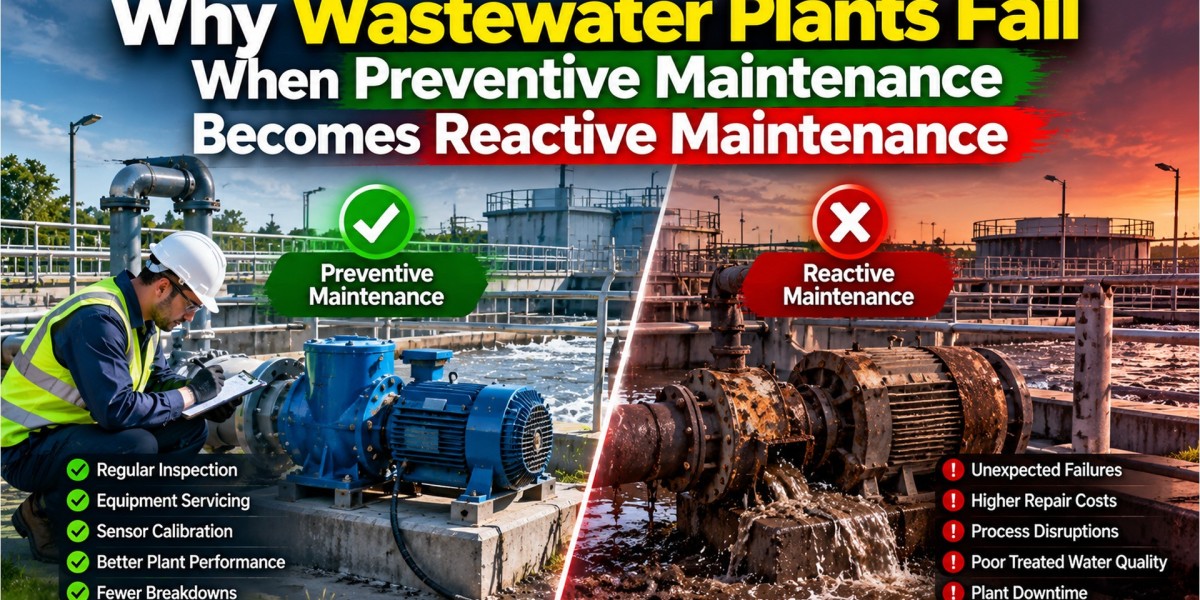

Most Treatment Plants Do Not Suddenly Stop Working — They Give Warnings First
A wastewater-treatment plant can continue running while its actual performance slowly declines.
A blower becomes noisier. Diffuser airflow becomes uneven. A pump begins losing flow. A pH sensor drifts. Sludge settles differently. Chemical consumption gradually increases.
None of these changes may stop the plant immediately.
That is exactly why they can be dangerous.
When maintenance happens only after equipment fails or treated-water quality deteriorates, a facility has moved from preventive maintenance into reactive maintenance.
For facilities managing Wastewater Treatment Plant Maintenance Pakistan, the difference between those two approaches can determine whether the plant operates predictably or spends its life moving from one emergency to another.
What Is Reactive Maintenance?
Reactive maintenance is simple:
Something fails, then someone fixes it.
This approach can appear economical because the facility avoids spending time or money servicing equipment that still seems to be operating.
But wastewater treatment is a connected process.
A single equipment problem can affect biological performance, sludge handling, treated-water quality and downstream equipment before complete failure occurs.
Preventive Maintenance Looks for Failure Before It Happens
Preventive maintenance uses planned inspection, servicing, calibration and replacement intervals to reduce the likelihood of unexpected failure.
Depending on the plant, this may include:
pump inspections;
blower servicing;
filter replacement;
diffuser checks;
instrument calibration;
valve inspection;
lubrication;
electrical checks;
and cleaning.
The objective is not to replace perfectly good equipment early.
It is to recognise deterioration before it interrupts treatment.
Wastewater Plants Are Especially Sensitive to Delayed Maintenance
Unlike some production equipment, wastewater treatment often cannot simply be switched off when a machine fails.
Wastewater continues entering the facility.
If a critical pump, blower or treatment stage is unavailable, incoming flow still needs to be managed.
This makes reliability particularly important.
Blower Problems Can Become Biological Problems
In aerobic biological treatment, blowers provide the air required for oxygen transfer.
A blower that slowly loses performance may still run while supplying insufficient air.
The result may eventually include:
low dissolved oxygen;
poor mixing;
unstable biological treatment;
odour;
and poorer final effluent.
Routine inspection can identify filters, belts, bearings, pressure or temperature issues before blower output becomes a process problem.
Diffuser Fouling Can Hide Under the Water
Diffusers may gradually become blocked or fouled.
Because they operate below the water surface, deterioration can be easy to ignore.
Warning signs may include:
uneven bubble patterns;
dead zones;
higher blower pressure;
reduced oxygen transfer;
and increased blower energy.
By the time biological performance declines noticeably, the diffuser problem may already be well developed.
Pumps Often Give Warning Before Failure
Pump problems may first appear as:
abnormal noise;
vibration;
reduced flow;
seal leakage;
increased motor temperature;
or repeated tripping.
Ignoring these signs until the pump stops completely can turn a planned service into an emergency repair.
A Flow Problem Can Become a Process Problem
If a transfer or recirculation pump loses capacity, hydraulic conditions inside the treatment plant may change.
This can affect:
tank levels;
retention time;
sludge return;
chemical dosing;
and downstream loading.
The mechanical problem therefore becomes a treatment-process problem.
Instrumentation Failure Can Be More Dangerous Because It Looks Normal
A failed pump is usually obvious.
An inaccurate instrument may not be.
If a pH probe, flowmeter, conductivity meter or dissolved-oxygen sensor drifts out of calibration, operators may make process decisions using incorrect information.
This can lead to unnecessary chemical dosing, incorrect aeration or poor process control.
Calibration Should Be Scheduled, Not Remembered Occasionally
Important instruments should have defined calibration or verification intervals based on equipment requirements and plant criticality.
The maintenance programme should also document when calibration was performed and what corrective action was required.
Sludge Problems Are Often Process Warnings
Changes in sludge behaviour can indicate developing treatment problems.
Operators may observe:
poor settling;
floating sludge;
excessive solids carryover;
unusual colour;
odour;
or abnormal sludge volume.
These symptoms should trigger investigation rather than waiting until treated-water quality fails.
Sludge Dewatering Equipment Also Needs Preventive Attention
Filter presses, screw presses and other dewatering systems can lose performance due to mechanical wear, poor cleaning, unsuitable sludge conditioning or changes in feed solids.
Regular inspection helps keep sludge handling from becoming the bottleneck of the entire treatment plant.
Chemical-Dosing Systems Can Drift Gradually
Dosing pumps, chemical tanks and injection systems require maintenance just like larger machinery.
Problems can include:
blocked lines;
worn pump components;
incorrect calibration;
empty chemical tanks;
or changes in wastewater requiring a different dosage.
Simply increasing the dosing setting is not a substitute for investigating why treatment performance has changed.
Cleaning Is Part of Maintenance
Screens, tanks, channels, filters, sumps and equipment areas can accumulate material that affects operation.
Routine cleaning helps prevent small solids-management issues from becoming pump blockages, odour problems or hydraulic restrictions.
Electrical Components Need Inspection Too
Wastewater plants rely on:
motors;
contactors;
control panels;
level switches;
variable-frequency drives;
and other electrical equipment.
Loose connections, overheating, moisture or repeated trips can signal developing problems.
Preventive Maintenance Needs a Schedule
A useful programme divides tasks by frequency.
For example:
Daily
visual equipment checks;
flow and level review;
alarm review;
blower and pump condition;
basic process observations.
Weekly
screen and filter inspection;
chemical-dosing checks;
equipment cleaning;
sludge-system review.
Monthly or Periodic
instrument verification;
electrical inspection;
lubrication;
blower maintenance;
pump servicing;
and deeper process review.
The actual intervals should follow the installed equipment and operating conditions.
Maintenance History Helps Identify Repeating Failures
If the same pump seal fails repeatedly or membranes foul more frequently than expected, replacing the component again may not solve the root problem.
Maintenance records help teams see patterns.
Repeated failures can point to:
incorrect operating conditions;
poor installation;
weak pretreatment;
incorrect equipment selection;
or process changes.
Critical Spare Parts Reduce Emergency Downtime
A facility does not need to stock every possible component.
But it should identify which relatively small parts could stop a critical process.
Possible examples include:
pump seals;
bearings;
blower filters;
belts;
dosing-pump kits;
sensors;
contactors;
and critical valves.
Preventive Maintenance Does Not Replace Process Knowledge
A perfectly maintained plant can still perform poorly if:
influent characteristics have changed;
the plant is hydraulically overloaded;
biological loading has increased;
chemical dosing is unsuitable;
or the original treatment process no longer fits current operations.
Good O&M combines equipment maintenance with process monitoring.
Know When the Plant Needs an Upgrade, Not Another Repair
If failures and performance issues continue despite good maintenance, the plant may have outgrown its original design.
Possible upgrade needs can include:
additional equalisation;
higher aeration capacity;
improved sludge handling;
new tertiary treatment;
additional monitoring;
or capacity expansion.
Build Maintenance Around Reliability, Not Emergencies
Facilities reviewing wastewater treatment plant maintenance in Pakistan should build a planned programme around equipment criticality, process performance and maintenance history.
The goal is not to eliminate every possible failure.
It is to reduce preventable failures and recognise deterioration early enough to respond in a controlled way.
Final Thoughts
Reactive maintenance often feels cheaper because spending happens only when something breaks.
In wastewater treatment, however, the cost of failure can spread far beyond the broken component.
It can affect treatment quality, sludge handling, chemical use, energy consumption and operational stability.
The best time to maintain critical treatment equipment is before the plant forces you to.




