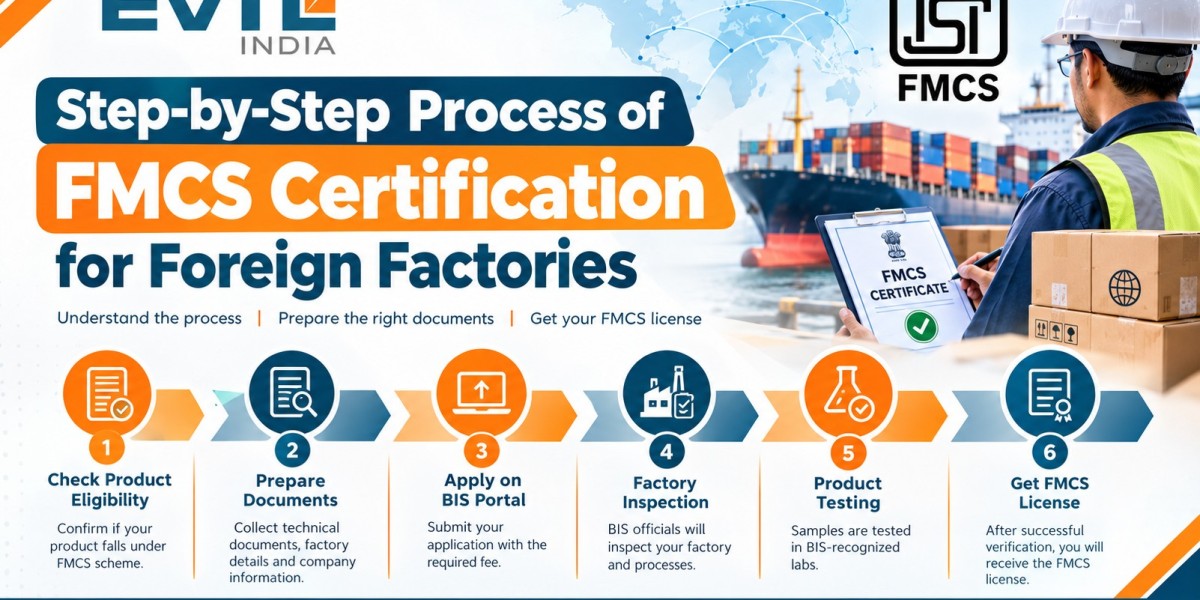

Selling in India from another country sounds exciting, but the paperwork can look scary. The good news is that the path is clear when you take it one step at a time. In this guide, we walk through every step in very easy words, so even a first-time exporter can follow it.
First, Understand the Goal
The Bureau of Indian Standards (BIS) gives a special mark, called the ISI mark, to products that meet Indian quality rules. For many products, this mark is compulsory. If your factory is outside India, you can get this mark through a BIS plan called FMCS, which has been running since the year 2000.
When BIS checks your factory and your product and finds them fine, you receive FMCS Certification, and that allows you to use the ISI mark on your product.
Step 1: Find the Right Indian Standard
Every product has an Indian Standard (IS) number. This is the rule book your product must follow.
- Search for the standard that matches your product.
- Check that your product design, size and material fit that standard.
- Make sure the product is on the government’s compulsory list.
Tip: A wrong choice here can waste months. If you are unsure, ask an expert before moving ahead.
Step 2: Appoint an Authorized Indian Representative
A foreign factory cannot talk to BIS directly. You need a person in India, called the Authorized Indian Representative (AIR).
- The AIR files papers and replies to BIS on your behalf.
- The AIR must be properly named through an authorization letter.
- An importer cannot apply in place of the factory owner. The application comes from you, the manufacturer.
Step 3: Collect Your Documents
Keep everything in one folder. You will usually need:
- Company registration proof
- Factory address and layout
- Flow chart of how you make the product
- Quality control manual
- List of machines and testing equipment
- Raw material details
- Letter naming your AIR
- Product details, such as model, size and brand name
Tip: Keep soft copies ready. When BIS asks a question, you can reply fast.
Step 4: File the Online Application
BIS has made FMCS applications online-only from 1 June 2026.
- Fill in the form carefully.
- Upload your papers.
- Pay the fees.
Tip: Check names, addresses and product details twice. A small spelling mistake can cause a query.
Step 5: Answer BIS Questions
After BIS reads your file, it may ask for more details or ask you to fix something.
- Reply clearly and quickly.
- Do not leave a query pending for many days.
- Send only what BIS has asked for.
Quick replies are one of the easiest ways to save time.
Step 6: Factory Inspection
BIS officers visit your factory. They want to see that you can make good products again and again.
- They check your machines and how well they work.
- They look at your testing lab and the tools in it.
- They check how you handle raw material and records.
- They see how you deal with products that fail a test.
A clean factory with good records makes this visit smooth.
Step 7: Sample Testing
Samples of your product are tested in a BIS-recognized lab in India.
- You pay the testing cost.
- If a sample fails, you may need to fix the problem and test again.
Tip: Test your own products before sending samples, so you are sure they meet the standard.
Step 8: Grant of License
If your papers, factory and test results are all fine, BIS gives you the license. This is your BIS FMCS License, and now you can print the ISI mark on your product.
How Long Does It Take?
Time depends on your product and how fast you reply. As a rough idea:
- Average time: about six months from a complete application
- Maximum time set by BIS: around 180 days
- First license period: one to two years
So please start many months before your first shipment.
What Will It Cost?
Plan for these costs:
- Application and license fees
- Testing charges
- Yearly marking fee
- A bank guarantee of USD 10,000 through an approved bank
- Inspection and travel costs
Ask for a clear cost list in writing before you begin.
Why Buyers Care
Indian buyers and customs teams often ask to see a BIS certificate for import in India before they accept your goods. If you have it ready, your shipment moves smoothly. If not, your goods can get stuck at the port.
After You Get the License
- BIS may visit your factory again.
- BIS may take samples from your production for testing.
- You must pay the marking fee every year.
- You must renew the license before it ends.
If your quality stays steady, renewal is easy.
Conclusion
EVTL India is one of the leading BIS Consultant in India, helping manufacturers obtain their BIS licenses hassle-free. Our team helps you at every step above, from choosing the right standard to the final grant of the license.
Take one step at a time, keep your papers ready and ask for help early. That is the simplest way to reach the Indian market without delay.
Contact EVTL India today:
? +91 95609 35898
? contact@evtlindia.com
? www.evtlindia.com