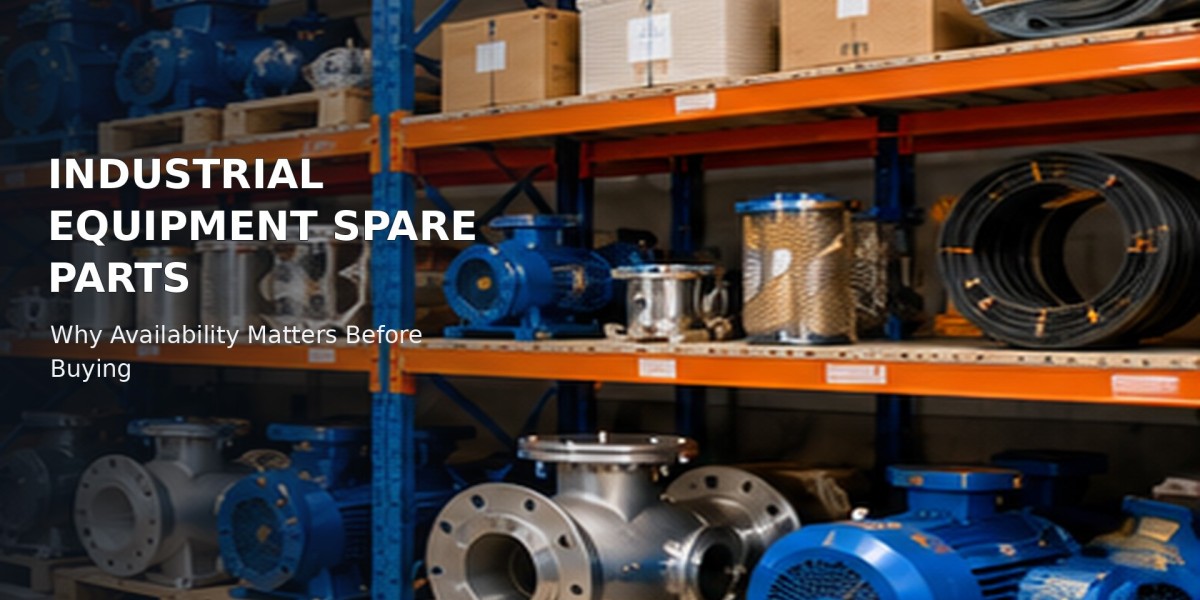

Industrial equipment is often purchased around capacity, price, delivery and technical performance. Spare parts are sometimes discussed much later, when the first planned service or unexpected failure occurs. By then, the buyer may discover that a small component has a longer lead time than the main machine had when it was originally ordered.
For plant operators and procurement teams, spare-part availability should therefore be part of equipment evaluation from the beginning. A machine is not only a capital purchase; it becomes an ongoing maintenance responsibility once it enters service.
The Purchase Price Is Only the Starting Point
Two machines can perform the same broad industrial duty while creating very different lifecycle requirements.
The buyer may need to consider:
routine consumables;
wear components;
critical spare parts;
specialist maintenance tools;
software or control-system support;
OEM service requirements;
local availability;
import lead times; and
the consequences if a replacement component cannot be sourced quickly.
A lower initial equipment price may still represent the wrong commercial choice if maintaining the machine becomes difficult during its working life.
Start by Identifying Routine Wear Items
Most industrial equipment contains components that require inspection or replacement through normal use.
Depending on the machine, these can include:
filters;
seals;
bearings;
belts;
gaskets;
lubricants;
contactors or electrical components;
sensors;
valves;
wear surfaces; and
other equipment-specific consumables.
Before buying the equipment, procurement teams should understand which parts fall into this category and how they are identified.
This allows the maintenance team to estimate routine stock requirements rather than waiting until the first planned service interval.
Critical Spares Need a Different Strategy
Not every spare part deserves the same stocking approach.
A low-cost component that can stop an entire production line may deserve more attention than a higher-value component installed on non-critical equipment with full redundancy.
Criticality assessments can consider:
effect of component failure;
availability of standby equipment;
supplier lead time;
availability of technically acceptable alternatives;
expected failure mode;
repair capability;
production consequences; and
safety or process implications.
Project planning insight: Spare-part criticality is not determined by part price. A small, inexpensive component can become operationally critical if the equipment cannot run without it and replacement lead time is long.
Ask About Spare Support Before the Purchase Order
Equipment quotations should make the lifecycle support position clear where it matters to the project.
Useful questions include:
Which parts are considered normal consumables?
Which parts are recommended for site stock?
Where are common spare parts held?
Which components normally require import?
How are replacement parts identified?
Are parts tied to the equipment serial number?
Are there superseded part numbers?
Can technically equivalent components be used?
Which parts require OEM-specific programming or setup?
What documentation is provided for spare identification?
These questions help establish whether the supplier is offering only a machine or a practical equipment lifecycle.
Part Numbers and Serial Numbers Matter
Industrial spare-part sourcing becomes considerably easier when equipment records are maintained accurately.
A good equipment register should capture:
manufacturer or OEM;
machine model;
serial number;
installation date;
location within the plant;
main assembly references;
recommended spare-parts list;
original part numbers;
maintenance manuals; and
relevant drawings.
Photographs are useful, particularly when identifying physical components, but appearance alone should not be treated as proof that a substitute part is compatible.
Equivalent Parts Require Technical Checking
Industrial buyers sometimes consider an alternative when the original component is unavailable or commercially impractical.
An equivalent may be possible, but matching physical dimensions is not always enough.
Depending on the component, compatibility can depend on:
material;
temperature rating;
pressure rating;
speed;
load;
voltage;
current;
control signal;
tolerance;
chemical compatibility;
mounting arrangement; and
software or firmware compatibility.
For critical equipment, substitutions should be checked against the actual operating requirement rather than accepted because the new part looks similar to the original.
Obsolescence Should Be Part of Lifecycle Planning
Industrial plants often remain in operation for many years, while individual electronic, electrical or mechanical products may be revised or discontinued during that period.
Buyers should therefore ask how equipment changes are communicated and what happens if a component is superseded.
Useful lifecycle information can include:
product support status;
replacement or migration paths;
recommended strategic spares;
availability of repair services;
backward compatibility;
control-system implications; and
documentation for replacement parts.
This is especially important for equipment that combines mechanical assemblies with proprietary electronic controls.
Lead Time Changes the Meaning of “Critical”
A component may be inexpensive and reliable but still justify site stock if sourcing a replacement after failure would take too long.
For this reason, spare-parts planning should consider both probability and consequence.
A useful discussion involves maintenance, operations and procurement together. Maintenance teams understand failure modes, operations understand the cost of equipment unavailability, and procurement understands supplier and logistics constraints.
Do Not Overstock Without a Reason
Spare planning does not mean buying every component on the parts list.
Excessive stock ties up capital, consumes warehouse space and can itself become obsolete or degrade while unused.
A sensible inventory strategy considers:
equipment criticality;
part lead time;
usage rate;
failure history;
installed quantity;
commonality across machines;
shelf-life limitations; and
availability from the supplier.
The objective is to hold the right parts, not simply more parts.
Maintenance Documentation Has Commercial Value
Equipment documentation is sometimes treated as an administrative handover item, but it directly supports spare-parts sourcing.
Ask for:
operation and maintenance manuals;
parts lists;
assembly drawings where available;
electrical drawings where relevant;
recommended consumables;
recommended critical spares;
service intervals;
equipment identification information; and
manufacturer contact or support references where appropriate.
Good documentation reduces the need to identify components from memory several years after the original purchase.
Think About Spare Parts When Comparing Equipment Suppliers
Industrial buyers assessing equipment should consider how the machinery will be supported after installation. Companies reviewing this category can explore RBC Engineering's industrial plant equipment information when preparing equipment and lifecycle requirements.
The commercial enquiry should make clear whether the requirement includes only equipment supply or also spare parts, installation, commissioning or maintenance support.
A Practical Pre-Purchase Spare-Parts Checklist
Before an equipment purchase is finalised, confirm:
equipment OEM and exact model;
routine consumables;
normal wear items;
recommended commissioning spares;
recommended critical spares;
part-identification method;
supplier stock location;
typical sourcing route;
known long-lead components;
special tools required;
maintenance documentation;
product obsolescence policy where relevant;
repair options; and
technical support requirements.
Frequently Asked Questions
Why check spare parts before buying industrial equipment?
Because spare availability affects maintainability and recovery after a failure. A suitable machine can still create operational problems if routine or critical components are difficult to obtain.
What is a critical spare part?
A critical spare is generally a component whose failure and replacement lead time could create unacceptable operational consequences. Criticality depends on the plant and equipment duty rather than part price alone.
Should every recommended spare be kept on site?
No. Stock decisions should consider criticality, usage, lead time, redundancy, shelf life and the cost of holding inventory.
Can an equivalent part replace an OEM spare?
Sometimes, but compatibility should be technically verified. Material, dimensions, electrical ratings, operating conditions and control compatibility may all matter.
What equipment information should be kept in a plant register?
At minimum, retain the manufacturer, model, serial number, plant location and relevant manuals and parts lists. More complex equipment may require additional drawings and configuration records.
Final Considerations
Spare-parts availability is easiest to manage before equipment enters the plant. Once the purchase has been made, buyers have far fewer options if essential components are difficult to source.
Including spare support, documentation, criticality and obsolescence questions in the original procurement process creates a more realistic view of the equipment's lifecycle and helps maintenance teams prepare for the years after commissioning.