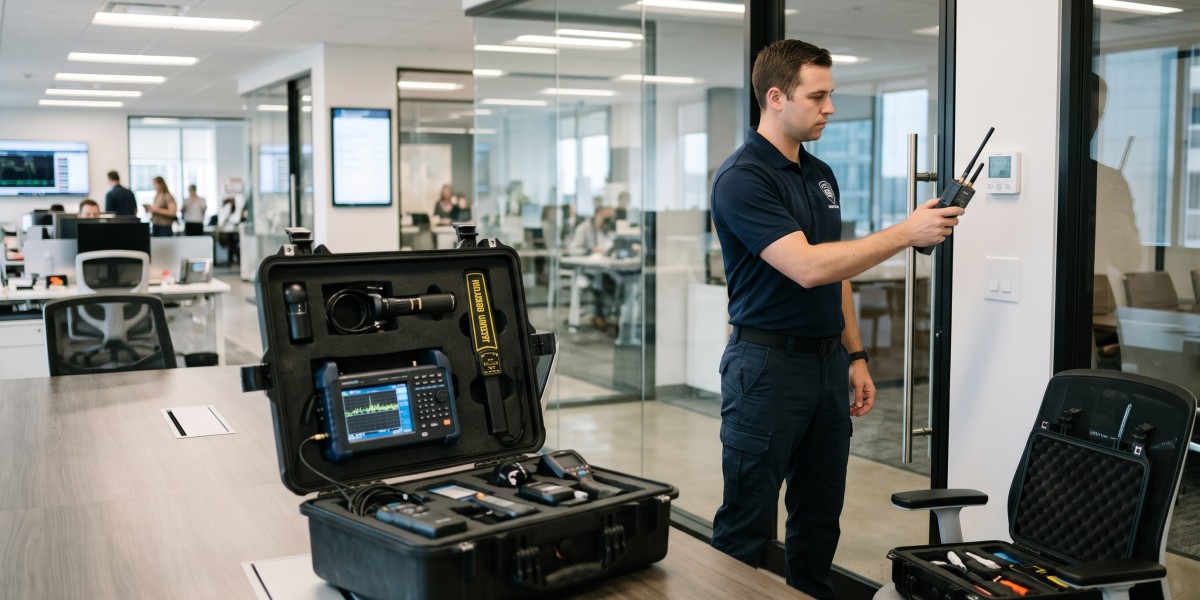

Confidential business meetings, executive discussions, financial negotiations, and sensitive client communications can become targets of unauthorised surveillance. A professional commercial bug sweep service helps businesses identify potential electronic eavesdropping devices and assess security risks within their offices and other sensitive commercial environments. Through Technical Surveillance Countermeasures (TSCM), qualified specialists examine designated areas for indicators of covert monitoring using appropriate technical equipment and inspection methods.
Unlike pest control services, a commercial bug sweep in the TSCM industry focuses entirely on electronic surveillance threats. These may include hidden microphones, unauthorised wireless transmitters, covert cameras, and other equipment that could compromise business privacy. The purpose is to identify potential surveillance vulnerabilities and provide evidence-based recommendations to help protect confidential information.
Organisations that handle valuable intellectual property, private negotiations, legal documents, or commercially sensitive information may benefit from professional TSCM inspections. Understanding how these assessments work can help business owners select appropriate security measures and make informed decisions about protecting their premises.
What Is a Commercial Bug Sweep Service in TSCM?
A commercial bug sweep service is a technical security inspection designed to detect and investigate potential electronic surveillance devices in business premises. It forms part of the wider field of Technical Surveillance Countermeasures, which focuses on identifying, assessing, and mitigating threats involving covert monitoring.
The word "bug" refers to an electronic surveillance device, not an insect. These devices may be designed to capture conversations, record activities, or transmit information without the knowledge or consent of the people being monitored.
A professional TSCM inspection may involve physical examination, radio-frequency analysis, and other technical assessment methods selected according to the environment and suspected threat.
What Types of Surveillance Threats Can Be Investigated?
The scope of an inspection depends on the client's requirements, the building, and the potential surveillance technologies involved.
A commercial TSCM assessment may investigate:
Hidden microphones and covert audio recording devices.
Unauthorised wireless transmitters.
Concealed cameras used for unauthorised monitoring.
Suspicious electronic components or modifications.
Potential surveillance equipment connected to power sources.
Radio-frequency activity that requires further investigation.
Indicators of tampering involving furniture, fixtures, or selected infrastructure.
Not every unfamiliar electronic device represents a security threat. Legitimate wireless equipment can generate signals that require careful interpretation. Findings must therefore be assessed by trained specialists rather than being treated as confirmed surveillance based on suspicion alone.
Why Do Businesses Need Commercial TSCM Inspections?
Businesses frequently exchange information that must remain confidential. If sensitive conversations are captured by an unauthorised third party, the consequences may extend beyond privacy concerns to financial losses, legal disputes, and reputational damage.
Commercial TSCM inspections help organisations evaluate one specific part of their security exposure: the possibility of covert electronic surveillance.
Protecting Executive Meetings and Boardrooms
Boardrooms are often used for discussions involving mergers, acquisitions, investment strategies, business restructuring, and confidential financial decisions.
Unauthorised recording of these discussions could expose commercially valuable information before it is officially announced or shared with authorised parties.
A commercial bug sweep service can help assess boardrooms and executive offices for potential surveillance devices and other technical indicators of unauthorised monitoring.
Areas that may be prioritised include:
Executive offices and private meeting rooms.
Boardrooms used for confidential discussions.
Conference facilities hosting sensitive negotiations.
Rooms used for mergers and acquisitions planning.
Private spaces where strategic decisions are discussed.
Inspections should be planned around the organisation's risk profile, particularly where confidential information is regularly exchanged.
Preventing Corporate Espionage
Corporate espionage involves obtaining confidential business information through unauthorised or deceptive methods. Electronic eavesdropping is one possible method, although information can also be exposed through insider threats, compromised accounts, or inadequate document security.
TSCM inspections are intended to address the physical and electronic surveillance aspect of this risk.
For companies developing new products, negotiating major contracts, or protecting proprietary processes, an assessment of sensitive spaces may form part of a wider corporate security strategy.
Maintaining Client Confidentiality
Law firms, financial advisers, consultants, and other professional service providers routinely handle confidential client information.
If private conversations are recorded without authorisation, the organisation may face a loss of trust or other consequences depending on the circumstances.
A technical inspection can help assess designated consultation rooms and meeting areas where confidentiality is particularly important. The findings should be incorporated into the organisation's existing privacy and security procedures.
How Does a Commercial Bug Sweep Service Work?
A professional TSCM inspection follows a structured process based on the environment, the identified risks, and the agreed scope of work. The methods used may vary because different surveillance technologies require different assessment approaches.
1. Initial Risk Assessment
Before the inspection begins, the TSCM specialist gathers information about the premises and the reasons for the assessment.
This discussion may cover the organisation's activities, sensitive meeting areas, previous security incidents, and any specific concerns about unauthorised access or information disclosure.
The assessment helps determine which areas should receive priority.
2. Physical Inspection of Commercial Premises
A physical inspection may involve examining designated rooms, fixtures, furnishings, electronic equipment, and other relevant areas for suspicious components or signs of tampering.
The purpose is to identify objects or modifications that warrant closer technical examination.
Any suspected device must be evaluated carefully. An unfamiliar object alone does not establish that surveillance is taking place, and equipment should not be removed or dismantled without appropriate authorisation.
3. Radio-Frequency and Electronic Analysis
Specialised instruments may be used to assess radio-frequency activity and investigate signals that appear inconsistent with the expected operating environment.
Depending on the inspection requirements, additional technical methods may be used to examine certain electronic surveillance risks.
Interpretation is essential because ordinary Wi-Fi networks, mobile phones, Bluetooth devices, and other legitimate electronics can produce radio-frequency activity. Some surveillance technologies may also be intermittent or difficult to identify through a single detection method.
For these reasons, an unexplained signal should be investigated in context rather than automatically classified as a surveillance device.
4. Technical Evaluation of Findings
Potential findings are reviewed to determine whether further investigation is necessary. Specialists may consider the device's characteristics, the surrounding environment, available physical evidence, and the limitations of the inspection equipment.
Where a suspected surveillance device is identified, the response should follow the client's security procedures and applicable legal requirements.
The difference between a confirmed discovery and an unresolved technical concern should be clearly documented.
5. Reporting and Security Recommendations
After the inspection, the client should receive a clear explanation of the areas examined, the methods used, and the findings identified within the agreed scope.
A professional report may include:
Areas covered by the inspection.
General categories of technical assessment performed.
Confirmed findings and unresolved concerns.
Relevant inspection limitations.
Recommended corrective actions.
Suggestions for future security assessments.
This documentation allows management to understand the results and decide whether additional security measures are required.
Which Commercial Environments Require TSCM Bug Sweeping?
The need for a TSCM assessment depends on the sensitivity of business information, the potential impact of unauthorised disclosure, and the organisation's security requirements.
Corporate Offices and Executive Suites
Corporate offices may contain confidential plans, financial records, strategic discussions, and sensitive communications.
Executive offices and conference rooms may be prioritised when they are regularly used for high-value or confidential discussions.
Law Firms and Legal Consultation Rooms
Legal professionals often discuss privileged communications, settlement strategies, litigation matters, and sensitive client information.
TSCM inspections can support efforts to maintain confidential meeting spaces, alongside appropriate access controls and professional confidentiality procedures.
Financial Institutions and Investment Firms
Financial organisations may handle information about investments, acquisitions, financing arrangements, and transactions that have significant commercial implications.
An assessment of selected meeting rooms may help identify potential electronic surveillance concerns and inform wider security planning.
Technology Companies and Research Facilities
Businesses involved in engineering, software development, research, and product design may hold valuable intellectual property.
TSCM inspections can be considered for areas where proprietary information is discussed, particularly when the consequences of unauthorised disclosure could be significant.
When Should You Arrange a Commercial Bug Sweep Service?
There is no universal inspection schedule that suits every business. Frequency should be determined by the organisation's risk assessment, the sensitivity of its operations, and any credible concerns about surveillance.
A commercial inspection may be considered in situations such as:
Moving into a new office or acquiring commercial premises.
Preparing for sensitive negotiations or major corporate transactions.
Investigating credible concerns about unauthorised monitoring.
Responding to unexplained signs of tampering or suspicious access.
Reviewing the security of executive offices and conference rooms.
Reassessing physical security after significant operational changes.
These circumstances do not prove that a surveillance device is present. They indicate situations in which an organisation may reasonably consider a professional technical assessment.
How to Choose a Qualified TSCM Provider
Selecting a suitable provider is important because surveillance detection requires technical knowledge, appropriate equipment, and careful interpretation of findings.
Evaluate Technical Expertise
Ask about the provider's TSCM experience, inspection methodology, and familiarity with commercial environments.
A reliable specialist should explain which risks can be assessed, what equipment may be used, and what limitations apply to the proposed inspection.
Check Confidentiality Procedures
The inspection may involve access to sensitive offices, documents, and business operations. Confidentiality arrangements should therefore be agreed upon before work begins.
Clarify how inspection records, photographs, findings, and other sensitive information will be handled and stored.
Request Clear Reporting
A professional provider should deliver findings in a format that business owners and security teams can understand.
Reports should distinguish between confirmed evidence, suspicious observations, and matters that remain unresolved. Recommendations should be linked to the findings rather than based on unsupported assumptions.
Be Cautious of Absolute Guarantees
No TSCM inspection can guarantee that every possible surveillance device will be detected in every circumstance. Results depend on the technology involved, the inspection environment, available equipment, and the scope of work.
Providers should explain these limitations honestly and avoid promising complete protection from every form of surveillance.
Strengthening Business Privacy Beyond TSCM Inspections
A technical inspection should be treated as one component of a wider information security programme.
Even when no surveillance device is identified, businesses should maintain procedures that reduce opportunities for unauthorised access and information disclosure.
Useful measures include:
Restricting access to confidential meeting rooms.
Maintaining an inventory of authorised electronic equipment.
Reviewing visitor and contractor access procedures.
Securing business devices and communication systems.
Training employees to recognise and report suspicious activity.
Protecting confidential documents and digital records.
Scheduling further assessments when the risk profile changes.
Cybersecurity controls are also essential because confidential information can be compromised through phishing, account compromise, insecure networks, or unauthorised access to digital files. TSCM and cybersecurity address different risks and should be managed together.
Final Thought
A professional commercial bug sweep service helps businesses investigate potential electronic surveillance threats through Technical Surveillance Countermeasures. By assessing sensitive offices, conference rooms, executive suites, and other designated areas, qualified specialists can help organisations identify potential vulnerabilities and make informed security decisions. The most effective approach combines appropriate technical inspections, accurate reporting, confidentiality procedures, and ongoing physical and digital security controls. Businesses should select experienced TSCM providers who explain their methods clearly, acknowledge inspection limitations, and base recommendations on evidence. Protecting confidential information requires consistent attention, and a properly planned TSCM assessment can be a valuable part of that effort.