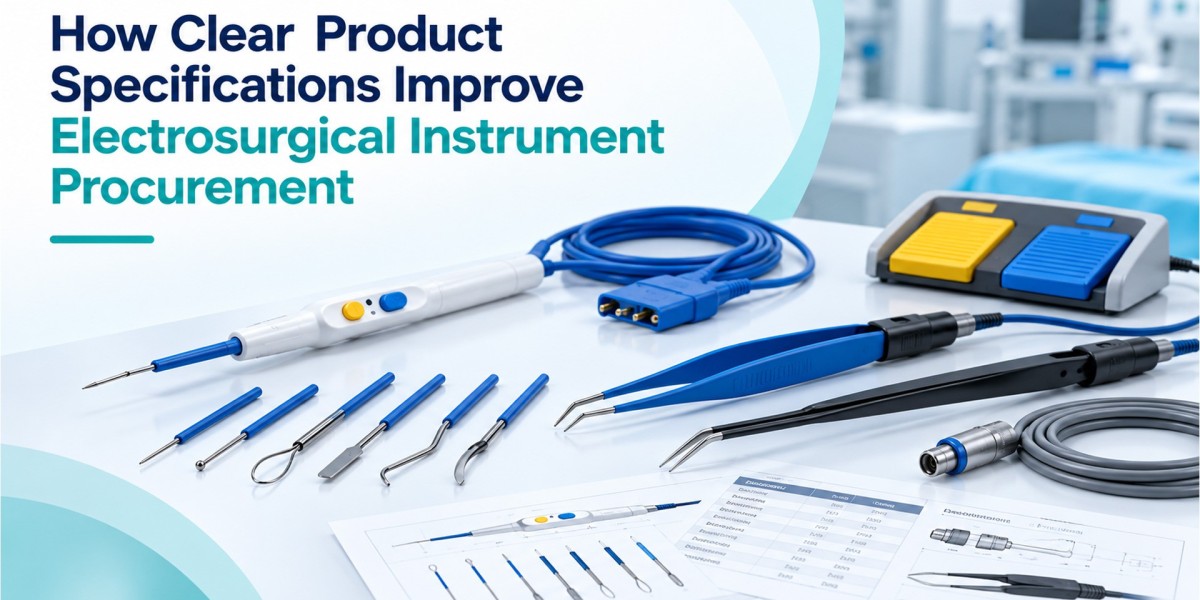

Successful medical-device procurement depends on more than identifying a product category and requesting a price. In electrosurgery, products that share the same general name can differ in dimensions, working-end configuration, cable arrangement, connector type and other technical characteristics.
For hospital purchasing teams and medical device distributors, the quality of the initial specification can therefore have a direct effect on the quality of the quotation that follows.
A request for Electrosurgical Instruments becomes significantly more useful when it explains exactly what is required rather than relying on broad terms such as bipolar forceps, active electrode or HF accessory.
The Product Name Is Only the Starting Point
Search terms and catalogue categories help buyers find the right product family, but they rarely define the complete purchasing requirement.
Consider bipolar forceps. The category may contain instruments that differ in pattern, length, distal geometry, surface configuration and cable arrangement.
The same principle applies to monopolar electrodes. Products may differ according to tip shape, shaft diameter, working length and handpiece connection.
For this reason, procurement teams should move from the broad product name to a structured technical specification as early as possible.
Begin With the Product Already in Use
Where a hospital or distributor already uses an approved instrument, the existing catalogue or product number can provide an important starting point.
It can help the supplier understand the product family and identify the technical characteristics that need to be reviewed.
This is especially useful when a buyer is investigating another available product or expanding its approved supplier base.
The existing product should not be treated automatically as proof that another instrument is interchangeable. Instead, it provides a practical reference point from which specifications can be compared.
Break the Requirement Into Technical Fields
A well-prepared enquiry separates the instrument into the characteristics that actually define it.
For bipolar forceps, this may include:
instrument pattern;
overall or working length;
tip or distal configuration;
surface requirement where applicable;
whether a cable is included or separate;
the required HF equipment connection.
For monopolar electrodes, the important fields may instead include:
electrode type;
working-end geometry;
shaft diameter;
working length;
handpiece interface;
equipment connection.
Presenting these details separately makes it easier for suppliers to understand the enquiry and easier for purchasing teams to compare the responses.
Dimensions Should Be Exact Where Possible
Words such as “short”, “long”, “fine” or “standard” can mean different things across different product catalogues.
Exact measurements provide much stronger information.
Where available, procurement teams should use the dimensions stated in the relevant product documentation, including working length, total length, shaft diameter or tip dimensions.
This also improves internal communication because procurement, sales and technical teams are discussing the same defined specification.
Connected Products Should Be Reviewed Together
Many electrosurgical products operate as part of a connected system.
A bipolar forceps may require a separate bipolar cable. A monopolar electrode may need to fit an established HF handle. The cable or handpiece may then need to connect to a particular electrosurgical unit.
For procurement purposes, it is often useful to think in terms of a connection pathway:
Bipolar instrument → cable → HF equipment
or:
Active electrode → HF handpiece → cable → HF equipment
This does not mean that every connected product must come from the same source. It means that the purchasing team should understand how the components are intended to fit together before finalising the order.
Cable Requirements Should Be Discussed Early
Cables are sometimes treated as secondary accessories, but they can materially change a quotation.
One product may already include a cable, while another may require the cable to be ordered separately.
Before comparing commercial offers, the buyer should therefore determine whether the quotation includes:
the instrument only;
the instrument with an integrated or supplied cable;
or the instrument plus a separately specified cable.
The equipment-side connection should also be identified where relevant.
This prevents apparently similar quotations from being compared when they actually contain different components.
Single-Use Products Add Supply-Specific Questions
When the requirement involves single-use instruments, procurement may also need to consider product presentation and stock management.
Depending on the product and purchasing process, useful information can include packaging quantity, sterile presentation, shelf-life information, storage requirements and product labelling.
These details should be confirmed for the actual product under review rather than assumed from another item in the same product family.
Price Comparison Comes After Specification Alignment
Unit price is important, but it becomes meaningful only after the technical requirements are aligned.
Two products described as bipolar forceps may differ in pattern, length or cable configuration. Two electrodes may have different shaft diameters or connections.
Comparing price before identifying those differences can produce a misleading commercial conclusion.
A stronger process is:
identify the requirement → compare the technical configuration → confirm what is included → review documentation → then compare commercial terms.
Better Enquiries Help Distributors Respond Faster
Medical distributors often work between the healthcare customer and manufacturer. Clear information benefits both sides.
A distributor can improve enquiry quality by recording the essential information in a consistent internal format.
| Information | Purpose |
|---|---|
| Product family | Defines the general instrument category |
| Existing product number | Provides technical context where available |
| Dimensions | Clarifies physical requirements |
| Working-end configuration | Distinguishes similar products |
| Cable or handpiece | Identifies connected components |
| Equipment information | Supports connection review |
| Quantity | Supports commercial quotation |
| Documentation needs | Supports procurement and quality review |
Useful Product Information Supports Better Buying Decisions
Medical-device content is most useful when it helps professional buyers understand what they need to specify next.
Detailed product families, clearly presented dimensions and connected-product information are more valuable than pages built primarily around promotional claims.
Buyers reviewing an electrosurgical instrument range can use the product structure to move from a broad category such as bipolar forceps or monopolar electrodes toward the more precise information needed for a technical enquiry.
Questions to Answer Before Sending an Electrosurgical Enquiry
Before contacting a supplier, procurement teams can review the following points:
Which instrument family is required?
Is an existing product number available?
Which dimensions are important?
What working-end or tip configuration is required?
Is a cable or HF handpiece needed?
Which equipment connection applies?
Is the requirement single-use or reusable?
What quantity is expected?
Which product documents are required for evaluation?
Conclusion
Clear specifications improve the quality of electrosurgical procurement because they give suppliers and buyers a common technical language.
The category name helps identify the product family, but details such as dimensions, working-end design, cable configuration and equipment connection define the actual purchasing requirement.
By establishing those details before comparing quotations, hospitals and distributors can reduce unnecessary clarification and make more informed technical and commercial comparisons.