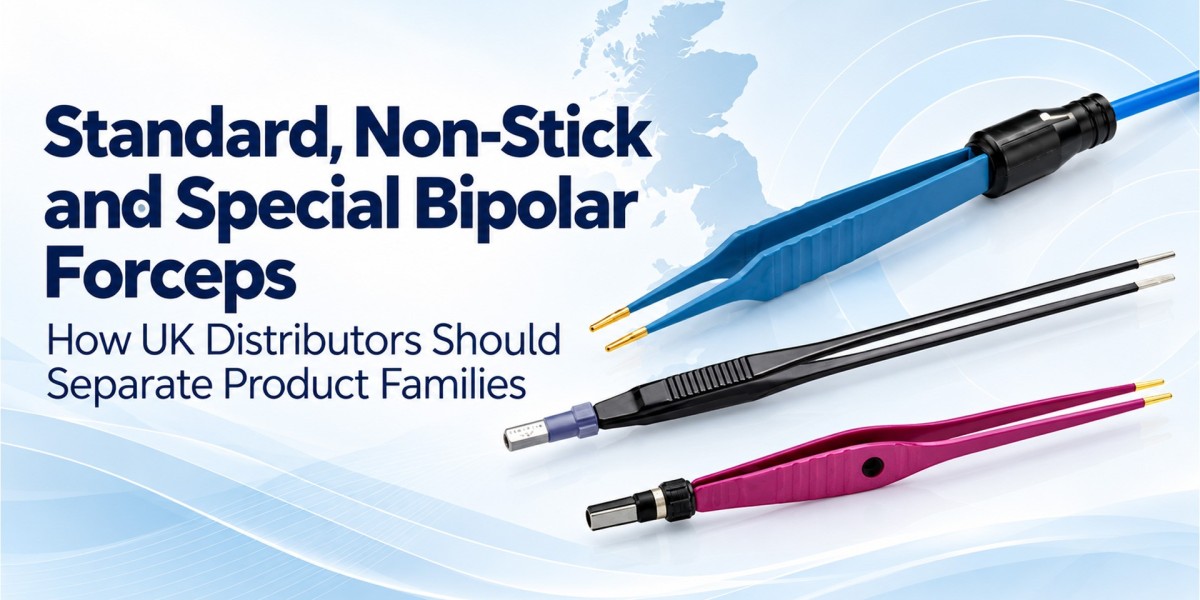

A UK hospital buyer searches a distributor's catalogue for a McPherson bipolar forceps at a particular length. Three results appear. One is standard, one is non-stick, and one is a specialist configuration. If the listings are well structured, the buyer sees at once which is which. If they are not, the buyer either calls to ask, orders the wrong item, or goes to another supplier whose catalogue is easier to read.
For distributors, bipolar forceps are one of the categories where catalogue structure has a direct effect on sales and returns. Many instruments share pattern names and look alike at a glance, but they are not interchangeable. Keeping standard, non-stick and special bipolar forceps clearly separate is one of the simplest ways to protect accuracy and customer confidence.
Why these three families get blurred
The confusion usually starts upstream. Clinical staff tend to describe bipolar forceps by pattern and length, not by family. A request for "bayonet bipolars, 20 cm" says nothing about coating or specialist design. When that description is copied into a catalogue listing, the family distinction disappears.
A second cause is catalogue growth over time. A distributor starts with standard lines, later adds a few non-stick variants at a customer's request, then takes on some special configurations. If each addition is attached to an existing listing as an "option" instead of being created as a separate product, the catalogue ends up with single entries that stand for several different instruments.
What blurred listings cost
Picking and dispatch errors: similar instruments under one listing are easily confused in the warehouse.
Returns and credit notes: a non-stick instrument sent where a standard one was expected, or the reverse, usually comes back.
Approval problems: hospital product-approval files relate to specific products. If a listing covers several references, the documents a customer holds may not match what arrives.
Lost trust: once a buyer has received the wrong variant, they are more likely to check every future order by phone, or to stop ordering.
Principles for a clean bipolar forceps catalogue
Make the family a top-level attribute. Standard, non-stick and special should be a filterable field and part of the product title, not a detail buried in the description.
One code per manufacturer reference. Each distinct product the manufacturer supplies should have its own distributor code. Avoid grouping "equivalent" items under a single code, even when they look alike.
Use a consistent naming convention. Build every title from the same fields in the same order, for example: family, pattern, tip, length, configuration, connector. Consistency lets customers compare similar items at a glance.
Describe features only as documented. If a product is described as non-stick, use the manufacturer's description of that feature. Do not add performance claims the manufacturer's documentation does not support.
Treat special configurations as their own products. Special bipolar forceps are usually requested by name and in lower volumes. Listing them separately, often as supply-to-order items, keeps them visible without cluttering core stock.
Write down your substitution policy. If a listed item is unavailable, a different family should never be sent without the customer's agreement. A clear policy protects both sides.
What UK customers expect from the listing
Hospital procurement teams and theatre buyers generally want to confirm a few things quickly: that the item matches the clinical request, that it connects to the equipment they use, and that the documentation they need is available. Listings that show the family, the full dimensional details and the connector type answer most of these questions without a phone call.
For distributors that also serve private clinics and independent hospitals, the same structure works well. Smaller buyers often reorder by product code, so a stable, clearly separated code for each variant makes repeat business easier.
Working with the manufacturer's structure
A catalogue is easier to keep clean when the manufacturer organises its range clearly. Cosil Instruments, for example, presents its bipolar range in distinct product families that include standard Bipolar Forceps, C-Tech Bipolar Instruments, Non-Stick Bipolar Forceps and Special Bipolar Forceps. Distributors can mirror that structure in their own catalogues rather than inventing a new one. For buyers deciding between the two families most often compared, Cosil's guide explains how non-stick and special bipolar forceps differ from a procurement point of view.
Whichever manufacturer a distributor works with, the useful habit is the same. Before creating a listing, confirm the family, pattern, tip, length, configuration and connector for that exact reference, and do not assume that every combination exists in every family.
A quick catalogue audit
Distributors reviewing an existing bipolar forceps range can check:
Does every listing map to exactly one manufacturer reference?
Is the family visible in the product title?
Are non-stick and special variants coded separately from standard lines?
Do titles follow one consistent naming order?
Is the connector type recorded for each item?
Is there a written substitution policy?
A "no" to any of these is worth fixing before the next round of customer orders.
Conclusion
Standard, non-stick and special bipolar forceps can share a pattern name and still be three different products. UK distributors that separate them clearly, with one code per reference, family-led titles and documented features, make ordering easier for hospitals and clinics and reduce costly errors for themselves. A well-structured catalogue quietly becomes a reason customers keep coming back.
Reviewing your bipolar forceps range? Audit your listings against the checklist above, and confirm each family, reference and connector with your manufacturer before your next catalogue update.




