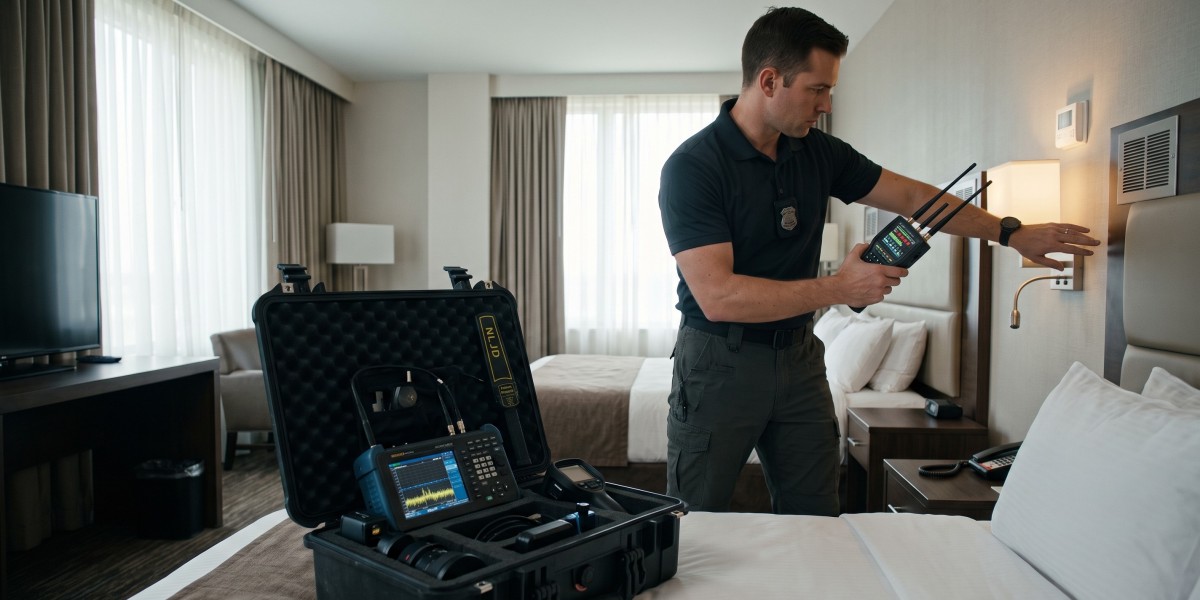

Staying in a hotel should provide comfort, privacy, and peace of mind. However, travellers who handle confidential business information, public figures, executives, and privacy-conscious guests may have concerns about unauthorised surveillance in temporary accommodation. Hotel room bug sweepers are used as part of technical surveillance countermeasures (TSCM) to help identify potential electronic surveillance devices and suspicious signals in hotel rooms.
The term "bug sweep" in this context refers to a professional security inspection, not pest control. These inspections may involve specialised electronic equipment, physical examination, and technical analysis to identify potential listening devices, hidden cameras, or other surveillance equipment.
Although most hotel stays are entirely routine, privacy concerns can be particularly important when sensitive conversations, confidential documents, or valuable business information are involved. Understanding how professional bug sweeps work can help travellers and organisations make informed decisions about their personal security.
What Are Hotel Room Bug Sweepers?
Hotel room bug sweepers are professional specialists or technical inspection services that assess hotel rooms for potential surveillance devices. Their work generally falls within the broader field of technical surveillance countermeasures, commonly known as TSCM.
A professional inspection is designed to identify potential indicators of unauthorised monitoring rather than simply searching for visible cameras. Some surveillance equipment may be concealed within ordinary objects, while other devices may transmit signals or store information locally.
The methods used during an inspection depend on the environment, the suspected threat, and the equipment being examined.
Understanding Technical Surveillance Countermeasures
TSCM is a specialised security discipline concerned with identifying and assessing potential technical surveillance threats.
In a hotel environment, an inspection may focus on devices that could be used to record conversations, capture images, or transmit confidential information without permission.
A professional TSCM inspection may include:
Electronic scanning for suspicious radio-frequency transmissions.
Physical examination of accessible areas and objects.
Inspection of unusual electronic devices or unexpected wiring.
Assessment of potential camera placements.
Evaluation of suspicious equipment identified during the inspection.
Documentation of findings and recommendations for further investigation.
Not every unusual electronic signal indicates surveillance. Hotels contain Wi-Fi routers, televisions, smart devices, wireless access points, and other equipment that may generate legitimate signals. Findings must therefore be assessed in context by a qualified professional.
Why Might Hotel Guests Need a Professional Bug Sweep?
For most travellers, normal hotel security measures are sufficient. However, certain circumstances may justify a more specialised privacy assessment.
1. Business Travellers Handling Confidential Information
Executives, consultants, legal professionals, and business owners sometimes discuss sensitive matters while travelling.
Examples include merger negotiations, financial projections, intellectual property, confidential client information, and strategic business plans.
If these conversations were recorded without authorisation, the information could potentially be misused.
A professional sweep may be considered when confidential discussions are planned in temporary accommodation, especially when a specific security concern has been identified.
Businesses should also remember that a hotel room inspection is only one part of a broader security strategy. Sensitive conversations should ideally take place in an appropriate meeting environment with suitable access controls.
2. High-Profile Individuals and Their Teams
Public figures, senior executives, diplomats, and individuals involved in sensitive legal or commercial matters may face different privacy risks from ordinary travellers.
Their travel arrangements can attract unwanted attention, and their conversations or personal activities may be particularly valuable to someone seeking unauthorised information.
In such circumstances, a qualified security team may assess the accommodation environment before it is used for confidential activities.
The level of inspection should be based on a realistic assessment of the person's circumstances rather than assumptions that surveillance is present.
3. Guests With Specific Privacy Concerns
Some travellers may notice an unfamiliar device, unexpected wiring, or an object that appears inconsistent with the room's normal equipment.
These observations do not prove that surveillance is taking place. Nevertheless, a reasonable concern can be reported to hotel management or assessed by an independent security professional.
A structured inspection may help determine whether an item has a legitimate purpose or requires further examination.
How Do Hotel Room Bug Sweepers Detect Potential Surveillance Devices?
Professional inspections may combine electronic detection methods with a physical assessment of the environment. No single method can reliably identify every possible surveillance device, so the inspection approach should reflect the suspected threat.
Radio-Frequency Detection
Some surveillance devices transmit audio, video, or other information through radio-frequency signals. Specialised receivers and spectrum-analysis equipment may be used to identify transmissions that require further investigation.
During an inspection, the professional may assess signal strength, frequency, timing, and the likely source of a transmission.
However, a signal alone is not proof of surveillance. Ordinary hotel electronics can produce radio-frequency activity, and some legitimate devices transmit intermittently.
Results must be interpreted carefully to avoid false alarms.
Physical Inspection
A physical inspection involves examining accessible areas for unusual equipment, modifications, or objects that may require further assessment.
Depending on the scope of work, the inspection may include furniture, electronic equipment, fixtures, and other areas relevant to the security concern.
Attention is generally given to inconsistencies rather than assuming that every unfamiliar object is suspicious.
For example, an unexplained device that does not match the room's normal equipment inventory may warrant additional investigation.
Any intrusive examination should be carried out with appropriate permission and within the limits of the inspection agreement.
Optical and Camera Assessment
Hidden cameras may be designed to blend into their surroundings, making them difficult to identify through a casual visual check.
A professional assessment may include examining potential camera placements and using suitable optical inspection tools where appropriate.
The effectiveness of these methods depends on the camera's design, lighting conditions, installation, and whether the device is actively operating.
Some cameras may record locally rather than transmit video continuously. Consequently, radio-frequency scanning alone cannot establish that a room is free of cameras.
Inspection of Electronic Devices
Hotel rooms often contain televisions, clocks, lighting controls, charging equipment, and smart devices.
When an item raises a credible concern, its identity and function may need to be assessed. A professional may compare the equipment with available documentation, examine its physical characteristics, or recommend further technical analysis.
Devices should not be dismantled or damaged without permission. Unnecessary interference may create additional problems and could affect legitimate hotel equipment.
What Areas May Be Included in a Hotel Room Bug Sweep?
The inspection scope depends on the property's layout, the client's concerns, and the permissions granted for the work.
A professional assessment may cover several parts of the accommodation.
Guest Room and Sleeping Area
The main guest room is usually the primary focus because it contains personal belongings and may be used for confidential conversations.
Relevant areas may include accessible furniture, electronic equipment, lighting fixtures, and objects that appear unusual or inconsistent with the room's intended use.
The inspection should be conducted systematically so that observations can be recorded and reviewed.
Bathroom and Dressing Areas
Bathrooms and changing areas are particularly sensitive because occupants reasonably expect a high degree of privacy.
Where there is a credible concern, these areas may be included in a professional assessment for potential unauthorised imaging devices.
Any suspicious finding should be documented carefully, and the guest's privacy should be respected throughout the process.
Meeting Areas and Connecting Spaces
Some hotel suites contain work areas, adjoining rooms, or spaces used for private meetings.
Depending on the assignment, these areas may also be assessed for potential surveillance risks.
The scope should be agreed upon before the inspection begins, particularly where adjoining rooms or shared spaces are involved.
What Should You Look for When Choosing Hotel Room Bug Sweepers?
Selecting a qualified provider is important because technical inspections require more than basic electronic detection equipment.
An experienced professional should be able to explain the inspection process, its limitations, and how findings will be evaluated.
Relevant TSCM Experience
Look for providers with demonstrable experience in technical surveillance countermeasures and privacy inspections.
Their expertise should extend beyond simply operating a signal detector. They should understand how legitimate wireless equipment behaves and how potential surveillance indicators can be investigated.
When evaluating a provider, consider:
Experience with hotel and temporary accommodation inspections.
Knowledge of electronic surveillance technologies.
Appropriate equipment for the identified threat.
A clear process for recording and interpreting findings.
Professional references or verifiable credentials, where available.
Claims of guaranteed detection should be treated cautiously. No inspection can establish absolute certainty that every surveillance device is absent.
Appropriate Equipment and Inspection Methods
The equipment used should be suitable for the suspected threat. Radio-frequency analysis, physical inspection, and optical assessment serve different purposes and should not be treated as interchangeable.
Ask the provider to explain which methods are included and which threats fall outside the scope of the inspection.
For example, a basic electronic scan may not identify a device that is switched off, recording locally, or designed to avoid detectable transmissions.
Clear explanations help clients understand what the inspection can realistically establish.
Confidentiality and Professional Conduct
Privacy inspections may involve sensitive travel information, personal belongings, business discussions, or confidential documents.
The provider should have clear procedures for handling this information and restricting access to inspection records.
Before booking, confirm:
How client information will be stored and protected.
Whether photographs or reports will be created.
Who will have access to the findings.
How suspicious items will be documented.
Whether the inspection can be completed discreetly and lawfully.
Confidentiality should be addressed before the work begins rather than assumed.
What Should You Do If You Suspect a Hidden Surveillance Device?
Discovering an unfamiliar object in a hotel room can be unsettling. However, a measured response is generally more useful than immediately assuming that the object is a surveillance device.
Avoid Disturbing the Object
If an item appears genuinely suspicious, avoid dismantling it or attempting to disable it.
Photographs may be taken from a safe distance if doing so is appropriate and lawful. Record the object's location and any relevant observations without unnecessarily handling it.
Preserving the item's condition may help a qualified professional assess it more accurately.
Contact Appropriate Personnel
Depending on the circumstances, contact hotel management, the property's security team, or a qualified TSCM provider.
If the concern involves an apparent privacy violation, threatening behaviour, or another potentially criminal matter, appropriate local authorities may also need to be notified.
If you believe your immediate privacy or personal safety is at risk, consider leaving the room while the concern is assessed.
Request a Professional Assessment
A qualified specialist can examine the concern using appropriate inspection methods and explain whether further investigation is warranted.
Findings should be presented objectively. An unusual signal or unfamiliar device should not be described as confirmed surveillance unless the evidence supports that conclusion.
If a potential surveillance device is identified, the next steps may include documentation, preservation of evidence, and coordination with the relevant authorities or property management.
Can Hotel Room Bug Sweeps Guarantee Complete Privacy?
No inspection can guarantee complete privacy under every possible circumstance.
Devices may be inactive, difficult to access, designed to avoid detection, or capable of recording information without transmitting it. Other privacy risks may arise from compromised accounts, insecure networks, unauthorised access to personal devices, or the handling of confidential information.
A hotel room sweep should therefore be viewed as one component of a broader security plan.
Combine Physical Inspections With Good Security Practices
Travellers and organisations can take additional steps to reduce unnecessary exposure of sensitive information.
Use strong passwords and multifactor authentication for important accounts.
Avoid discussing highly confidential matters in environments that have not been assessed for privacy.
Keep sensitive documents and electronic devices secure.
Use trusted communication systems for confidential business discussions.
Report credible security concerns promptly.
Arrange professional inspections when the risk assessment justifies them.
These measures address different types of risk and can complement a professional TSCM assessment.
Final Thought
Privacy is an important consideration when staying in temporary accommodation, particularly for travellers handling confidential business information or facing specific security concerns. Hotel room bug sweepers provide specialised inspection services intended to identify potential surveillance threats through appropriate electronic and physical assessment methods. Choosing a qualified TSCM professional, understanding the limitations of detection equipment, and responding carefully to suspicious findings can support a more informed approach to travel security. While no inspection can guarantee absolute privacy, a properly scoped assessment combined with sensible security practices can help travellers and organisations manage potential risks and make better decisions about protecting sensitive information.