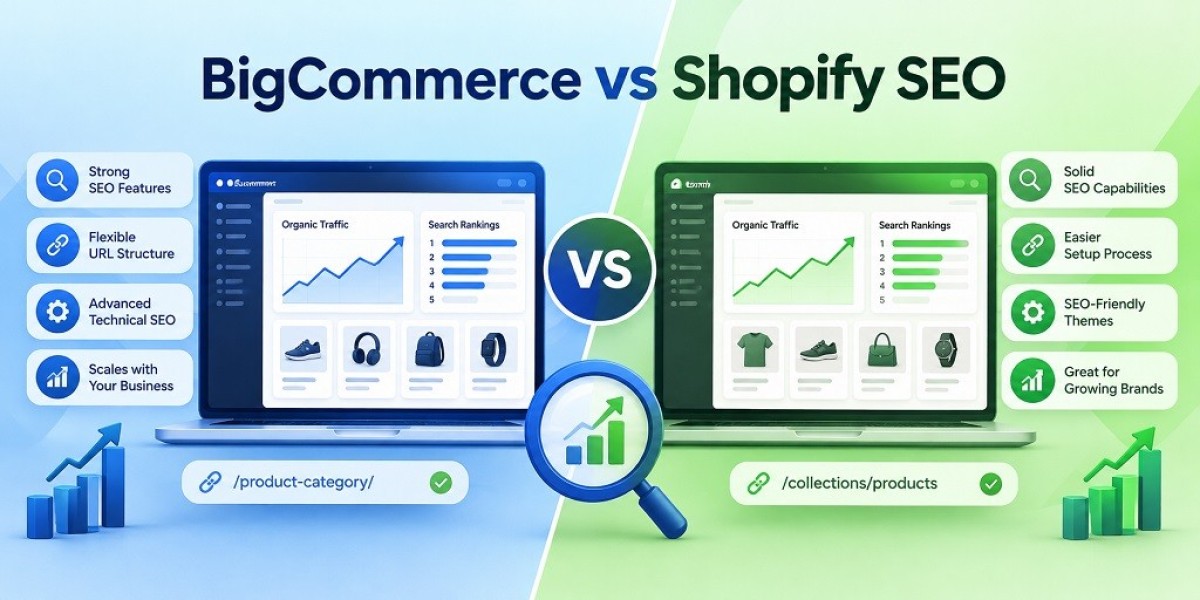

- For mid-market stores, BigCommerce holds the technical SEO edge on URL control, native faceted catalogs and large-catalog performance.
- Shopify wins on app ecosystem, theme speed tooling and ease of editing.
- Shopify forces fixed URL prefixes such as /products/ and /collections/. BigCommerce lets you customize every path.
- Either platform ranks well when configured correctly. The gap shows up at 10,000+ SKUs.
BigCommerce vs Shopify SEO: The Short Answer
In a BigCommerce vs Shopify SEO comparison focused purely on technical capability, BigCommerce gives mid-market stores the stronger advantage. It offers full URL customization, built-in 301 redirect management, and fewer plugin dependencies. Shopify is easier to run day to day, but its structural limits cost large catalogs flexibility.
BigCommerce vs Shopify SEO: Side-by-Side Differences
Technical FactorBigCommerceShopifyURL structureFully editable paths, including category depthFixed /products/, /collections/, /pages/ prefixesDuplicate contentSingle product URL per item by defaultProduct URLs duplicate under /collections/ paths, resolved by canonical tagsFaceted navigationNative Google-friendly filtering and Product Filtering controlsRelies on tags or third-party appsRedirectsBulk 301 import plus automatic redirects on URL changeURL redirects built in, with a bulk CSV importrobots.txtEditable directlyEditable through the robots.txt.liquid template since 2021Headless optionNative API-first, Catalyst frameworkHydrogen frameworkCheckoutCustomizable on all plansFully customizable only on Shopify Plus
Site Architecture and Crawl Control
Crawl efficiency decides how fast new products get indexed. BigCommerce lets teams shorten URLs, remove category prefixes and set clean paths such as /mens-running-shoes/. Shopify's mandatory prefixes add depth, and its collection-based product URLs create duplicate paths that depend on canonical tags to resolve.
Faceted navigation exposes the larger gap. BigCommerce handles filter parameters natively. Shopify stores typically add an app, and each app adds JavaScript weight and crawl-budget risk.
Page Speed and Core Web Vitals
Google measures Core Web Vitals on three metrics: Largest Contentful Paint (under 2.5 seconds), Interaction to Next Paint (under 200 milliseconds) and Cumulative Layout Shift (under 0.1). Both platforms run on global CDNs and serve modern image formats automatically.
Shopify's Online Store 2.0 themes are fast out of the box, but app scripts degrade scores quickly. Stores with 15 or more apps commonly fail INP. BigCommerce ships more features natively, so mid-market stores load less third-party code.
Where Shopify Still Wins
- Editing speed: Merchandisers update titles, metafields and collections faster in Shopify's admin.
- App depth: The Shopify App Store has thousands of SEO, review and schema tools.
- Theme ecosystem: More developers know Liquid, which lowers build costs.
Stores under roughly 5,000 SKUs with simple category trees rarely feel Shopify's constraints. The platform choice matters less than the audit discipline behind it. Google's SEO Starter Guide applies equally to both.
Which Platform Fits Your Store
Choose BigCommerce when you run large catalogs, multiple storefronts, complex filtering or B2B pricing. Choose Shopify when your team prioritizes merchandising speed and relies on apps for marketing workflows. Both platforms support structured data, XML sitemaps and canonical tags.
Concluding Thoughts
Technical SEO outcomes depend on configuration as much as platform. Genius eCommerce, an agency focused exclusively on eCommerce platforms, audits both BigCommerce and Shopify stores to find the specific crawl, speed and architecture issues limiting growth.
BigCommerce vs Shopify SEO: A Technical Head-to-Head Comparison for Mid-Market Stores FAQ
Is BigCommerce better than Shopify for SEO?
For mid-market stores with large catalogs, yes. BigCommerce provides editable URL paths, native faceted filtering and fewer required apps. Shopify is competitive for smaller catalogs.
Can Shopify's URL structure be changed?
No. Shopify keeps the /products/, /collections/, /pages/ and /blogs/ prefixes fixed. Teams can edit the handle after the prefix and manage redirects, but not the prefix itself.
Which platform loads faster for Core Web Vitals?
Both perform well at launch. Load speed usually depends on installed apps and theme code, and Shopify stores tend to accumulate more third-party scripts.




