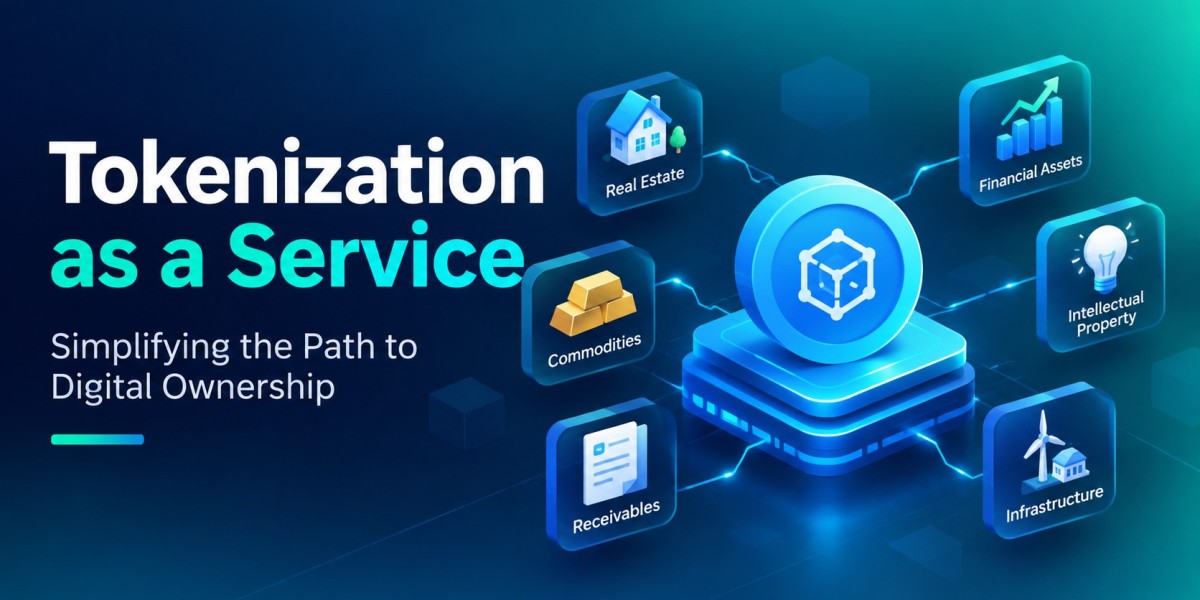

Enterprises manage a wide range of assets, including real estate, equipment, commodities, financial instruments, intellectual property, and future revenue streams. However, converting these assets into digital representations can involve complex technology, fragmented data systems, compliance requirements, and substantial development costs.
Tokenization-as-a-Service (TaaS) offers an alternative by providing businesses with the infrastructure and technical expertise required to digitize eligible assets through blockchain-based platforms. Instead of building an entire tokenization ecosystem from scratch, enterprises can use specialized services to manage token creation, asset records, investor access, and transaction workflows.
What Is Tokenization-as-a-Service?
Tokenization-as-a-Service is a service model that enables businesses to create, issue, and manage digital tokens representing assets or legally defined rights associated with them. A TaaS provider may offer blockchain infrastructure, smart contract development, asset onboarding, token issuance, compliance integrations, and ongoing platform maintenance.
Depending on the provider and business requirements, these services can support the digitization of:
Real estate: Commercial properties, residential developments, and rental income rights.
Financial assets: Eligible bonds, private credit instruments, and other financial products.
Physical assets: Industrial equipment, machinery, commodities, and inventory.
Business cash flows: Receivables, royalty streams, and contractual revenue rights.
Intellectual property: Licensing rights, royalties, and other legally transferable interests.
Tokenization does not automatically transfer legal ownership or make an asset tradable. The underlying rights, applicable regulations, and supporting legal agreements must be clearly established.
1. Reducing the Complexity of Enterprise Asset Digitization
Developing a tokenization platform internally requires expertise in blockchain architecture, smart contracts, cybersecurity, asset management, and regulatory compliance. These requirements can create significant operational challenges for enterprises without dedicated Web3 teams. Tokenization-as-a-Service can simplify this process by bringing multiple capabilities together under one service model.
Businesses may access prebuilt infrastructure, configurable token standards, asset management dashboards, and transaction processing tools instead of developing every component independently.
This approach can help enterprises concentrate on identifying suitable assets, defining business objectives, and establishing the legal structure for tokenization.
2. Accelerating Tokenization Platform Deployment
Building a tokenization platform from scratch can involve lengthy development cycles, integration challenges, and repeated testing. TaaS providers may offer reusable technical components that help shorten the implementation process.
Depending on the project scope, these components can include:
Smart contract templates adapted to specific asset requirements.
Digital asset issuance and lifecycle management tools.
Wallet integrations and transaction monitoring.
Investor onboarding and identity verification workflows.
Administrative dashboards and reporting capabilities.
Reusable infrastructure can reduce duplicated development work. However, enterprises still need appropriate customization, security testing, legal review, and operational validation before launching a platform.
3. Supporting Multiple Asset Classes Through One Infrastructure
Large enterprises often manage different asset categories across separate systems. This fragmentation can make asset tracking, reporting, and ownership administration difficult.
A suitable tokenization platform can provide a shared infrastructure for representing different eligible asset classes while preserving their individual requirements.
For example, a property business might digitize legally defined property interests, while a manufacturing enterprise could explore tokenization for equipment ownership interests or contractual payment rights.
A common platform may support asset registration, token issuance, transaction histories, and reporting across these initiatives.
However, different asset classes may require distinct token structures, legal agreements, transfer restrictions, and compliance procedures. A shared infrastructure should accommodate these differences rather than treating every asset identically.
4. Integrating Compliance Into Digital Asset Workflows
Enterprise asset digitization requires more than creating tokens. Businesses must also address identity verification, investor eligibility, ownership records, data protection, and applicable financial regulations.
Tokenization-as-a-Service providers may offer tools that support these requirements, including:
Know Your Customer (KYC) and Anti-Money Laundering (AML) integrations.
Permissioned token transfers and investor eligibility checks.
Transaction monitoring and audit trails.
Role-based access controls.
Reporting and documentation workflows.
Embedding these capabilities into the platform can help reduce manual processes and improve consistency.
Nevertheless, using a TaaS provider does not automatically make a tokenized offering compliant. Enterprises remain responsible for determining their legal obligations and ensuring that the service configuration meets the relevant requirements.
5. Improving Asset Transparency and Record Management
Traditional asset management often relies on spreadsheets, separate databases, paper documentation, and disconnected reporting systems. These arrangements can make it difficult to maintain consistent records across departments and external stakeholders.
Blockchain-based tokenization can create traceable records of token issuance and permitted transfers. When connected to reliable asset documentation and appropriate business systems, this infrastructure can improve visibility into asset-related activities.
Enterprises may use these capabilities to monitor token balances, review transaction histories, manage ownership records, and simplify selected reporting processes.
However, blockchain records do not independently verify the physical existence, valuation, or legal status of an underlying asset. Reliable documentation, independent verification, and appropriate governance remain essential.
6. Creating Flexible Asset Management and Distribution Models
Tokenization can help enterprises develop more structured approaches to managing ownership interests and contractual economic rights.
For example, a commercial property business could explore tokenized interests supported by appropriate legal arrangements. A business with recurring contractual receivables could investigate digital representations of eligible payment rights.
Where legally permitted and correctly configured, smart contracts may automate selected activities, such as:
Distributing eligible payments according to predefined rules.
Applying transfer restrictions.
Recording token transfers.
Executing approved administrative workflows.
Generating transaction records for reconciliation.
Automation can reduce repetitive administrative work, but it depends on accurate data, properly tested smart contracts, and clearly defined legal and operational responsibilities.
Tokenization also does not guarantee liquidity, investor demand, or successful secondary-market trading.
7. Reducing the Need for Extensive In-House Blockchain Expertise
Building and maintaining blockchain infrastructure requires specialized technical skills. Enterprises may need developers, security specialists, smart contract auditors, infrastructure engineers, and digital asset operations teams.
Tokenization-as-a-Service can provide access to some of these capabilities through an external provider.
Depending on the service agreement, the provider may handle platform configuration, smart contract deployment, infrastructure maintenance, system upgrades, and technical support.
This model can help enterprises reduce the need to develop every capability internally. It may also allow teams to focus on asset selection, business partnerships, legal structuring, and operational strategy.
However, businesses should evaluate provider expertise, security practices, service-level commitments, integration costs, and long-term platform dependencies before selecting a solution.
8. Supporting Enterprise System Integration
Asset tokenization is most useful when digital asset workflows connect with existing enterprise operations.
A TaaS platform may integrate with enterprise resource planning (ERP) systems, customer relationship management (CRM) tools, accounting software, custody solutions, and asset management databases.
These integrations can help synchronize selected asset information, reduce duplicate data entry, and improve reporting across business functions.
For example, a manufacturing company could connect equipment records with a tokenization platform to maintain a more consistent view of eligible assets and their associated digital representations.
Successful integration depends on data quality, API availability, access permissions, and compatibility with existing systems. Enterprises should also establish clear controls over which systems serve as authoritative sources for asset information.
9. Making Enterprise Tokenization More Scalable
An enterprise may begin with a limited proof of concept before expanding tokenization across additional assets or business units.
Tokenization-as-a-Service can support this phased approach by providing reusable infrastructure and configurable workflows.
A business might initially digitize one eligible asset category, evaluate the operational results, and then expand to additional categories after validating the legal, technical, and commercial model.
A practical implementation roadmap could include:
Asset assessment: Identify assets and determine whether the associated rights are suitable for tokenization.
Business model definition: Establish the purpose of tokenization, intended participants, and expected operational benefits.
Legal and compliance review: Confirm ownership structures, transfer restrictions, and applicable regulatory requirements.
Provider selection: Evaluate infrastructure, security, integrations, pricing, and customization capabilities.
Platform configuration: Implement token structures, asset records, permissions, and required workflows.
Testing and validation: Review smart contracts, cybersecurity controls, data accuracy, and operational processes.
Controlled deployment: Launch a limited implementation and measure its performance before expanding.
This approach helps enterprises evaluate tokenization incrementally rather than committing immediately to a large-scale deployment.
10. Evaluating the Cost and Business Value of TaaS
Tokenization-as-a-Service may reduce the need for extensive in-house infrastructure development, but the total cost depends on the complexity of the project.
Potential expenses include platform subscriptions, customization, smart contract audits, legal services, compliance integrations, blockchain transaction fees, custody arrangements, and ongoing maintenance.
Enterprises should assess the total cost of ownership rather than comparing providers solely on initial setup fees.
Useful evaluation metrics include implementation time, cost per asset onboarded, manual processing requirements, transaction reconciliation time, system reliability, and compliance administration costs.
A successful implementation should demonstrate measurable operational or commercial value. Tokenization is not automatically more cost-effective than traditional systems, particularly when the assets involved have limited transferability or do not benefit from shared digital infrastructure.
Challenges Enterprises Should Consider
Despite its potential benefits, tokenization-as-a-Service introduces several considerations that businesses should address before implementation.
Legal enforceability: The relationship between a digital token and the underlying asset or contractual rights must be clearly established.
Security risks: Smart contract vulnerabilities, compromised credentials, and inadequate access controls can expose digital assets to operational and financial risks.
Provider dependency: Relying on an external platform can create migration challenges, service continuity concerns, or restrictions on future customization.
Data accuracy: Tokenization cannot correct inaccurate asset records or replace proper verification of underlying assets.
Interoperability: Enterprises should evaluate whether their chosen infrastructure can integrate with existing systems and support future requirements.
Commercial viability: The benefits of tokenization should justify implementation and ongoing operating costs.
Addressing these issues early can help enterprises develop a more sustainable asset digitization strategy.
Conclusion
Tokenization-as-a-Service could simplify enterprise asset digitization by providing access to blockchain infrastructure, token issuance tools, compliance integrations, asset management workflows, and ongoing technical support.
Rather than building every component internally, businesses can use a service-based approach to explore tokenization across real estate, financial instruments, equipment, receivables, and other eligible assets.
The most effective implementations begin with clearly defined business objectives, legally established asset rights, reliable data, and a carefully selected technology provider.
For enterprises exploring real-world asset tokenization, TaaS can offer a practical starting point for building digital asset capabilities while maintaining the governance, security, and operational controls required for enterprise adoption.
Frequently Asked Questions
1. What is Tokenization-as-a-Service?
Tokenization-as-a-Service is a model in which a provider supplies the technology and related services required to create, issue, and manage blockchain-based tokens representing assets or associated rights.
2. How can TaaS benefit enterprises?
It can reduce the need to develop blockchain infrastructure internally, simplify selected asset management workflows, support system integration, and provide access to tokenization expertise.
3. Which assets can enterprises tokenize?
Depending on their legal status and suitability, enterprises may explore real estate, equipment, commodities, eligible financial instruments, receivables, royalties, and contractual revenue rights.
4. Does Tokenization-as-a-Service eliminate compliance requirements?
No. Enterprises must still address applicable laws, ownership rights, investor eligibility, data protection, and other regulatory obligations. A service provider can support compliance workflows but cannot guarantee compliance in every situation.
5. How should a business choose a TaaS provider?
Businesses should assess the provider's technical capabilities, security standards, smart contract auditing practices, compliance integrations, customization options, interoperability, pricing, and long-term support.




