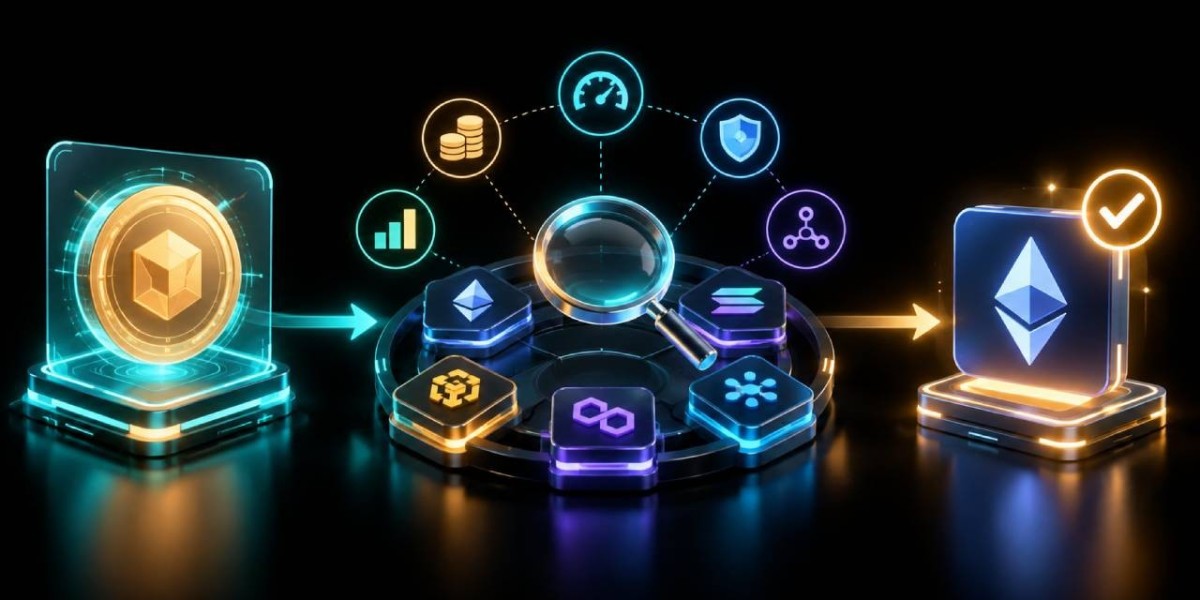

Choosing the right blockchain is one of the most important decisions in token development. The blockchain you select affects transaction fees, processing speed, smart contract capabilities, security, wallet compatibility, and access to users. A suitable network can support your project's growth, while the wrong choice may lead to high operating costs, limited adoption, or expensive migration work.
Whether you are creating a utility token, governance token, stablecoin, security token, or real-world asset (RWA) token, you should evaluate each blockchain against your project's technical requirements, business goals, and long-term plans.
This guide explains the key factors to consider when selecting a blockchain for token development.
1. Define Your Token's Purpose
Start by identifying what your token needs to accomplish. Different token use cases require different blockchain capabilities.
For example, a governance token may need reliable voting integrations and transparent transactions. A gaming token may require low-cost, frequent transactions. An RWA token may need controlled transfers, investor eligibility checks, and integration with external legal or financial systems.
Consider these common use cases:
Utility tokens: Support access to products, services, or platform features.
Governance tokens: Enable participation in protocol or community decisions.
Payment tokens: Support transfers and payments with suitable transaction costs.
Gaming tokens: Handle frequent in-game transactions and digital asset interactions.
RWA tokens: Represent interests in assets such as property, funds, or other eligible real-world assets.
Security tokens: Represent regulated financial interests and may require transfer restrictions and compliance controls.
Write down your token's required features before comparing blockchain networks. This helps you focus on networks that match your actual needs.
2. Compare Transaction Fees and Network Performance
Transaction fees affect both users and project operating costs. If users must pay high fees for basic token transfers, they may be less willing to interact with your platform.
Evaluate the following factors:
Average and peak transaction fees
Transaction confirmation times
Network throughput under real demand
Network congestion during busy periods
Costs of deploying and interacting with smart contracts
Availability of scaling solutions
For example, a platform that supports frequent microtransactions may benefit from a low-cost network or a suitable Layer 2 solution. A project that prioritizes access to a mature decentralized finance ecosystem may accept different cost and performance trade-offs.
Do not evaluate a blockchain using advertised transaction speeds alone. Test its performance under realistic workloads and consider how fees change during periods of high demand.
3. Evaluate Smart Contract Compatibility
Smart contracts define how tokens behave. They can control transfers, minting, burning, access permissions, vesting schedules, and other token functions.
Some blockchain networks support the Ethereum Virtual Machine (EVM), allowing developers to use familiar Solidity-based development tools and compatible token standards. Other networks use different programming languages, virtual machines, or development environments.
Before selecting a network, check:
Supported programming languages
Availability of established token standards
Developer tools and testing frameworks
Smart contract auditing options
Upgrade and deployment mechanisms
Compatibility with required protocols and applications
EVM compatibility may simplify development when your team already uses Solidity. However, it should not be the only deciding factor. Consider the network's security model, ecosystem, and technical suitability as well.
4. Assess Security and Network Reliability
Blockchain security is essential because token contracts may control valuable assets and permissions. A network with established infrastructure and strong development resources can offer useful advantages, but no blockchain eliminates every risk.
Review the network's operating history, validator or consensus design, incident history, client diversity, and recovery procedures. Consider how the network handles outages, congestion, protocol upgrades, and potential attacks.
You should also assess token contract security separately from blockchain security.
A secure token development process may include:
Role-based access controls
Restrictions on minting and burning
Testing for unauthorized transfers and privilege misuse
Independent smart contract audits
Unit, integration, and fuzz testing
Monitoring for unusual contract activity
Secure management of administrative keys
Remember that a reliable blockchain cannot compensate for vulnerable smart contracts or poor key management.
5. Check Wallet, Exchange, and Ecosystem Support
A token needs an accessible ecosystem if it is to reach its intended users. Before choosing a blockchain, investigate whether the wallets, decentralized applications, analytics platforms, and integrations required by your project support it.
Check the availability of:
Popular wallets used by your target audience
Decentralized exchanges and liquidity infrastructure
Block explorers and transaction analytics
Bridges and cross-chain tools, where required
Developer communities and technical documentation
Custody providers and institutional integrations, if relevant
Exchange support should be treated as a possibility to evaluate, not a guaranteed outcome of blockchain selection. Each exchange has its own listing requirements and review process.
Choose a network based on the actual needs of your users rather than popularity alone.
6. Understand Token Standards and Customization Needs
Token standards define common rules for how tokens operate within a blockchain ecosystem. Using an established standard can improve compatibility with wallets, applications, and developer tools.
For example, Ethereum uses ERC-20 for fungible tokens and ERC-721 for many non-fungible tokens. Other ecosystems provide their own standards for similar use cases.
Your choice depends on the assets and functions you need to support.
Ask whether your token requires:
Fungible or non-fungible asset support
Minting and burning controls
Pausable transfers or other emergency functions
Vesting and scheduled token releases
Role-based permissions
Restricted transfers or investor eligibility checks
Integration with decentralized finance protocols
Custom functionality may be necessary, especially for RWA and regulated asset projects. However, additional features increase development and testing requirements. Keep the token design as simple as possible while meeting documented business and technical needs.
7. Consider Scalability and Long-Term Costs
Your blockchain should support your expected usage today and have a practical path for future growth. Estimate how many users, transactions, token holders, and smart contract interactions your platform may need to handle.
Also consider the full cost of operating the token, not just the initial deployment fee.
Potential costs include smart contract development, audits, deployment, transaction subsidies, infrastructure, monitoring, indexing, bridge integrations, and ongoing maintenance.
A Layer 2 network may reduce transaction costs for certain applications, but it can introduce additional considerations involving bridging, sequencers, withdrawal processes, and dependencies on underlying networks.
Build a realistic cost model using expected and peak usage scenarios before making a final decision.
8. Create a Blockchain Selection Checklist
Use a structured checklist to compare candidate networks against the same requirements.