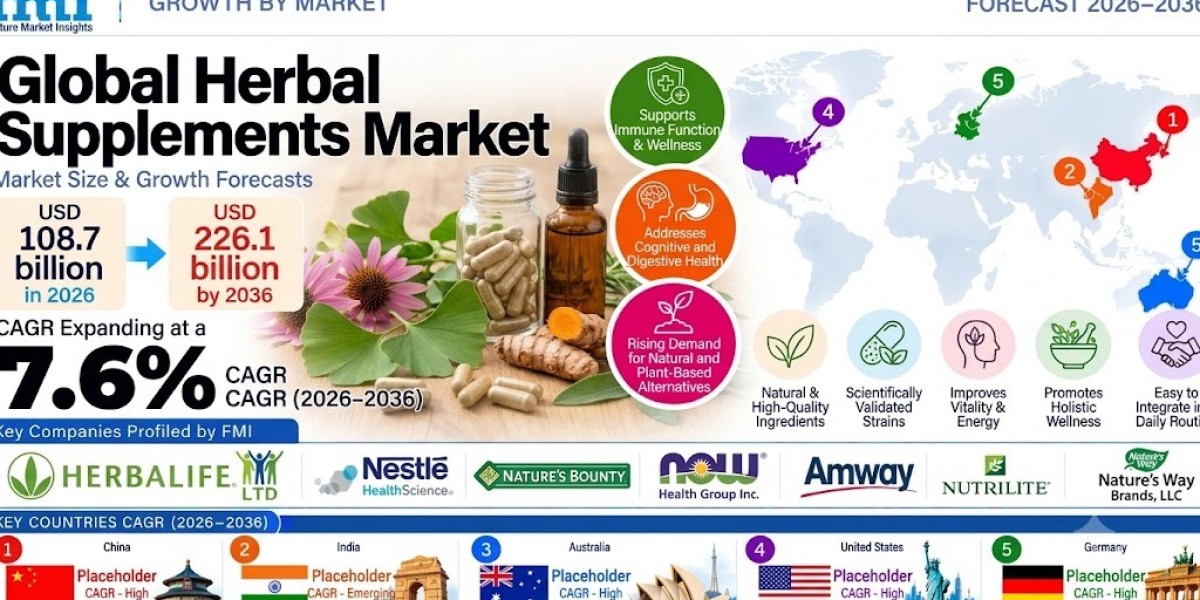

NEWARK, Del., October 22, 2026 — The global Herbal Supplements Market is gaining momentum as consumers increasingly incorporate botanical ingredients into their daily wellness routines and seek convenient products for preventive health and general well-being. According to the latest market intelligence report published by Future Market Insights (FMI), the market is valued at USD 108.7 billion in 2026 and is projected to reach USD 226.1 billion by 2036. The industry is anticipated to expand at a compound annual growth rate (CAGR) of 7.6% over the forecast period. Growth is supported by rising interest in botanical nutrition, increasing demand for convenient supplement formats, expanding wellness-focused product portfolios, and continued innovation in ingredient identification, formulation, and quality assurance.
Herbal Supplements Market Key Market Takeaways
- Market Valuation: USD 108.7 billion in 2026, rising to USD 226.1 billion by 2036.
- Growth Rate: Expanding at a 7.6% CAGR from 2026 to 2036.
- Leading Form: Soft gel and pill formats are projected to account for approximately 27.0% of the form segment in 2026.
- Leading Ingredient Category: Other ingredients, including horehound and elderberry, are projected to account for approximately 34.0% of the ingredients segment in 2026.
- Fastest-Growing Country: Japan is projected to record the highest growth among the profiled country markets, at a 12.0% CAGR.
- Other High-Growth Markets: The United States is forecast to expand at an 11.0% CAGR, followed by South Korea at 9.0%, the United Kingdom at 8.0%, and Germany at 6.0%.
- Core Growth Driver: Increasing consumer interest in routine wellness, botanical formulations, convenient supplement formats, and preventive health practices.
- Key Players: Herbalife Ltd., Nestlé Health Science (Nature's Bounty), NOW Health Group Inc., Amway Corp. (Nutrilite), and Nature's Way Brands, LLC.
? Explore Market Forecasts, Competitive Benchmarking & Industry Insights: https://www.futuremarketinsights.com/reports/sample/rep-gb-11311
Industry Shifts & Market Dynamics
The herbal supplements market is evolving as consumers increasingly seek botanical products that fit into convenient, repeatable wellness routines. Herbal supplements contain plant-derived ingredients used in products such as capsules, pills, powders, liquids, gummies, and chewable formulations. These products serve a range of consumer preferences, from traditional botanical preparations to modern supplement formats designed for everyday use.
Routine replenishment is an important factor influencing market development. Consumers who incorporate supplements into established wellness habits can generate recurring demand for familiar products. Clear ingredient information, understandable serving instructions, consistent formulations, and reliable product availability can influence purchasing decisions and brand loyalty.
Soft gel and pill formats are projected to account for approximately 27.0% of the form segment in 2026. Their premeasured servings make them convenient for consumers who prefer products that do not require preparation or measuring. These formats also support standardized packaging and distribution, making them suitable for established retail and online supplement channels.
Other ingredients, including horehound and elderberry, are projected to account for approximately 34.0% of the ingredients segment in 2026. This category encompasses a range of botanicals beyond individually tracked ingredients such as turmeric, echinacea, ginger, ginseng, flaxseeds, and moringa. The diversity of available botanical ingredients creates opportunities for manufacturers to differentiate formulations and address specific consumer preferences.
Ingredient quality and preparation consistency remain important considerations. Botanical species, plant parts, extraction methods, and preparation strength can influence the composition of finished products. Manufacturers and ingredient suppliers must maintain suitable specifications and documentation to support product quality, traceability, and compliance with applicable requirements.
Product innovation is also influencing competition. Capsules and pills offer familiar formats, while powders, liquids, gummies, and chewables provide alternatives for consumers with different preferences. Companies can use format innovation to expand product portfolios, improve convenience, and create additional consumption occasions.
Despite these opportunities, the industry faces challenges related to raw material variability, sourcing costs, product qualification, contamination controls, and regulatory requirements. Rules governing botanical ingredients and health-related claims differ across markets, creating additional considerations for manufacturers seeking international distribution.
Companies that invest in dependable sourcing, botanical identification, quality testing, formulation consistency, and transparent product information are positioned to strengthen their competitive presence. As consumers continue to evaluate supplement products based on convenience and trust, quality assurance and reliable product documentation are likely to remain central to market development.
Key Players Influencing the Herbal Supplements Market
Herbalife Ltd., Nestlé Health Science (Nature's Bounty), NOW Health Group Inc., Amway Corp. (Nutrilite), and Nature's Way Brands, LLC are among the companies identified in the herbal supplements market landscape.
These companies participate in the broader nutritional supplement and botanical wellness ecosystem, offering products through retail, online, and distributor-supported channels. Their portfolios illustrate different approaches to product positioning, consumer access, formulation development, and quality management.
Competitive differentiation depends on product quality, ingredient transparency, botanical identification, format variety, brand recognition, distribution reach, and the ability to maintain consistent product specifications. Companies serving multiple markets must also address differences in product classification, labeling, and permissible health-related claims.
Retail-oriented brands can compete through product accessibility, recognizable formulations, and clear packaging information. Distributor-supported businesses can combine product availability with customer guidance, while companies emphasizing analytical capabilities can differentiate themselves through ingredient identity testing and quality-control processes.
Ingredient sourcing and traceability are important considerations across the competitive landscape. Manufacturers need to assess botanical identity, plant origin, extraction procedures, and finished-product specifications to maintain consistency across production batches.
As the industry develops, companies that combine convenient product formats with dependable quality controls, differentiated formulations, and effective distribution strategies may be better positioned to capture opportunities across the global herbal supplements market.
Recent Developments in the Herbal Supplements Market
- Botanical Identity Testing: Advances in botanical identification methods are creating opportunities to strengthen ingredient verification and improve confidence in raw material quality.
- Convenient Supplement Formats: Capsules, soft gels, gummies, chewables, and liquids provide manufacturers with opportunities to address different consumer preferences and daily-use routines.
- Botanical Product Innovation: Interest in ingredients such as elderberry, turmeric, ginger, ginseng, and moringa is supporting product differentiation across wellness-focused supplement portfolios.
- Quality Assurance and Traceability: Greater emphasis on ingredient specifications, botanical identity, and sourcing documentation is influencing supplier qualification and manufacturing practices.
- Personalized Supplement Channels: Consultation-led product selection and portioning models are creating opportunities for clearly identified formulations and standardized serving information.
- Regulatory and Labeling Compliance: Differences in botanical qualification and health-claim requirements across markets are increasing the importance of market-specific documentation and product communication.
These developments reflect broader industry trends in botanical wellness, supplement innovation, product quality, and regulatory compliance. Individual company announcements and market-specific regulatory changes should be verified against official sources before publication.
For detailed Herbal Supplements Market analysis covering market size, forecasts, forms, ingredient categories, regional opportunities, and competitive developments, visit the Official Report: https://www.futuremarketinsights.com/reports/herbal-supplements-market
Regional Market Summary
According to Future Market Insights, Japan is projected to record the fastest growth among the profiled country markets, with a CAGR of 12.0% from 2026 to 2036. Market opportunities are influenced by demand for wellness products, established supplement consumption, and requirements governing the manufacturing and labeling of relevant products containing natural extracts.
The United States is projected to expand at a CAGR of 11.0%, supported by demand for botanical supplements, established retail distribution, and interest in incorporating supplements into regular wellness routines. South Korea is expected to register a CAGR of 9.0%, while the United Kingdom is forecast to grow at 8.0%.
Germany is projected to expand at a CAGR of 6.0%. Across these markets, demand is influenced by product accessibility, ingredient quality, consumer awareness, and the ability of manufacturers to meet relevant product and labeling requirements.
Regional growth also depends on regulatory conditions. Requirements for dietary ingredients, botanical preparations, manufacturing practices, and health-related claims can differ substantially between countries. Suppliers expanding internationally must align their formulations, documentation, and marketing practices with the applicable rules in each target market.
- Japan: The herbal supplements market is projected to grow at a CAGR of 12.0% from 2026 to 2036, supported by wellness demand and opportunities for botanical products that meet relevant manufacturing and labeling requirements.
- United States: The market is expected to expand at a CAGR of 11.0%, supported by established supplement distribution and demand for products that fit regular wellness routines.
- South Korea: The market is projected to register a CAGR of 9.0%, reflecting opportunities associated with functional wellness products and consultation-led supplement channels.
- United Kingdom: The market is forecast to grow at a CAGR of 8.0%, supported by demand for botanical supplements and opportunities for differentiated wellness formulations.
- Germany: The market is expected to expand at a CAGR of 6.0%, with opportunities influenced by established supplement distribution and regulatory requirements for botanical product communication.
- China: The market presents opportunities associated with botanical ingredient use, expanding consumer wellness demand, and the development of differentiated supplement formulations.
- India: The market offers opportunities linked to traditional botanical knowledge, ingredient availability, and growing product development across the nutritional supplement sector.
- Other European Markets: Opportunities are associated with botanical product innovation, supplement distribution, and the development of formulations that comply with applicable regional requirements.
Analyst Insights
The herbal supplements market is increasingly shaped by consumer demand for botanical products that can be incorporated into consistent daily wellness routines. Manufacturers are responding through a broad range of formulations, including pills, soft gels, powders, liquids, gummies, and chewable products.
Soft gel and pill formats remain important because they offer premeasured servings and straightforward use. Meanwhile, the broad category of other botanical ingredients, including horehound and elderberry, provides opportunities for differentiated formulations beyond individually tracked ingredients.
Product quality is a central consideration in this market. Botanical species, plant parts, extraction methods, and preparation strength can influence the characteristics of a finished supplement. Manufacturers that maintain clear specifications and reliable quality-control procedures can better support consistency across production batches and distribution channels.
Regional growth projections indicate opportunities for suppliers across Asia, North America, and Europe. Japan and the United States are projected to record comparatively strong growth among the profiled country markets, while South Korea and the United Kingdom also offer opportunities for botanical supplement suppliers.
However, commercial success depends on more than consumer interest. Companies must consider ingredient availability, manufacturing costs, regulatory requirements, distribution access, and the ability to communicate product characteristics clearly without making unsupported health claims.
Manufacturers can strengthen their market positions by investing in botanical identification, supplier qualification, traceability, consistent formulations, and consumer-friendly product formats. Partnerships with distributors and retail channels can further improve access to target customers.
As the industry develops, companies that balance formulation innovation, dependable quality, transparent labeling, and regulatory compliance are positioned to capture emerging opportunities in the global herbal supplements market.
Frequently Asked Questions
Q: What is the projected size of the herbal supplements market by 2036?
A: The global herbal supplements market is projected to reach USD 226.1 billion by 2036, increasing from USD 108.7 billion in 2026 and expanding at a CAGR of 7.6% over the forecast period.
Q: Which form segment leads the herbal supplements market?
A: Soft gel and pill formats are projected to account for approximately 27.0% of the form segment in 2026. Their premeasured servings and convenience support their use in daily supplement routines.
Q: Which ingredient category leads the herbal supplements market?
A: Other ingredients, including horehound and elderberry, are projected to account for approximately 34.0% of the ingredients segment in 2026.
Q: Which country exhibits the highest growth rate?
A: Japan is projected to record the highest growth among the profiled country markets, with a CAGR of 12.0% from 2026 to 2036.
Q: What factors are driving the herbal supplements market?
A: Market growth is supported by demand for routine wellness products, interest in botanical ingredients, convenient supplement formats, product innovation, and the expansion of retail and online distribution channels.
Q: Who are the key players in the herbal supplements market?
A: Notable companies identified in the market landscape include Herbalife Ltd., Nestlé Health Science (Nature's Bounty), NOW Health Group Inc., Amway Corp. (Nutrilite), and Nature's Way Brands, LLC.
Q: What challenges affect the herbal supplements market?
A: Key challenges include raw material variability, sourcing costs, botanical identification, quality assurance, regulatory requirements, and differences in labeling and health-claim rules across markets.
Q: How are herbal supplements used?
A: Herbal supplements are available in formats such as soft gels, pills, powders, liquids, gummies, and chewables. Consumers use these products as part of various wellness routines, subject to product directions and applicable requirements.
Q: Why is botanical identity important in the herbal supplements market?
A: Botanical identity helps manufacturers confirm that ingredients match their intended specifications. Plant species, plant parts, and extraction methods can influence the composition of finished preparations, making identity verification and quality controls important.
Q: How does regulation influence the herbal supplements market?
A: Regulations affect ingredient qualification, manufacturing practices, product labeling, safety documentation, and permissible health-related claims. Companies must evaluate the applicable requirements in each market before introducing or expanding a product.
Q: What role does product format play in market development?
A: Product format influences convenience, serving consistency, and consumer preference. Soft gels and pills provide premeasured servings, while powders, liquids, gummies, and chewables offer alternative consumption experiences.
Q: What opportunities exist for herbal supplement manufacturers?
A: Opportunities include differentiated botanical formulations, improved quality assurance, convenient delivery formats, stronger ingredient traceability, and expansion through retail, online, and distributor-supported channels.
Related Food, Health & Nutrition Industry Reports
Plant-Based Pet Food Market https://www.futuremarketinsights.com/reports/plant-based-pet-food-market
Glycine Market https://www.futuremarketinsights.com/reports/glycine-market
Pigeon Pea Market https://www.futuremarketinsights.com/reports/pigeon-pea-market
Cereal Bars Market https://www.futuremarketinsights.com/reports/cereal-bars-market
Bread Crumbs Market https://www.futuremarketinsights.com/reports/bread-crumbs-market
About Future Market Insights
Future Market Insights (FMI) is an ESOMAR-certified market research and consulting firm providing syndicated, customized, investment, and social media research across industries, including food and beverage, healthcare, chemicals, technology, and consumer products. FMI delivers market intelligence, competitive analysis, and strategic insights to help organizations evaluate emerging opportunities and make informed business decisions. The company has offices in the United States, the United Kingdom, the UAE, and India.
Media Contact
For Press & Corporate Inquiries
Rahul Singh
AVP – Marketing and Growth Strategy
Future Market Insights, Inc.
Phone: +91 8600020075
For Sales: sales@futuremarketinsights.com
For Media: Rahul.singh@futuremarketinsights.com
Website: https://www.futuremarketinsights.com/