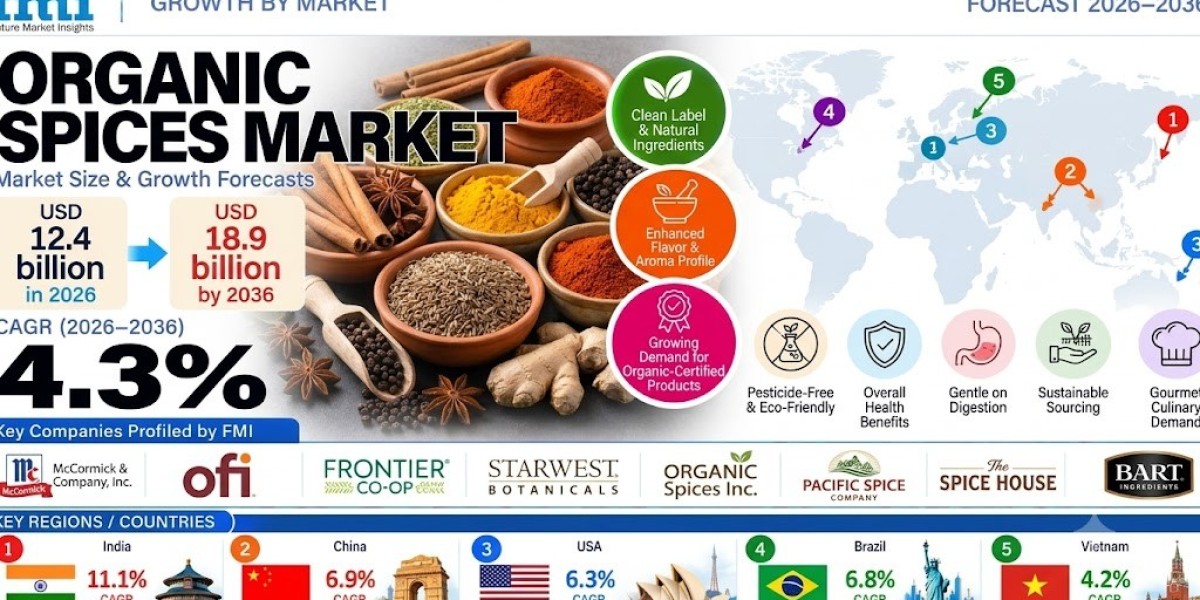

Organic Spices Market to Reach USD 18.9 Billion by 2036
NEWARK, Del., October 21, 2026 — The global Organic Spices Market is gaining momentum as consumers, food manufacturers, and foodservice operators increasingly seek certified organic ingredients that support clean-label positioning, product quality, and transparent sourcing. According to the latest market intelligence report published by Future Market Insights (FMI), the market is valued at USD 12.4 billion in 2026 and is projected to reach USD 18.9 billion by 2036. The industry is anticipated to expand at a compound annual growth rate (CAGR) of 4.3% over the forecast period. Growth is supported by increasing demand for organic food products, rising awareness of ingredient traceability, expanding applications of organic spices in functional foods, and food manufacturers' efforts to reformulate products using certified organic ingredients.
Organic Spices Market: Key Market Takeaways
- Market Valuation: USD 12.4 billion in 2026, rising to USD 18.9 billion by 2036.
- Growth Rate: Expanding at a 4.3% CAGR from 2026 to 2036.
- Leading Product Segment: Turmeric is projected to account for 22.0% of the product segment in 2026.
- Leading Form: Powder and granules are expected to represent 48.0% of the form segment in 2026.
- Leading Nature Segment: Certified organic spices are projected to account for 68.0% of the nature segment in 2026.
- Leading Packaging Type: Pouches and sachets are expected to account for 56.0% of packaging demand.
- Leading Distribution Channel: Store-based retailing is projected to account for 46.0% of distribution channel demand.
- Leading End User: The food industry is expected to represent 42.0% of end-user demand in 2026.
- Fastest-Growing Country: The United States is projected to record a CAGR of 4.4% through 2036, matching South Korea.
- Other Key Markets: The European Union and Japan are forecast to expand at a 4.3% CAGR, followed by the United Kingdom at 4.2%.
- Core Growth Driver: Increasing demand for clean-label products, certified organic ingredients, transparent sourcing, and chemical-residue-conscious food production.
? Get Detailed Market Forecasts, Competitive Benchmarking & Industry Insights: Request a Sample Report : https://www.futuremarketinsights.com/reports/sample/rep-gb-14384
Industry Shifts & Market Dynamics
The organic spices market is evolving as consumers increasingly prioritize ingredient transparency, food quality, and sourcing practices when purchasing everyday food products. Organic spices are gaining visibility across mainstream grocery stores, specialty food retailers, restaurants, and food manufacturing operations as demand expands beyond traditional organic and natural food categories.
Growing interest in clean-label foods is encouraging manufacturers to incorporate certified organic spices into seasonings, sauces, ready-to-eat meals, snack products, beverages, and other processed foods. These ingredients enable businesses to address consumer preferences for organic sourcing while differentiating their products in competitive food categories.
Product differentiation remains an important competitive factor. Turmeric is projected to account for 22.0% of the product segment in 2026. Its extensive culinary applications, established position in Asian cuisines, and use in functional food formulations support its importance within the organic spices category. Organic turmeric is also used in products marketed around curcumin, creating opportunities across food, beverage, and supplement applications where applicable regulatory requirements are met.
Ginger, basil, cumin, and other organic spices provide additional opportunities for manufacturers and suppliers. Organic ginger is used in beverages, seasonings, bakery products, and prepared foods, while cumin remains important in international cuisines, spice blends, and ready-to-cook products. Basil and other organic herbs support demand from manufacturers seeking distinctive flavor profiles and certified ingredient sourcing.
Product form also influences purchasing decisions. Powder and granules are expected to represent 48.0% of the form segment in 2026. Their convenience, ease of measurement, and compatibility with industrial mixing and blending processes make them suitable for both household cooking and large-scale food manufacturing. Whole spices, flakes, fresh roots, and pastes provide additional formats for applications requiring different flavor characteristics, textures, and preparation methods.
Certification is another major consideration. Certified organic spices are projected to account for 68.0% of the nature segment in 2026. Food manufacturers and retailers often require documented evidence of organic status, ingredient origin, and compliance with applicable certification standards. Suppliers that maintain reliable records throughout cultivation, processing, storage, and distribution can strengthen buyer confidence.
Packaging and distribution also influence market development. Pouches and sachets are expected to account for 56.0% of packaging demand, supported by their suitability for retail distribution, portion control, and convenient storage. Store-based retailing is projected to represent 46.0% of distribution channel demand as organic spices gain shelf space in supermarkets, hypermarkets, and specialty food stores.
Food manufacturers represent an important source of demand, accounting for a projected 42.0% of end-user demand in 2026. Companies reformulating existing products or launching new organic product lines require dependable ingredient quality, consistent flavor performance, and traceability documentation.
Supply chain integrity remains a significant industry consideration. Organic spices can be exposed to risks involving adulteration, contamination, inconsistent quality, and inadequate certification records. Maintaining product integrity requires appropriate supplier qualification, testing, segregation, and traceability throughout the supply chain.
Companies investing in certified sourcing, quality assurance, processing efficiency, packaging innovation, and dependable distribution are positioned to strengthen their competitive presence. As the market develops, suppliers that combine verified organic credentials with consistent product quality and competitive pricing may be better positioned to capture opportunities across retail, foodservice, and industrial food manufacturing.
Key Players Influencing the Organic Spices Market
McCormick & Company, Frontier Co-op, Simply Organic, Rapid Organic Pvt. Ltd., Organic Spices Inc. (Spicely), Diaspora Co., Curio Spice Co., Burlap & Barrel, Indus Organics, and Feel Good Organics are among the companies identified in the organic spices market landscape.
These companies operate across different parts of the organic spice value chain, including certified ingredient sourcing, spice processing, branded retail products, specialty distribution, and international supply. Their competitive positioning depends on product quality, certification capabilities, sourcing relationships, traceability, packaging, and access to retail and food manufacturing customers.
Established spice companies benefit from broad distribution networks, established brands, and experience in quality control. Specialized organic spice businesses can differentiate themselves through product origin, supplier relationships, distinctive spice varieties, and focused organic product portfolios.
For food manufacturers, procurement decisions increasingly involve more than price and flavor. Buyers may assess organic certification, origin documentation, residue testing, microbial quality, adulteration controls, and the supplier's ability to deliver consistent volumes.
Retail-focused suppliers must also balance product presentation, packaging performance, shelf life, and affordability. Maintaining consumer trust requires clear labeling and accurate representation of organic credentials.
As competition develops, companies that combine reliable sourcing with transparent documentation, consistent product quality, and effective distribution may be better positioned to strengthen their presence in the global organic spices market.
Recent Developments in the Organic Spices Market
- Expansion of Certified Organic Product Portfolios: Spice suppliers are responding to demand for organic ingredients by expanding product selections across turmeric, ginger, cumin, basil, and other culinary spices.
- Supply Chain Traceability: Greater emphasis on documented ingredient origin, organic certification, and chain-of-custody records is influencing purchasing decisions among food manufacturers and retailers.
- Quality Assurance and Adulteration Prevention: Testing, supplier qualification, and improved processing controls are becoming important considerations for maintaining organic product integrity.
- Clean-Label Product Reformulation: Food manufacturers are incorporating organic spices into selected product lines to address demand for transparent ingredients and certified organic sourcing.
- Packaging Innovation: Pouches, sachets, jars, and resealable containers provide opportunities to improve product protection, convenience, and retail presentation.
- Mainstream Retail Expansion: Organic spices are increasingly positioned alongside conventional seasonings in mainstream grocery stores, helping improve consumer accessibility.
- International Market Development: Suppliers are developing sourcing and export capabilities to serve food manufacturers and retailers that require documented compliance with relevant organic certification standards.
These developments reflect broader industry trends in organic ingredient sourcing, certification, quality assurance, and retail distribution rather than independently verified announcements by every company listed.
For detailed Organic Spices Market analysis covering market size, forecasts, product categories, forms, end users, distribution channels, packaging, regional opportunities, and competitive developments, visit the official FMI report. https://www.futuremarketinsights.com/reports/organic-spices-market
Regional Market Summary
According to Future Market Insights, the United States and South Korea are projected to record the fastest growth among the profiled country markets, with a CAGR of 4.4% through 2036. In the United States, demand is supported by established organic food distribution, retailer sustainability initiatives, and consumer interest in certified organic products.
South Korea's market growth is supported by health-conscious purchasing preferences, development of the organic food industry, and demand for ingredients that meet the requirements of domestic food manufacturers and export-oriented food businesses.
The European Union is projected to expand at a CAGR of 4.3%, supported by established organic certification frameworks and procurement requirements among retailers and food manufacturers. Japan is also forecast to grow at a CAGR of 4.3%, reflecting demand for quality ingredients and opportunities in organic food applications.
The United Kingdom is expected to register a CAGR of 4.2%. Its market development is influenced by organic certification requirements, grocery retailer strategies, and consumer demand for products with transparent ingredient sourcing.
Across these markets, suppliers must address local certification rules, documentation requirements, quality expectations, and packaging preferences. Market growth will also depend on the ability to maintain dependable supply while managing the costs associated with certified organic cultivation and processing.
- United States: The organic spices market is projected to grow at a CAGR of 4.4% through 2036, supported by organic food demand, retailer sourcing initiatives, and consumer willingness to pay for certified products.
- South Korea: The market is expected to expand at a CAGR of 4.4%, supported by health-conscious consumer preferences, organic food industry development, and demand from food manufacturers.
- European Union: The market is forecast to grow at a CAGR of 4.3%, driven by organic certification frameworks, retailer sourcing requirements, and demand for traceable food ingredients.
- Japan: The market is projected to register a CAGR of 4.3%, supported by interest in quality food ingredients, organic product availability, and demand from food manufacturing and retail channels.
- United Kingdom: The market is expected to expand at a CAGR of 4.2%, with opportunities linked to organic food demand, grocery retailer initiatives, and transparent sourcing practices.
Analyst Insights
The organic spices market is increasingly shaped by demand for clean-label ingredients, verified organic sourcing, and reliable product quality. As organic foods gain mainstream acceptance, spices are becoming important ingredients for manufacturers seeking to differentiate products through ingredient selection and sourcing transparency.
Turmeric remains a significant product category, accounting for a projected 22.0% of the product segment in 2026. Its broad culinary applications and presence in functional food formulations support demand across several end-use categories. Ginger, cumin, basil, and other organic spices provide further opportunities for suppliers to address diverse consumer preferences and manufacturing requirements.
Powder and granules remain important because they offer convenient handling and compatibility with industrial food production. At the same time, certified organic spices account for a substantial share of the market, reflecting the importance of documented certification and traceability in purchasing decisions.
Supply chain integrity is a major consideration for the industry's development. Buyers require confidence that organic ingredients remain appropriately identified and segregated throughout sourcing, processing, storage, and distribution. Suppliers must also address risks involving adulteration, contamination, inconsistent quality, and certification gaps.
Food manufacturers provide an important growth opportunity as companies reformulate products and introduce organic product lines. However, successful supplier relationships depend on reliable volumes, consistent flavor profiles, competitive pricing, and the ability to satisfy technical and documentation requirements.
Companies that invest in certification management, supplier qualification, analytical testing, traceability, and processing efficiency may be better positioned to meet the needs of both retail customers and industrial buyers.
As the industry develops, suppliers that balance verified organic sourcing, consistent quality, supply chain transparency, and competitive pricing are positioned to capture emerging opportunities in the global organic spices market.
Frequently Asked Questions
Q: What is the projected size of the organic spices market by 2036?
A: The global organic spices market is valued at USD 12.4 billion in 2026 and is projected to reach USD 18.9 billion by 2036, growing at a CAGR of 4.3%.
Q: What is the expected growth rate of the organic spices market?
A: The market is expected to expand at a CAGR of 4.3% from 2026 to 2036, supported by demand for certified organic ingredients, clean-label food products, and transparent sourcing.
Q: Which product segment leads the organic spices market?
A: Turmeric is projected to account for 22.0% of the product segment in 2026, supported by its broad culinary applications and use in selected functional food formulations.
Q: Which form holds the leading market share?
A: Powder and granules are expected to represent 48.0% of the form segment in 2026, supported by their convenience, ease of handling, and suitability for food manufacturing.
Q: Which nature segment dominates the market?
A: Certified organic spices are projected to account for 68.0% of the nature segment in 2026, reflecting buyer requirements for documented organic certification and transparent sourcing.
Q: Which packaging type leads the market?
A: Pouches and sachets are expected to account for 56.0% of packaging demand, supported by convenient handling, portion control, and suitability for retail distribution.
Q: Which end-user segment leads the organic spices market?
A: The food industry is projected to account for 42.0% of end-user demand in 2026, reflecting procurement by food manufacturers developing new products and reformulating existing product lines.
Q: Which countries exhibit the highest growth rates?
A: The United States and South Korea are projected to record the highest growth among the profiled markets, each with a CAGR of 4.4% through 2036.
Q: What factors are driving the organic spices market?
A: Market growth is supported by increasing demand for clean-label ingredients, consumer interest in organic foods, food manufacturer reformulation, improved traceability, and wider retail availability.
Q: Who are the key players in the organic spices market?
A: Notable companies include McCormick & Company, Frontier Co-op, Simply Organic, Rapid Organic Pvt. Ltd., Organic Spices Inc. (Spicely), Diaspora Co., Curio Spice Co., Burlap & Barrel, Indus Organics, and Feel Good Organics.
Q: What challenges affect the organic spices market?
A: Key challenges include the cost of certified organic cultivation, supply chain complexity, adulteration risks, inconsistent raw material quality, certification compliance, and the need for traceability throughout processing and distribution.
Q: How are organic certification requirements influencing the market?
A: Certification requirements encourage suppliers to maintain documentation covering ingredient origin, production practices, processing, and handling. These records help buyers verify compliance with the relevant organic standards in their target markets.
Q: Why is traceability important in the organic spices market?
A: Traceability helps buyers verify ingredient origin and organic credentials while supporting quality assurance and efforts to prevent adulteration. Reliable records can strengthen supplier credibility and facilitate procurement by retailers and food manufacturers.
Related Food & Beverage Industry Reports
Spirits Market https://www.futuremarketinsights.com/reports/spirits-market
White Mulberry Leaves Extract Market https://www.futuremarketinsights.com/reports/white-mulberry-leaves-extract-market
Convenience Food Market https://www.futuremarketinsights.com/reports/global-convenience-foods-market
Cold Water Swelling Starch Market https://www.futuremarketinsights.com/reports/cold-water-swelling-starch-market
Citrus Oil Market https://www.futuremarketinsights.com/reports/citrus-oils-market
About Future Market Insights
Future Market Insights (FMI) is an ESOMAR-certified market research and consulting firm providing syndicated, customized, investment, and social media research across industries, including food and beverage, healthcare, chemicals, technology, and consumer products. FMI delivers market intelligence, competitive analysis, and strategic insights to help organizations evaluate emerging opportunities and make informed business decisions. The company has offices in the United States, the United Kingdom, the UAE, and India.
Media Contact
For Press & Corporate Inquiries
Rahul Singh
AVP – Marketing and Growth Strategy
Future Market Insights, Inc.
Phone: +91 8600020075
For Sales: sales@futuremarketinsights.com
For Media: Rahul.singh@futuremarketinsights.com
Website: https://www.futuremarketinsights.com/