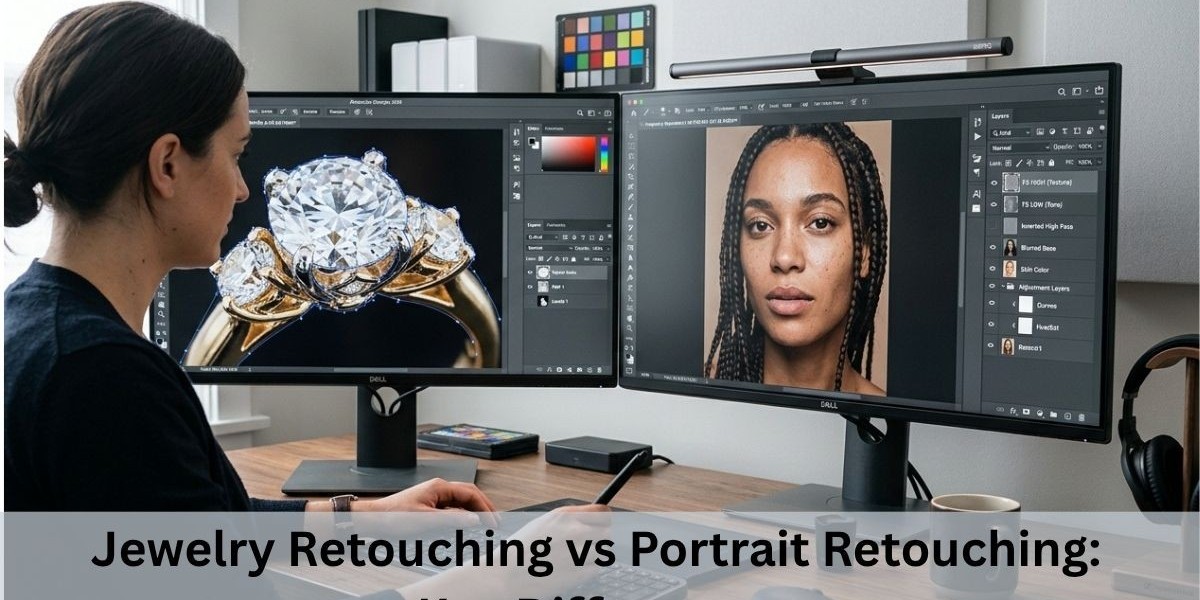

In the professional photography and digital post-production arena, image editing is not a uniform art. While all types of retouching can produce engaging photographs, a different approach is needed to retouch images of non-human luxury items as compared to human features. When considering high-end jewelry retouching services, brands need to be aware that it involves technical precision at a micro level that is distinct from facial retouching services.
Although both niches have the same goal — visual excellence — their underlying philosophies, software applications, and pricing are at opposite ends of the creative spectrum. Knowing these important differences is essential for commercial photographers, e-commerce businesses, and agency managers seeking to make the best post production investment and promote their visual brand.
Core Objectives: Physical Perfection vs. Human Authenticity
Businesses that invest in a professional photo retouching service have different goals when dealing with different types of photos:
Jewelry Retouching Objectives: Jewelry editing aims for ultra-flawless structural perfection. When viewing metal surfaces, viewers would expect them to be completely dust free, free of scratches, grease or unwanted reflections from the camera. The light facets, light refractions, and color saturation of every diamond or coloured gemstone needs to be incredibly sharp, crisp and accurate. Since the online jewelry purchasing experience is dependent on consumer trust, the retouched image needs to provide a sleek and luxurious look without compromising on the physical aspects of the jewelry.
Portrait Retouching Objectives: Mood, emotion and organic realism are the keys of portrait and beauty editing. The idea is to accentuate the natural beauty and to soften any imperfections that need to be camouflaged, such as skin blemishes, stray hair and skin redness. The difference between the novelty of inanimate luxury products and a human face is that over-editing an image of the latter will remove authenticity and add a “fakeness” that will disconnect the viewer from the subject.
Jewelry vs. Portrait Retouching: How the Workflows Differ
The technical delivery of these two art forms demonstrates the difference in the technical requirements of the arts that they represent:
1. Focus Stacking vs. Frequency Separation
One of the key challenges with macro jewelry photography is that it is inherently extremely shallow depth of field. A single camera shot of the ring or brooch rarely will capture the entire piece in crisp detail. Professional jewelry retouching services overcomes this, by taking dozens of focus-stacked shots to create a razor sharp composite image. When merged, retouchers are able to restore metal highlights and fine-tune reflection control.
The other type of portrait retouchers, however, heavily use Frequency Separation. This advanced technique filters out an image into high frequency details (skin texture, pores, fine lines) and low frequency details (color, tone, shading). This will make it easier for editors to correct any patchy skin tones without losing the natural texture of the skin
2. Metal Polishing vs. Dodge & Burn
Metals are polished to remove micro abrasions, restore lost specular highlights and to add custom vector gradients for a smooth liquid shine of gold, silver or platinum.
When taking portraits, shape and form are created by the use of Dodge & Burn (selective lightening and darkening). Retouchers make small micro dodge and burn passes to contour the cheekbones, to help highlight the eyes, and for shadow balance to give the face a nice, even look without changing facial features.
The Photoshop Tools Retouchers Use for Jewelry and Portraits
Although Adobe Photoshop serves as the primary workspace for both specialties, the underlying tools and methods differ substantially:
| Feature / Technique | Jewelry Retouching | Portrait Retouching |
| Primary Pathing Tool | Pen Tool (Vector Paths for sharp edges) | Lasso & Healing Tools (Soft, organic selection) |
| Detail Enhancement | High-Pass Sharpening & Focus Stacking | Frequency Separation & Texture Sampling |
| Shape Correction | Symmetrical Alignment & Surface Rebuilding | Liquify Tool (Subtle facial & hair adjustments) |
| Color Calibration | Exact Metal & Gemstone Color Matching | Skin Tone Grading & Eye-Color Enhancement |
Jewelry editors spend a lot of time to cut out the small prongs, chain links, and gemstone bezels from backgrounds with clean vector paths. Portrait editors use soft-edged brushes, pressure sensitive tablets and custom colour palettes for organic human skin tones, in contrast.
Jewelry vs. Portrait Retouching: What Drives the Cost?
The pricing structures are based on the amount of labor required, the quantity and artistic choice in the disciplines.
How Much Does Jewelry Retouching Cost?
The usual commercial jewelry retouching serviceservices for jewelry retouching are tiered/dollar per image:
Standard E-Commerce ($2 – $8 per image): Removal of backgrounds, basic dust removal, color corrections, and basic drop shadows are performed.
High-End / Luxury ($10 - $25+ per image): Special focus stacking, gemstone color grading, full reconstruction of metal surfaces and custom reflection generation.
Volume Rates: For catalog projects that are optimized for high volumes, volume rates are often available, which helps to minimize editing costs per unit.
How Much Does Portrait Retouching Cost?
Portrait and editorial retouching generally comes in at a price per photo or per hour, depending on the artistic level of the retouch:
Standard Headshots / Corporate ($5 - $15 per shot): Basic smoothing, teeth whitening, background cleaning, and stray hair removal.
High-End Beauty / Editorial ($20 – $50+ per image or $30 – $100/hr): Micro dodge and burn, custom skin tone balancing, complex masking of the hair, artistic color grading.
Jewelry work is extremely technical, with precise and accurate geometric execution, so it is typical to use specialized production labs for outsourcing. Portrait work, however, is more subjective and artistic, and often pays more per hour to an established editorial artist.
Final Thoughts
Understanding the specific technical requirements of jewelry and portrait photography allows you to ensure that your visual assets are in line with your in general brand requirements. Portrait retouching emphasizes the preservation of warmth and organic texture while high-quality jewelry retouching services require absolute mathematical precision, sharp vector pathing, and masterful light reflection management.
If you're looking to display your product lines with perfection and improve conversions, having a specialist editing partner is the answer. Whether you're an e-commerce retailer looking to showcase your products with a polished, professional look or a content creator needing an in-house image editor that performs under high pressure, Visuals Clipping is designed to meet the demands of high-end product photography and ensure that every image you share shines and exudes professionalism and authority.
Also Read: Natural Skin Retouching Guide 2026