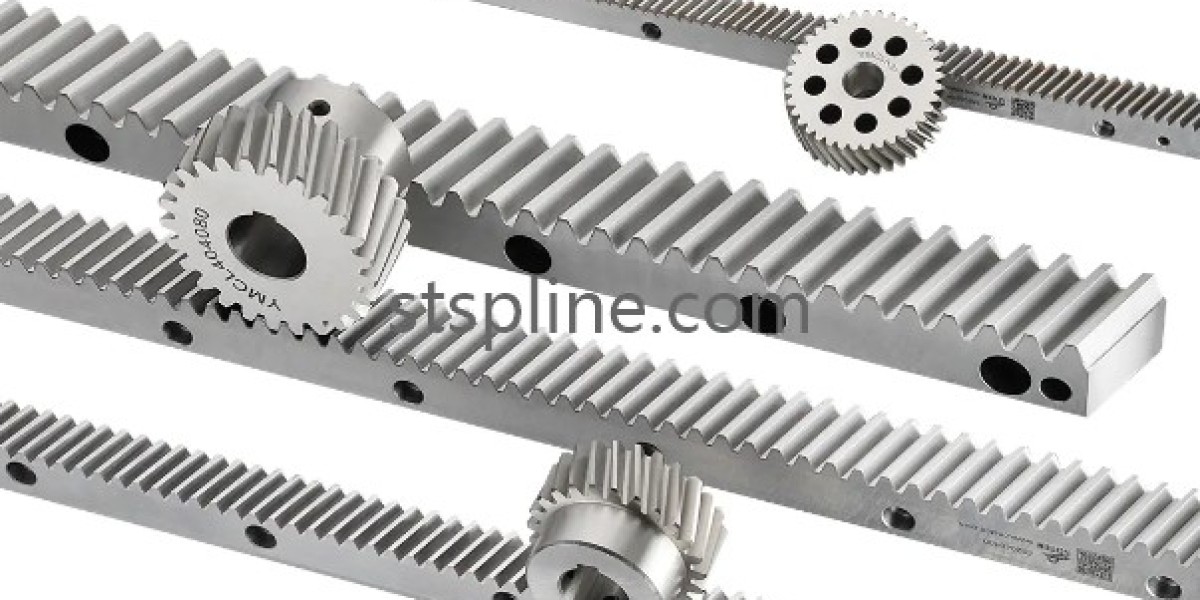

Metal transmission components are widely used in machinery that requires dependable force transfer, controlled movement, and stable mechanical engagement. A properly manufactured Metal Rack And Pinion assembly converts the rotary movement of a pinion into linear displacement along a toothed rack. The system can be integrated into CNC machine tools, laser cutting equipment, industrial robots, automated production lines, and material handling machinery. Its performance depends on several connected factors, including metal composition, tooth geometry, machining quality, mounting accuracy, and the operating conditions of the complete machine.
Steel is a common material for rack and pinion manufacturing because it combines mechanical strength with practical machining characteristics. Carbon steel can suit general industrial applications where load requirements and operating conditions are moderate. Alloy steel may be considered for applications involving higher loads, repeated movement, or more demanding wear requirements. Material selection should be based on transmission force, working speed, duty cycle, lubrication, and environmental exposure. The goal is to match the material properties to the actual application rather than choose a material based on strength alone.
The tooth profile is another important design consideration. Rack and pinion components must have compatible geometry to achieve suitable meshing and transfer motion consistently. Module, pressure angle, tooth spacing, and dimensional tolerances influence how the pinion engages with the rack. Inaccurate tooth geometry can create uneven contact, additional backlash, vibration, and accelerated wear. For machinery requiring repeatable positioning, the gear interface must also work with the motor, reducer, coupling, linear guide, and control system. Coordinated design helps avoid transmission problems that cannot be solved by changing a single component.
Manufacturing processes determine how accurately the intended geometry is produced. Depending on the product design, metal rack production may involve material cutting, blank machining, tooth milling, gear cutting, heat treatment, grinding, and surface finishing. Each process serves a particular purpose. Tooth machining establishes the engagement profile, while heat treatment may improve surface hardness or wear behavior when required. Grinding can be used for applications that need more refined tooth accuracy or surface quality. Process selection should reflect the specified tolerances, material, component length, and expected operating conditions.
A carefully engineered Metal Rack And Pinion system can support different mechanical layouts and travel requirements. Short racks may be suitable for compact machinery, while longer sections can support gantry equipment and extended linear axes. Where several rack sections are joined, the mounting arrangement and connection geometry need careful attention. Poor alignment between sections can produce inconsistent tooth engagement and changes in movement resistance. A stable machine frame, accurately prepared mounting surfaces, and appropriate fastening methods help maintain the intended transmission path throughout the operating range.
Metal rack drives serve a broad range of industrial applications. CNC routers and machining centers use linear transmission systems to move machine axes. Laser cutting equipment relies on coordinated motion to follow programmed cutting paths. Automated assembly lines use mechanical drives to position fixtures, tools, and workpieces. Robotic transfer systems and gantry manipulators require predictable travel to support repeated handling operations. Each application has its own requirements for speed, load, positioning accuracy, and environmental protection, so the transmission assembly should be selected as part of the complete mechanical design.
Quality control helps verify that finished components are suitable for assembly and operation. Relevant checks may include material verification, hardness testing where specified, tooth profile inspection, pitch measurement, straightness checks, surface condition, and mounting dimensions. Inspection criteria should be agreed upon before production, particularly when components are manufactured to customer drawings. Consistent measurements and clear technical documentation help buyers evaluate dimensional conformity and reduce the risk of installation problems. For customized components, communication between the design team and manufacturer is essential when tolerances or interface dimensions require clarification.
Maintenance practices also influence service life. Rack and pinion teeth should be kept free from excessive chips, abrasive dust, and other contaminants. Appropriate lubrication helps reduce friction and contact wear, while periodic inspection can reveal unusual noise, uneven tooth contact, loosened fasteners, or increased backlash. Alignment should be checked after installation and whenever machine structures or transmission components are replaced. Maintenance frequency depends on operating speed, load, working environment, and production intensity.
For equipment manufacturers, selecting a metal transmission supplier involves reviewing machining capability, material options, dimensional inspection, customization support, and production consistency. SOTER supplies rack and pinion products for industrial machinery and automated motion systems, supporting applications that require coordinated mechanical transmission. Engineers and purchasing teams can explore available straight-tooth rack configurations at https://www.stspline.com/product/straight-teeth-rack/ and assess their suitability for specific equipment designs and operating requirements.