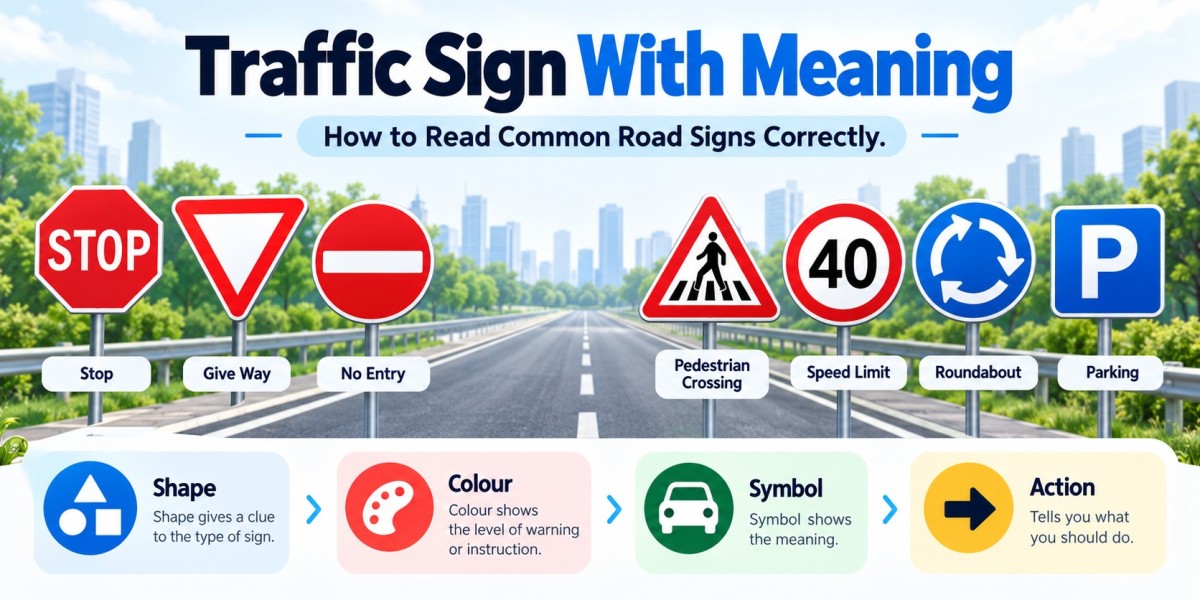

Understanding a traffic sign with meaning is about more than recognising a shape or colour. Good drivers learn to read the full message of a sign, connect it with the road around them, and decide what action is required before they reach the hazard, junction, restriction, or change in traffic conditions.
That is why learning road signs properly is useful for both theory-test preparation and everyday driving. A sign may tell you to stop, give priority, reduce speed, avoid a road, follow a direction, or prepare for something ahead. The challenge is knowing which message applies and how quickly you need to respond.
Start With the Shape Before Reading the Symbol
One of the quickest ways to understand road signs is to notice their shape first.
Although exact designs vary by country, many road systems use familiar patterns. Triangular signs often warn drivers about hazards ahead. Circular signs commonly communicate restrictions, prohibitions, or mandatory instructions. Rectangular and square signs are frequently used for directions, services, parking, or other information.
A Stop sign is a good example of why shape matters. Its unusual outline helps drivers recognise the instruction quickly, even before reading the word.
When studying a traffic sign with meaning, ask yourself three questions:
What is the shape telling me?
What does the symbol represent?
What action should I take?
That habit makes sign recognition faster and more practical.
Colour Helps You Understand the Type of Message
Colour is another clue.
Red is often connected with restrictions, prohibitions, warnings, or instructions that require immediate attention. Blue may indicate mandatory movement, permitted directions, parking, or information depending on the sign system. Yellow can be associated with warnings or priority in some countries, while green is often used for route or motorway information.
Do not rely on colour alone, though.
A red border around a circular sign may show a restriction, but the symbol inside tells you exactly what is restricted. A blue circular sign may require a particular direction rather than simply provide information.
For theory-test preparation, learn the colour and symbol together.
Stop and Give Way Are Not the Same Instruction
These two road signs are often studied together because both deal with priority, but the required action is different.
A Stop sign normally requires the driver to come to a complete stop at the correct position before moving again when it is safe.
A Give Way or Yield sign tells the driver to give priority to other road users. Depending on the traffic situation and local rules, a complete stop may not always be necessary.
This distinction matters in real traffic. A learner who treats both signs exactly the same may misunderstand a theory question or react incorrectly at a junction.
The best way to remember them is not by shape alone. Think about what the driver must physically do.
Warning Signs Tell You What May Happen Next
Warning signs prepare you for a risk rather than simply telling you what is prohibited.
Common examples include:
Sharp bends
Roundabouts
Pedestrian crossings
Railway crossings
Slippery roads
Roadworks
Narrow roads
Intersections
Animals crossing
Steep gradients
If you see a bend warning, the sign does not necessarily tell you an exact speed. It tells you that the road ahead may require more careful steering, better observation, and possibly a lower speed.
This is a useful way to study any traffic sign with meaning: connect the sign with the driving decision it should trigger.
Prohibition Signs Need Careful Comparison
Some signs look almost identical except for one symbol, line, or additional plate.
No Entry, No U-turn, No Overtaking, and vehicle-restriction signs may all use similar red-and-white design elements, but their meanings are very different.
Do not memorise them as “red signs.”
Look at the symbol inside.
A barred motorcycle may restrict motorcycles. A height figure may limit vehicles above a specified height. A turning arrow crossed by a red bar may prohibit that movement.
Small details can completely change the meaning.
Road Signs Often Work With Additional Plates
One of the most overlooked parts of a road sign is the smaller plate underneath it.
An additional plate can tell you:
How far away a restriction begins
How long it continues
Which direction it applies
Which vehicle types are affected
What times the rule applies
Whether an exception exists
For example, a parking restriction may only apply during certain hours. A warning sign may tell you a hazard begins several hundred metres ahead.
Reading only the main sign can therefore give you an incomplete message.
Road Markings Can Change How You Read a Sign
Signs should rarely be interpreted in isolation.
At an intersection, the Stop or Give Way sign may be combined with a stop line, lane arrows, pedestrian crossing, or traffic lights.
On a multi-lane road, a direction sign may only apply to one lane.
Near roadworks, temporary signs and temporary lane markings may override the normal layout.
When studying road signs, practise reading the whole scene. Look at the sign, the road surface, lane position, nearby vehicles, traffic lights, and any additional plates.
The real question is not just “What is this sign called?” but “What does this sign mean here?”
Similar Signs Can Require Very Different Actions
Learners often make mistakes because they focus on appearance rather than function.
A warning sign for a pedestrian crossing is different from the marking that identifies the crossing itself. A sign showing a roundabout ahead is different from a mandatory roundabout direction sign. A minimum-speed sign is different from a maximum-speed sign even though both may show a number.
Comparing similar signs side by side is one of the fastest ways to improve recognition.
Instead of studying 50 signs separately, group related signs and ask how the required driver response changes.
Country Rules Still Matter
Not every traffic sign has exactly the same design or legal meaning in every country.
International conventions have helped make many signs look similar, especially across Europe and other regions using related standards, but national and local rules still matter.
A familiar symbol may use a different colour, wording, shape, or legal interpretation somewhere else.
This is particularly important when travelling abroad or studying for a country-specific driving theory test.
Use general sign knowledge as a foundation, then confirm the exact local rule.
A Simple Method for Reading Any Road Sign
When you meet an unfamiliar sign, do not panic. Break it down.
First, identify the category from the shape and colour.
Next, read the symbol, number, or wording.
Then check whether there is an additional plate.
Finally, look at the road around the sign and decide what action is required.
That action may be to slow down, stop, give priority, change lane position, avoid a manoeuvre, follow a direction, or simply prepare for a hazard.
This method turns sign recognition into practical driving knowledge.
Learn the Message, Not Just the Name
The real purpose of studying a traffic sign with meaning is not to collect sign names. It is to understand what the road is telling you before you need to react.
A driver who recognises a symbol but does not know what action follows has only learned half the lesson.
Study road signs by category, compare signs that look alike, pay attention to additional plates, and practise reading signs together with road markings and traffic conditions.
For more examples, country-specific signs, sign categories, and explanations, visit the Traffic Signs & Signals guide and use it as a reference while preparing for your driving theory test or reviewing everyday road rules.







