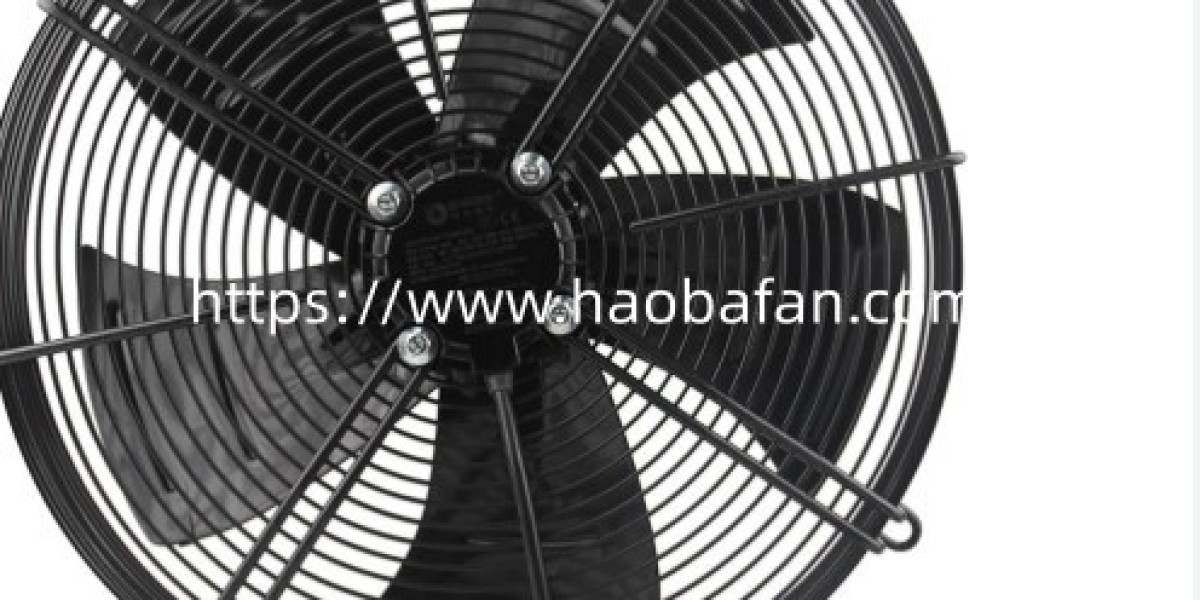

Compact ventilation equipment can be valuable when an application requires direct air movement but offers limited installation space. An External Rotor Axial Fan combines an external rotor motor arrangement with an axial impeller, allowing the motor and airflow-producing assembly to be integrated into a relatively compact structure. The resulting equipment can support ventilation and cooling applications where space, airflow direction, and mechanical stability all need to be considered.
Axial fans move air mainly along the central axis of the rotating impeller. This makes them suitable for applications involving direct air circulation, exhaust, equipment cooling, and ventilation through relatively open airflow paths. Combining this principle with an external rotor motor can help create an assembly in which the motor is closely integrated with the impeller rather than occupying a separate external drive arrangement.
Blade engineering has a direct influence on airflow behavior. Blade angle, curvature, spacing, and surface condition affect how efficiently the rotating assembly moves air. Consistent blade construction is important because differences between individual blades may influence airflow distribution and rotational balance. Manufacturing processes should therefore maintain control over forming, positioning, attachment, and inspection.
The external rotor motor also requires careful construction. The rotor surrounds the stator and rotates as part of the motor assembly, creating an integrated arrangement that can reduce the space required for the complete fan structure. Correct alignment and secure component connections are essential for stable rotation. Electrical insulation, connection quality, and motor protection should also correspond with the intended application environment.
Thermal management is another important consideration. Electrical motors generate heat during operation, and ventilation equipment may be required to operate continuously. The integrated structure should provide an appropriate path for heat dissipation while maintaining stable mechanical operation. Environmental temperature, surrounding airflow, installation position, and operating schedule can all influence thermal conditions.
Balancing becomes particularly important because the motor and impeller operate as a closely coordinated rotating system. Any uneven distribution of mass may produce vibration. Excessive vibration can affect bearings, mounting points, fasteners, and surrounding structures. Accurate component manufacturing and appropriate balancing procedures can therefore contribute to smoother operation and reduced mechanical stress.
Noise performance depends on both aerodynamic and mechanical factors. Blade movement naturally creates airflow sound, while motor operation and vibration can contribute additional noise. Housing resonance may further amplify sound if structural components are insufficiently supported. Proper blade geometry, accurate balancing, secure mounting, and suitable airflow pathways can help control unnecessary operating noise.
Protective components are important for axial fan installations because the rotating blades may be accessible during operation. Guards can help reduce the possibility of accidental contact while maintaining an appropriate airflow opening. Mounting structures should also provide adequate support, particularly where the fan is installed on walls, panels, ducts, or equipment housings.
Maintenance requirements should not be overlooked when choosing compact fan equipment. Dust and debris can collect on the blades and housing, potentially affecting airflow and balance. Periodic inspection can identify loose fasteners, damaged guards, corrosion, unusual vibration, and abnormal sounds. Maintenance access should be considered during system design so that cleaning and inspection can be performed efficiently.
Applications can include equipment cooling, air-conditioning systems, refrigeration equipment, electrical cabinets, industrial ventilation, commercial air circulation, and agricultural facilities. Selection should take into account airflow direction, installation space, environmental exposure, operating conditions, and the surrounding system.
For buyers comparing an External Rotor Axial Fan, manufacturing quality is as important as compact construction. Impeller consistency, motor integration, balancing, housing strength, thermal management, protective design, and maintenance accessibility should all be evaluated together. Taizhou Haoba Electromechanical Co Ltd. provides ventilation equipment for different industrial air movement applications, with further information available at https://www.haobafan.com/product/mixed-flow-fan/ for customers reviewing compact axial airflow solutions.