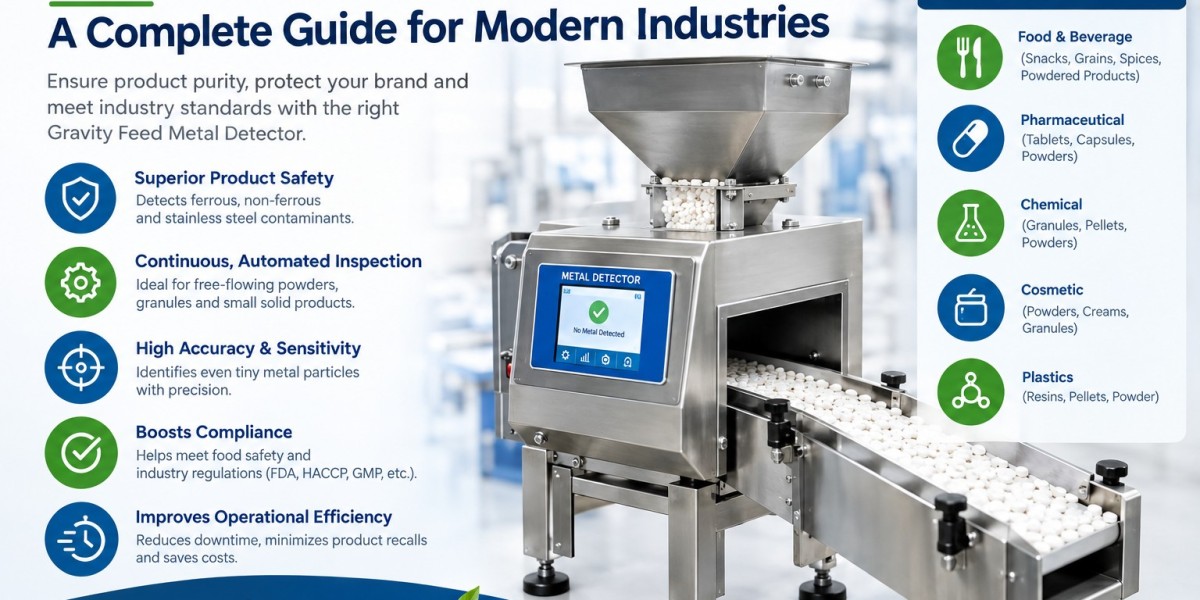

Metal contamination can create serious problems for businesses involved in food processing, pharmaceuticals, plastics, chemicals, and other industries. A reliable gravity feed metal detector can help identify unwanted metal particles before contaminated products reach customers or damage production equipment. However, with many models available, choosing the right system requires careful consideration of your production needs, product characteristics, and operating environment.
Understand Your Product
The first step is to understand the material that will pass through the metal detector. Gravity feed systems are commonly used for free-falling products such as powders, granules, seeds, grains, and small food products.
Consider whether your product is dry, wet, sticky, dusty, or oily. Product characteristics can affect detection performance and may require a detector specifically designed to minimize false alarms. Understanding the size, density, and flow rate of your product will also help you select an appropriate system.
Consider Detection Sensitivity
Detection sensitivity is one of the most important factors when selecting a gravity feed metal detector. The system should be capable of detecting the smallest metal contaminants that could affect product safety or quality.
Look for equipment capable of identifying different types of metal, including ferrous, non-ferrous, and stainless-steel contaminants. The required sensitivity will depend on your product, application, and industry standards. A supplier should be able to explain the expected detection performance for your specific application.
Check the Throughput Requirements
Every production facility has a specific processing speed. Before purchasing a detector, determine how much material passes through the production line per minute or hour.
Choosing a system that cannot handle your required throughput may create bottlenecks and reduce productivity. On the other hand, an unnecessarily large system could increase equipment costs. Select a detector that matches your actual production requirements while allowing some room for future expansion.
Evaluate Construction and Hygiene
For food, pharmaceutical, and other hygiene-sensitive industries, construction quality is particularly important. A gravity feed metal detector should be manufactured using durable, easy-to-clean materials and should have a design suitable for the production environment.
Look for features such as stainless-steel construction, smooth surfaces, hygienic connections, and minimal areas where product or dust can accumulate. If the detector will operate in a demanding environment, consider its resistance to moisture, temperature changes, dust, and cleaning chemicals.
Look at Rejection Systems
Detecting contamination is only part of the process. The system must also provide an effective way to remove contaminated material from the production stream.
Different applications may require different rejection mechanisms. The best choice depends on product characteristics, flow rate, and the level of contamination control required. A reliable rejection system should operate quickly and accurately without unnecessarily interrupting production.
Consider Installation and Integration
Your metal detector should integrate smoothly with the existing production line. Before purchasing, check the available installation space, pipe or chute dimensions, product flow direction, and connection requirements.
A compact system can be particularly useful where production space is limited. It is also important to consider how the detector will connect with upstream and downstream equipment, control systems, and collection or rejection equipment.
Review Controls and User-Friendly Features
Modern metal detectors often include digital control panels that make setup, monitoring, and maintenance easier. Look for an intuitive interface that allows operators to adjust settings, monitor detector performance, and review alarms.
Features such as password protection, automatic product setup, data recording, and performance monitoring can improve operational control. Easy-to-understand controls can also reduce training requirements for production staff.
Choose a Reliable Supplier
The quality of the supplier is just as important as the equipment itself. Choose a manufacturer or supplier with experience in your industry and a strong understanding of metal detection applications.
Ask about installation assistance, operator training, spare parts, calibration, maintenance, and after-sales technical support. Reliable support can help minimize downtime and maintain consistent detection performance throughout the equipment's operating life.
Compare Total Cost of Ownership
Price should not be the only consideration when choosing a gravity feed metal detector. A lower-cost system may become expensive if it requires frequent maintenance, produces excessive false rejects, or lacks dependable technical support.
Compare equipment quality, energy consumption, maintenance requirements, spare parts availability, warranty coverage, and expected service life. Investing in a suitable system can provide better long-term value and help protect your production process.
Conclusion
Choosing the best gravity feed metal detector requires more than comparing equipment prices. Businesses should evaluate product characteristics, detection sensitivity, throughput, construction, rejection methods, installation requirements, controls, and supplier support.
By carefully matching the detector to your production requirements, you can improve contamination control, protect product quality, reduce production risks, and maintain a more efficient manufacturing operation. The right metal detection system is ultimately an investment in both product safety and long-term business reliability.