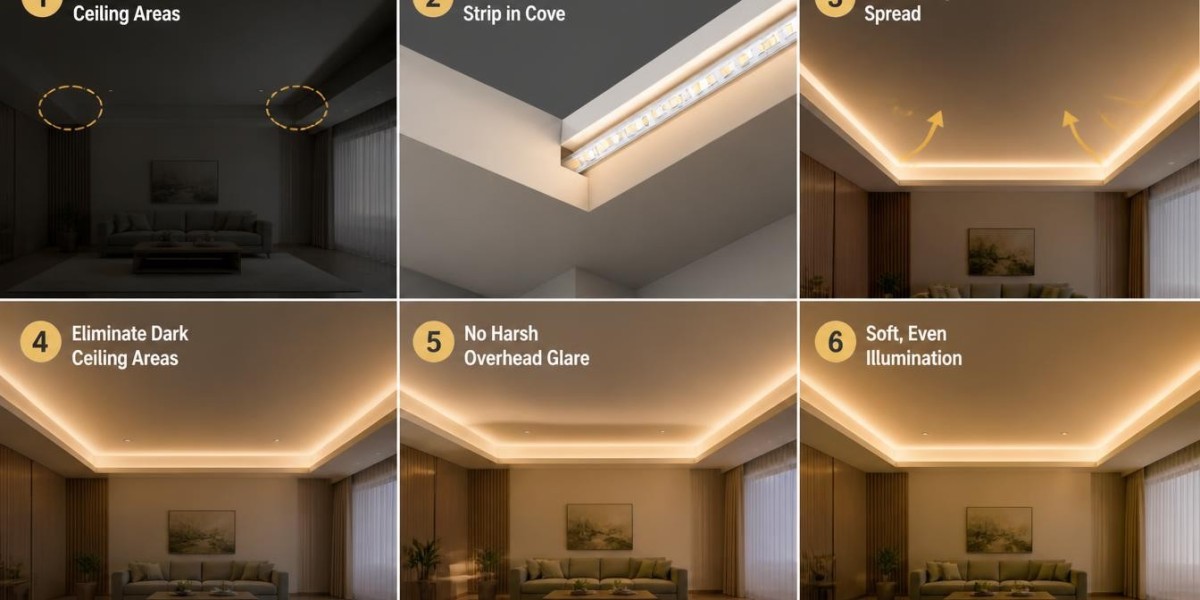

Darker ceiling zones give rise to a sense of imbalance in a room. Cove lighting LED strip lights install light closer to the ceiling periphery, making the ceiling distribute light more softly.
Why Is There A Need For Indirect Lighting For Darker Ceiling Zones?
The advantage of cove lighting LED strip lights is regulated brightness. Rather than illuminating occupants with bright light, the strip guides light towards the ceiling or upper wall surfaces.
This helps hide the source and make the ceiling serve as the main reflective plane.
IES describes cove lighting as a hidden source that diffuses light over ceilings and upper wall surfaces.
Consequently, there will be a well-lit ceiling plane but no fixture visible.
What Are Cove Lighting LED Strip Lights?
They are flexible or rigid linear LED sources installed inside a recessed ceiling detail. Many systems use an aluminum channel for straight installation.
Different versions suit different ceiling problems. These are common choices:
Single-color strips for steady ambient ceiling illumination
Tunable-white strips for adjustable color appearance
RGB or RGBW strips for decorative effects
High-density strips for smoother light with fewer visible points
Selection depends on ceiling height, cove depth, brightness, controls, and viewing angles.
Which Features Help Prevent Harsh Glare?
Placement matters more than simply choosing a bright strip. Indirect illumination occurs when the ceiling receives the light first and reflects it into the room.
Glare can appear when LEDs sit too close to the cove lip or remain visible from seating positions.
IES recommends aligning the cove lip with fixture height and allowing enough space for the intended ceiling wash.
A matte white ceiling can distribute light smoothly. Reflective surfaces may reveal LED sources or create bright images.
CIRC Lighting can specify dimmable strips when softer evening output is needed without losing ceiling definition. This also supports glare reduction when brightness is carefully controlled.
How Do Different Strip Options Compare?
The table below shows how common strip types can address dark ceiling zones.
Strip Type | Best Use | Main Benefit | Key Consideration |
Single-color | General ceiling glow | Simple and consistent | Fixed light color |
Tunable white | Flexible rooms | Adjustable color appearance | Compatible controls required |
RGB/RGBW | Decorative ceilings | Color effects | More complex control |
High-density | Smooth ceiling wash | Fewer visible LED points | Heat management matters |
LED technology supports efficient operation, but system design also affects performance. DOE explains that LED source efficacy and luminaire design both influence electricity use.
How Should You Install Them For An Even Ceiling Wash?
Start with the ceiling detail. The cove needs enough depth and width for light to reach the intended surface without exposing LEDs.
Follow this sequence for an effective installation:
1. Measure the cove length and identify the driver location.
2. Confirm strip voltage, wattage, and driver capacity.
3. Install an aluminum channel or suitable heat-management surface.
4. Position the strip so LEDs stay hidden from normal viewpoints.
5. Keep runs straight and maintain consistent spacing around corners.
6. Connect compatible dimming or control equipment.
7. Test the ceiling wash before closing or finishing the cove.
IES also recommends sufficient installation access and using mock-ups when the visual effect is important.
How Do Cove Dimensions Affect Light Distribution?
Cove dimensions directly affect how evenly light reaches the ceiling. A shallow cove can expose LEDs or create bright spots.
The strip needs enough separation from the ceiling surface to spread light before it reaches the room. The cove lip should also hide the LED source from normal viewing angles.
Before installation, check these details:
Cove depth: Provides space for the strip to direct light toward the ceiling.
Cove height: Helps keep the LEDs hidden from common viewing positions.
Ceiling distance: A greater distance can produce a wider and softer light spread.
Surface finish: Light-colored matte ceilings generally reflect light more evenly.
Viewing angle: Check the room from seated and standing positions before fixing the strip.
A quick test can reveal problems early. Temporarily position the strip and observe the ceiling from several points around the room.
Final Remarks
The dark spots on ceilings require better light distribution than a brighter ceiling fixture. Cove lighting LED strip lights can provide controlled illumination by providing the right illumination from an inconspicuous source. The best results come from choosing the right cove dimensions, strip output, heat management, compatible controls, and testing before final installation.