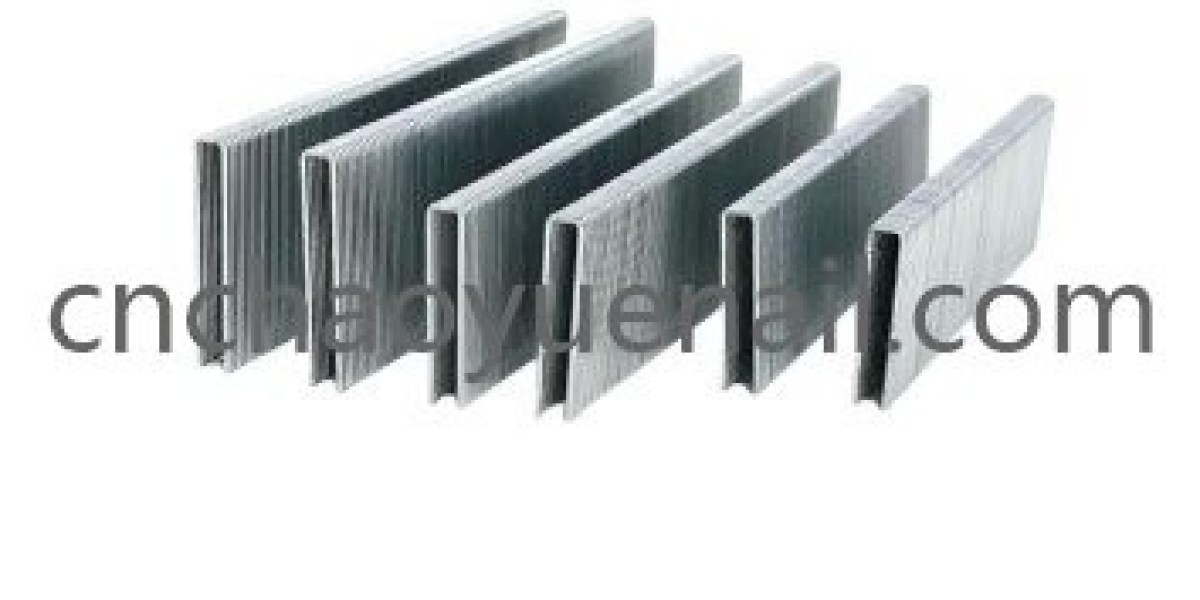

Consistent staple production requires close control over steel material, wire preparation, forming accuracy, and finished-product inspection. 80 Staples represent a fastening product category where manufacturing consistency is important for professional users who depend on predictable handling and compatibility with suitable installation equipment. From incoming steel inspection to automated forming and final packaging, each stage can influence the quality and usability of the finished fastener.
Raw-material management provides the foundation for stable production. Steel wire used for staple manufacturing should have consistent characteristics and a suitable surface condition before processing begins. Manufacturers can inspect incoming material to identify potential variations that may affect drawing, straightening, or forming. Maintaining controlled raw-material sources also improves traceability and helps production teams investigate quality variations when they occur.
Wire drawing prepares steel for subsequent manufacturing operations by creating a more controlled and uniform wire condition. The process requires appropriate equipment settings and lubrication to manage friction and maintain surface quality. Once drawing is completed, straightening equipment prepares the wire for automated feeding. Stable straightness is important because forming machines rely on controlled wire movement to produce repeatable staple geometry.
The forming stage combines feeding, cutting, bending, and shaping operations. Automated machines can perform these actions continuously while maintaining a synchronized production sequence. Forming dies and cutting components must be accurately positioned because the finished crown and legs depend on the interaction between the wire and tooling. Consistent machine operation helps reduce variation and supports more efficient high-volume production.
Production tooling requires ongoing attention because repeated mechanical contact can gradually change the condition of cutting and forming surfaces. Tool wear may influence staple alignment, shape, and surface condition if it is not identified in time. Preventive maintenance provides a structured method for checking dies, cutters, guides, feeding mechanisms, and other critical components. Regular maintenance can help maintain production stability while reducing unexpected equipment interruptions.
Surface finishing is selected according to the characteristics required for the intended application. Appropriate treatment can improve surface condition and provide additional protection during transportation or storage. The finishing process should be monitored carefully to maintain uniformity and avoid visible defects. After treatment, quality checks can help identify irregular surfaces, contamination, or incomplete processing before the products enter the packaging stage.
Compatibility with fastening tools is a practical consideration for many professional users. Pneumatic and electric stapling equipment generally depends on consistent fastener geometry and reliable feeding behavior. Variations in staple shape or alignment can affect how fasteners move through a compatible tool. Controlled forming therefore contributes not only to product appearance but also to smoother installation and more predictable positioning during repetitive assembly operations.
Quality control can be organized across multiple manufacturing stages. Incoming material checks help verify steel consistency, while in-process monitoring can identify changes in wire feeding and forming behavior. Finished products can be inspected for shape, alignment, surface condition, and packaging quality. Automated vision systems may assist with detecting visible defects during continuous production, while sampling and documented batch inspection provide additional verification.
Packaging should protect the staples while supporting efficient storage and distribution. Correct sorting and labeling help prevent different products from becoming mixed during warehouse handling. Suitable packaging can also reduce unnecessary exposure to moisture, dust, and mechanical damage. For distributors and industrial buyers, clear identification and batch information make inventory organization more efficient and support traceability throughout the supply chain.
Manufacturing efficiency is closely related to process stability. Accurate wire feeding and controlled forming can reduce unnecessary material waste, while monitoring equipment performance helps identify sources of production variation. Steel offcuts and other suitable scrap may be directed into recycling systems. Maintaining forming equipment also helps reduce defective output caused by worn components, allowing manufacturers to use raw materials and production time more efficiently.
Application requirements should guide fastener selection rather than relying on a single product characteristic. Buyers may need to consider the material being joined, compatible installation equipment, environmental exposure, surface requirements, packaging preferences, and overall workflow. When 80 Staples are selected for professional assembly, consistent steel processing and controlled forming provide an important basis for reliable handling. More information about available steel fasteners and manufacturing capabilities can be found at https://www.cnchaoyuenail.com/product.







