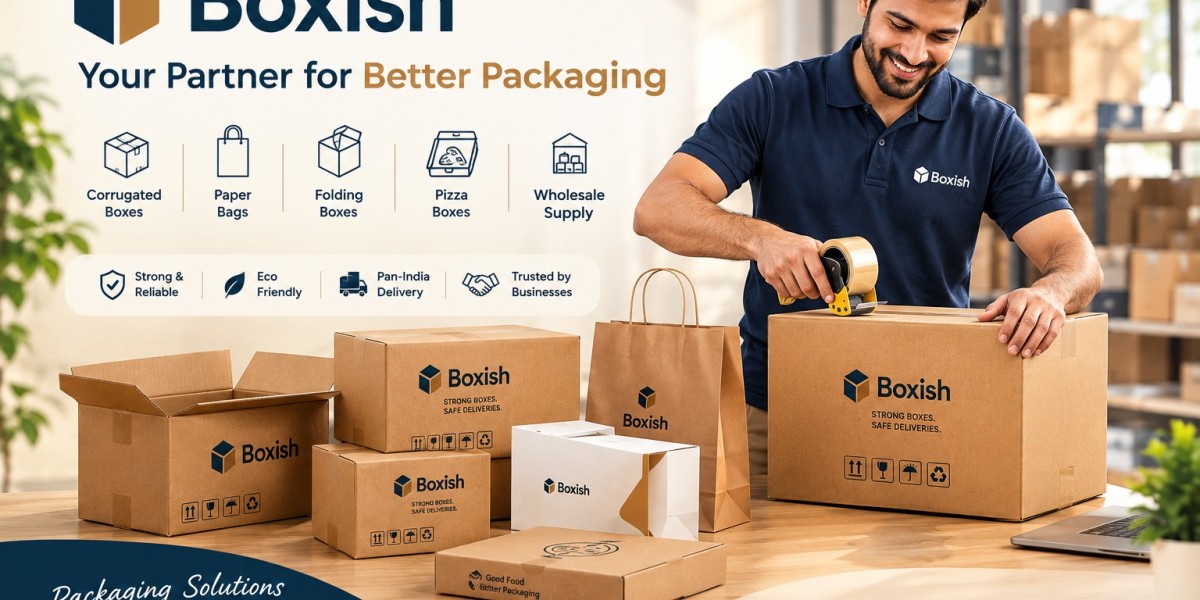

Choosing a reliable packaging supplier is an important decision for businesses that purchase corrugated boxes in large quantities. Packaging affects product protection, warehouse operations, shipping, inventory planning, and overall fulfilment efficiency.
Before placing a large order, businesses should understand exactly what they are purchasing. Paper quality, ply construction, box dimensions, manufacturing consistency, customization, lead time, and order quantity can all affect how the packaging performs.
Working with a suitable corrugated box manufacturer can also make it easier for businesses to maintain consistent packaging specifications across regular orders. However, businesses should ask the right questions before committing to a large purchase.
This guide explains the important questions businesses should consider when evaluating a manufacturer for their packaging requirements.
Why Businesses Should Evaluate a Corrugated Box Manufacturer Carefully
Large packaging orders are different from occasional purchases.
When a business orders hundreds or thousands of boxes, even a small difference in dimensions or material quality can affect daily operations.
Packaging problems may lead to:
Product damage
Difficult packing
Storage issues
Delayed order fulfilment
Packaging shortages
Excessive material usage
Inconsistent product presentation
Before placing a bulk order, businesses should therefore evaluate both the product and the manufacturing process.
The goal is to find packaging that matches the product requirements and can be supplied consistently over time.
What Type of Corrugated Boxes Does the Manufacturer Produce?
The first question should be about the manufacturer's product range.
Businesses may require different box constructions depending on their products and shipping conditions.
Ask whether the manufacturer produces:
3-ply boxes
5-ply boxes
Standard shipping boxes
Custom-size boxes
Printed boxes
Retail packaging
Heavy-duty packaging
Product-specific packaging
A manufacturer with different options may be able to support changing packaging requirements as the business grows.
What Paper Quality and GSM Are Used?
Paper quality plays an important role in the performance of corrugated board.
GSM, or grams per square metre, indicates the weight of the paper used in the construction.
However, businesses should not evaluate packaging based only on GSM.
Ask the manufacturer about:
Liner paper quality
Paper GSM
Flute structure
Ply construction
Paper combination
Board specifications
Manufacturing standards
A box with suitable paper specifications should be selected according to the actual product and handling conditions.
What Ply Is Suitable for the Product?
Businesses often need to decide between different ply constructions.
3-Ply Boxes
3-ply construction generally consists of two liner layers and one fluted layer.
It can be suitable for many lightweight and moderately weighted products.
5-Ply Boxes
5-ply construction contains additional layers and can provide greater structural support for more demanding applications.
It may be considered for:
Heavy products
Larger packages
Higher stacking requirements
Long-distance transportation
Industrial applications
The manufacturer should be able to explain which construction is appropriate for the product rather than simply recommending the thickest option.
Can the Manufacturer Provide Custom Box Sizes?
Standard boxes may not fit every product efficiently.
A box that is too large can create unnecessary empty space, while an undersized box can make packing difficult.
Businesses should ask whether the manufacturer can produce custom dimensions according to their requirements.
Custom sizes can be useful for:
Ecommerce products
Product kits
Retail merchandise
Industrial components
Subscription shipments
Multi-product orders
Before confirming a custom order, businesses should provide accurate product dimensions and consider the space required for internal protection.
Can the Manufacturer Provide Consistent Dimensions?
Consistency becomes particularly important when businesses reorder packaging regularly.
If the dimensions change between batches, employees may find it difficult to follow established packing processes.
Businesses should ask how the manufacturer maintains consistency in:
Length
Width
Height
Board construction
Folding
Joint quality
Overall finish
Consistent dimensions can make packaging operations easier to standardize.
Can the Manufacturer Provide Samples?
Businesses should ideally test packaging before placing a large order.
Ask whether the manufacturer can provide samples or a small trial quantity.
The sample can be tested with the actual product for:
Product fit
Box strength
Assembly
Closing
Sealing
Handling
Stacking
Internal protection
Testing the actual product is more useful than evaluating the box only by appearance.
What Is the Minimum Order Quantity?
Minimum order quantity can vary between manufacturers and product types.
Businesses should ask about the minimum quantity for:
Standard boxes
Custom sizes
Printed boxes
Special constructions
Different ply options
Understanding the MOQ helps businesses plan purchases according to their storage capacity and actual packaging consumption.
A growing business should avoid ordering significantly more packaging than it can reasonably store and use.
What Is the Production Lead Time?
Lead time is important when packaging is required regularly.
Ask how long the manufacturer normally needs to produce and prepare an order.
Lead time may vary depending on:
Order quantity
Box size
Customization
Printing
Production schedule
Material availability
Businesses should consider lead time when deciding how much packaging inventory to maintain.
Waiting until packaging completely runs out before placing a new order can create unnecessary fulfilment problems.
Can the Manufacturer Handle Regular Bulk Orders?
A business with recurring packaging requirements needs more than a one-time supplier.
Ask whether the manufacturer can support regular orders and maintain the same specifications over time.
Businesses should discuss:
Expected monthly quantity
Seasonal demand
Reorder frequency
Production capacity
Lead times
Specification consistency
A clear understanding of future requirements can make packaging inventory easier to manage.
What Printing and Customization Options Are Available?
Businesses may want packaging that includes branding or product information.
Ask the manufacturer about available customization options, such as:
Logo printing
Brand name
Product information
Handling instructions
Custom colors
Custom dimensions
Printing requirements should be finalized before production because they can affect both lead time and pricing.
Businesses should also request a sample or proof when accurate branding is important.
How Does the Manufacturer Handle Quality Control?
Quality control is especially important for large packaging orders.
Businesses should ask how the manufacturer checks finished boxes before dispatch.
Relevant quality checks may include:
Box dimensions
Board construction
Folding accuracy
Joint strength
Printing quality
Surface condition
Batch consistency
A consistent inspection process can help reduce variations between production batches.
How Does the Manufacturer Handle Packaging Specifications?
Businesses that reorder the same box should maintain a clear specification.
This may include:
Box dimensions
Ply
Paper GSM
Flute construction
Printing
Box style
Quantity
Ask the manufacturer whether these specifications can be maintained for future orders.
This is particularly important when packaging is used for products that require a consistent fit.
What Delivery Coverage Is Available?
Businesses should also ask about delivery arrangements.
Important questions include:
Where does the manufacturer deliver?
What is the expected delivery time?
Is delivery available for bulk orders?
How are large quantities packed for transportation?
Are shipping charges included or separate?
Understanding delivery arrangements before ordering can help businesses plan inventory more effectively.
Can the Manufacturer Supply Additional Packaging Materials?
Businesses often require more than one type of packaging material.
Depending on the product, they may also need protective materials or packaging components for different stages of packing and shipping.
For example, businesses may use Corrugated Sheets for separation and additional protection inside larger packages.
Having access to related packaging materials can make purchasing and inventory management more convenient.
Is Flexible Protective Packaging Available?
Some products have irregular shapes or sensitive surfaces that require flexible protection.
A Corrugated roll can be used for wrapping products, protecting edges and surfaces, or adding another protective layer before items are placed inside boxes.
Businesses handling multiple product types may find flexible protective materials useful alongside standard boxes.
How Should Businesses Compare Pricing?
Price is naturally an important part of a bulk packaging purchase, but it should not be the only consideration.
Businesses should compare the overall packaging cost, including:
Price per box
Printing
Customization
Delivery
Storage
Additional protective material
Product damage
Replacement costs
A slightly higher-priced box may provide better value if it fits the product properly and performs consistently.
The objective should be to compare overall value rather than simply selecting the lowest unit price.
What Happens if There Is a Quality Problem?
Before placing a large order, businesses should understand the manufacturer's process for handling quality issues.
Ask about:
Damaged boxes
Incorrect dimensions
Printing errors
Quantity shortages
Manufacturing defects
Replacement procedures
Complaint handling
Having clear communication about quality issues can reduce uncertainty when placing recurring orders.
Common Mistakes When Choosing a Manufacturer
Choosing Only by Price
The cheapest supplier may not provide the required quality or consistency.
Ordering Without Testing
A sample should be checked with the actual product before committing to a large quantity.
Ignoring Lead Time
Businesses can face packaging shortages if they do not account for production and delivery time.
Not Confirming Specifications
Dimensions, ply, paper quality, printing, and quantity should be clearly confirmed before production.
Ordering More Than the Business Can Store
Bulk purchasing should be balanced with available storage capacity and actual consumption.
Changing Specifications Without Testing
A small change in material or construction can affect packaging performance.
Questions to Ask Before Placing the Final Order
Before confirming a large packaging purchase, businesses can use this checklist:
What box construction is recommended?
What paper GSM is being used?
What are the exact box dimensions?
Is the size customizable?
What is the minimum order quantity?
What is the production lead time?
Can samples be provided?
Can the same specifications be maintained for repeat orders?
What printing options are available?
How is quality checked?
What are the delivery arrangements?
How are quality issues handled?
Having answers to these questions can make the purchasing process more transparent.
How to Build a Long-Term Packaging Supply Process
Businesses with regular packaging needs should think beyond individual orders.
A simple packaging plan can include:
Product Requirements → Box Specification → Sample Testing → Bulk Order → Quality Check → Inventory Monitoring → Reorder
This process can help businesses maintain suitable packaging availability without placing unnecessary emergency orders.
Businesses should also track the monthly consumption of each box size. This information can help estimate future requirements and determine when to reorder.
Final Thoughts
Choosing a corrugated box manufacturer requires more than comparing prices.
Businesses should evaluate paper quality, ply construction, dimensions, manufacturing consistency, customization, samples, minimum order quantities, lead times, quality control, delivery arrangements, and after-sales support before placing a large order.
The right manufacturer should be able to understand the product requirements and provide packaging that fits the intended application.
Testing samples with actual products is particularly important before committing to a large quantity. Businesses should also maintain clear specifications so that future orders remain consistent.
By asking the right questions and evaluating the complete supply process, businesses can make more informed packaging purchasing decisions and build a reliable system for regular shipping and storage requirements.
Frequently Asked Questions
1. What should businesses ask a corrugated box manufacturer before ordering?
Businesses should ask about paper quality, GSM, ply, dimensions, customization, MOQ, lead time, samples, quality control, delivery, and repeat-order consistency.
2. Should businesses request samples before placing a bulk order?
Yes. Testing a sample with the actual product can help evaluate fit, strength, sealing, handling, and overall packaging performance.
3. What is more important: price or box quality?
Both should be considered. Businesses should evaluate the total packaging cost and performance rather than selecting a supplier based only on the lowest unit price.
4. Can a manufacturer provide custom-sized corrugated boxes?
Many manufacturers can provide custom dimensions depending on production capabilities, order quantity, and product requirements. Businesses should confirm the available options before ordering.
5. Why is manufacturing consistency important for repeat packaging orders?
Consistent dimensions, materials, construction, and printing can make packing operations more predictable and help businesses maintain the same packaging standards across recurring orders.