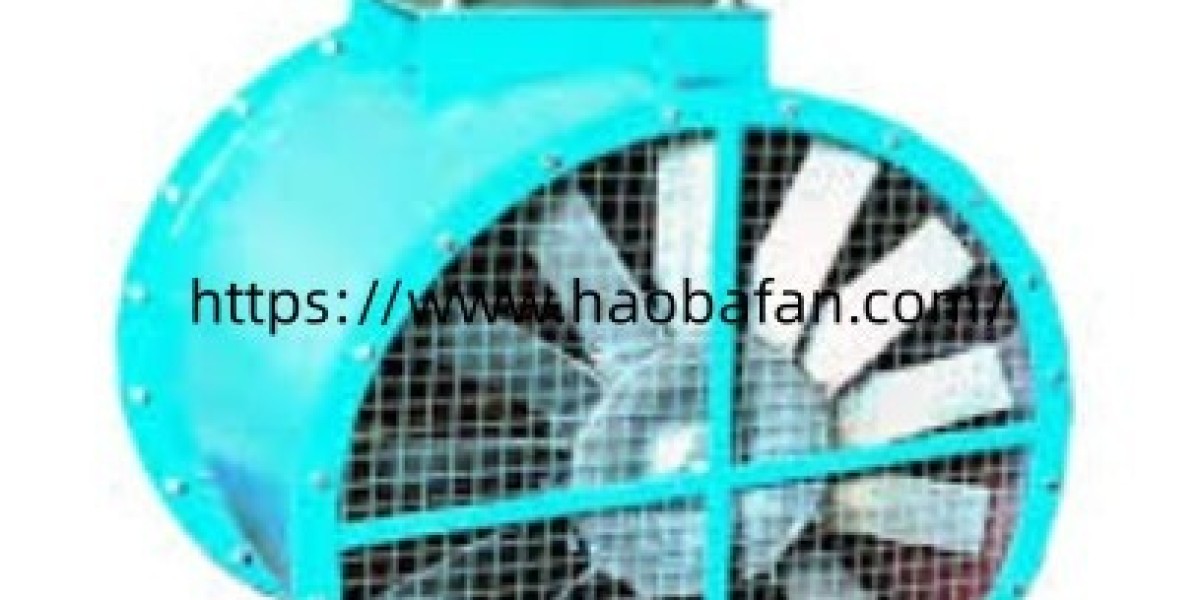

Industrial facilities often generate heat, humidity, airborne particles, and other conditions that make effective air extraction important. An Axial Flow Exhaust Fan can help move unwanted indoor air toward an exterior discharge point, supporting continuous air exchange in factories, workshops, warehouses, agricultural buildings, and similar environments. Its practical effectiveness depends on fan construction as well as the building's overall airflow arrangement.
Axial exhaust equipment operates by rotating blades that move air primarily along the fan's central axis. The straightforward airflow direction can make axial designs suitable for wall, window, roof, or open-area exhaust applications. However, the fan must be correctly positioned so that extracted air can leave the building efficiently while replacement air enters through appropriate openings.
Blade construction directly affects airflow behavior. Blade profile, angle, curvature, and structural rigidity determine how efficiently the rotating assembly transfers energy to the air. Consistent blade production is important because variations can affect airflow distribution and rotational balance. Suitable materials also need to withstand the environmental conditions associated with the installation.
The housing or frame provides structural support for the impeller and motor while defining the airflow pathway. Depending on the installation environment, materials may need to resist moisture, dust, corrosion, or temperature variation. Outdoor exhaust installations require additional attention to weather exposure, drainage, protective covers, and sealing around the building opening.
Motor integration is another key manufacturing consideration. The motor needs to deliver stable rotation while remaining securely mounted to the fan structure. Electrical protection, heat dissipation, alignment, and connection quality should be considered during assembly. These factors become especially relevant when exhaust equipment operates continuously in industrial environments.
Balancing the rotating assembly helps control vibration. An uneven impeller can create mechanical movement that transfers into the housing, mounting points, or building structure. Excessive vibration may contribute to component wear and unwanted noise. Manufacturing inspection and balancing procedures can therefore support smoother operation and longer-term mechanical stability.
Airflow planning is particularly important for exhaust systems. Simply removing air from one location does not guarantee uniform ventilation throughout a building. The position of exhaust equipment should be considered together with fresh-air inlets, internal partitions, production equipment, heat sources, and areas where stagnant air may accumulate. A coordinated airflow route can help improve the effectiveness of the overall ventilation strategy.
Noise may also influence equipment selection. Sound can come from the motor, rotating blades, airflow turbulence, vibration, and the surrounding structure. Appropriate blade design and balancing can help control some mechanical and aerodynamic noise, while secure mounting can reduce vibration transmission. The building itself may amplify sound depending on its construction and internal layout.
Maintenance should include inspection of blades, guards, mounting points, electrical connections, and airflow openings. Dust or debris may accumulate on the impeller and affect airflow or rotational balance. Outdoor equipment may also require inspection for corrosion, moisture intrusion, and weather-related deterioration. Maintenance should follow suitable procedures and safety practices for the installed equipment.
Applications for axial exhaust equipment include production workshops, warehouses, agricultural facilities, equipment rooms, commercial spaces, and other buildings requiring continuous air extraction. The correct solution depends on the building structure, heat sources, environmental conditions, installation position, and ventilation objectives.
When selecting an Axial Flow Exhaust Fan, buyers should evaluate the fan as part of the complete ventilation system. Blade construction, motor integration, housing quality, balancing, installation requirements, maintenance access, and environmental compatibility all contribute to practical suitability. Taizhou Haoba Electromechanical Co Ltd. provides ventilation equipment for different air movement applications, with further information available at https://www.haobafan.com/product/mixed-flow-fan/ for customers reviewing industrial exhaust and ventilation solutions.