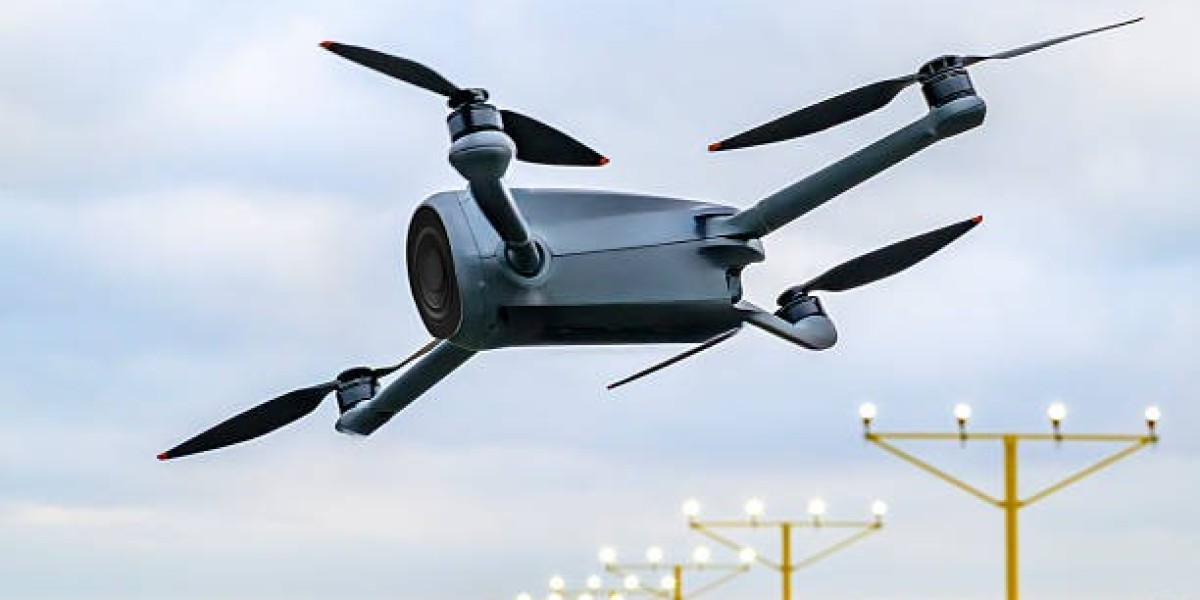

The rapid proliferation of unmanned aerial systems is creating a new security challenge for German airports. Unauthorized drone activity near runways can interrupt aircraft movements, trigger delays and diversions, and create serious safety risks for passengers and crews. As aviation traffic continues to increase, airports and security authorities are increasingly turning toward dedicated detection, identification, tracking, and mitigation technologies to protect critical airspace and maintain operational continuity.
A comprehensive assessment by MarkNtel Advisors reveals that the Germany Airport Drone Disruption Management Market stood at around USD 37 million in 2025 and is anticipated to expand from USD 43 million in 2026 to USD 70 million by 2032, registering a CAGR of 8.46% during 2026–2032. The Germany airport drone disruption management study highlights increasing unauthorized drone incidents, government investment in counter-UAS capabilities, and the need for continuous airport surveillance as major factors supporting demand, with hardware holding a 58% share in 2026.
Unauthorized Drone Activity Raises Operational Risks
Drone incursions have become an increasingly important concern for German aviation. The source study records 116 relevant drone disruption incidents across 25 German commercial airports in 2025, demonstrating the operational scale of the challenge. Such events can result in flight cancellations, diversions, runway restrictions, and substantial economic losses.
Germany's air navigation provider, Deutsche Flugsicherung (DFS), also confirms that unauthorized drone flights around airports can lead to delays, diversions, and flight cancellations. Its airport drone-safety guidance explains that controllers may suspend take-offs and landings when drone sightings create safety concerns, while DFS is working with airports and security authorities to strengthen detection and defense capabilities.
Hardware Leads the Component Landscape
Hardware accounted for approximately 58% of the component segment in 2026, making it the leading category. Detection and mitigation hardware forms the physical foundation of airport counter-drone infrastructure, with technologies including radar, radio-frequency sensors, electro-optical/infrared systems, acoustic sensors, and other specialized equipment.
Airports require reliable systems capable of identifying small and potentially fast-moving aerial objects against complex backgrounds. Multi-sensor architectures can combine information from different technologies to improve detection accuracy and provide security personnel with a more comprehensive view of low-altitude airspace.
Major Commercial Airports Represent the Largest Opportunity
Major commercial airports accounted for approximately 76% of the airport-type segment in 2026. These facilities handle large volumes of passengers and aircraft, making even short disruptions potentially costly.
Frankfurt, Munich, Berlin, and other major airports operate within highly utilized airspace where drone incidents can have consequences extending beyond a single facility. The concentration of passenger traffic, cargo operations, and connecting flights increases the value of rapid detection and response capabilities.
The scale of Germany's aviation activity further reinforces this requirement. The study reports approximately 3.071 million flight movements in 2025, representing a 3.5% increase from 2024. Higher traffic volumes can increase the operational exposure associated with unauthorized drone activity.
Government Investment Supports Counter-UAS Deployment
Public investment is becoming an important driver of the industry. Germany's Bundestag Budget Committee approved approximately USD 58 million for Bundespolizei drone-defense capabilities in the 2026 federal budget, including around USD 34.8 million allocated toward civil airports.
The government also committed approximately USD 116 million to establish a dedicated Bundespolizei drone-defense unit, which became operational in December 2025. Such investments create demand not only for detection and mitigation equipment but also for training, maintenance, integration, and operational support services.
Detection Technologies Become More Sophisticated
Modern airport protection requires more than simply detecting an unidentified flying object. Security teams need to determine whether an object is actually a drone, identify its characteristics, establish its location, track its movement, and assess whether it represents a threat.
Radar can provide detection and tracking capabilities, while RF systems can identify radio-frequency emissions associated with certain drones. EO/IR sensors can provide visual or thermal confirmation, and acoustic systems can contribute additional information in appropriate environments.
Remote Identification is also becoming increasingly relevant as regulatory frameworks evolve. Combining multiple detection technologies can help reduce false alarms and improve confidence before mitigation measures are initiated.
Integrated Multi-Sensor Surveillance Gains Momentum
The industry is increasingly moving toward integrated architectures rather than isolated detection systems. Germany's DLR CUSTODIAN project brings together multiple research institutes to develop coordinated capabilities for drone detection, tracking, situational assessment, and neutralization.
Commercial innovation is following a similar direction. Multi-sensor solutions combining RF, radar, and electro-optical technologies are being developed to provide continuous detection and identification. This trend is particularly relevant for airports because complex environments require systems capable of operating reliably across different weather, terrain, and interference conditions.
Active Mitigation Expands the Technology Opportunity
Detection alone cannot eliminate the operational risk created by unauthorized drones. Airports and security authorities also require authorized mitigation capabilities for situations where an identified drone presents a credible threat.
The study identifies RF/GNSS-based mitigation, drone-capture systems, directed-energy systems, and other authorized technologies within the mitigation segment. Germany's legal and institutional framework is evolving alongside these capabilities, including changes that expand the role of national security and defense authorities in responding to serious drone threats.
Because mitigation around airports must account for aircraft safety and surrounding infrastructure, deployment requires careful coordination between airport operators, air navigation authorities, police, and other authorized agencies.
Interoperability Becomes a Key Requirement
Counter-drone systems must work alongside existing airport-security, surveillance, communications, and air-traffic-management infrastructure. This creates a significant opportunity for interoperable platforms capable of sharing information across multiple operational systems.
Airport operators increasingly need centralized command-and-control capabilities that can combine detection feeds, threat assessments, tracking information, and response procedures. Interoperability can reduce fragmented decision-making and help security personnel respond more quickly when an unauthorized drone enters protected airspace.
Mobile Systems Provide Operational Flexibility
Although fixed installations are important for continuous airport protection, mobile and portable systems can provide additional flexibility. Mobile counter-UAS equipment can potentially be deployed to temporary security zones, critical infrastructure sites, major events, or areas where permanent installations are impractical.
The Bundespolizei's procurement of highly mobile drone-detection and verification vehicles illustrates the growing importance of flexible counter-drone capabilities. Such systems can complement permanent airport infrastructure while extending protection to changing operational environments.
Economic Losses Encourage Preventive Investment
The financial impact of drone disruption provides another reason for airports to invest in prevention. The study estimates approximately USD 69.6 million in economic damage associated with relevant drone disruption incidents across German commercial airports in 2025.
For major hubs, a single disruption can affect airlines, passengers, airport operators, cargo companies, and surrounding transportation networks. Consequently, investment in detection and mitigation systems can be viewed not only as a security expenditure but also as a mechanism for protecting operational continuity and reducing disruption-related costs.
Outlook for Germany’s Airport Drone Defense Industry
Germany's airport drone disruption management industry is moving toward more permanent, integrated, and technologically advanced protection systems. Rising drone activity, increasing flight movements, government investment, and the economic consequences of disruptions are creating sustained demand for detection, tracking, identification, and authorized mitigation capabilities.
Hardware is expected to remain central to deployment, while multi-sensor surveillance, interoperable command systems, mobile detection platforms, and advanced mitigation technologies will increasingly shape procurement decisions. As Germany's airports continue strengthening resilience against unauthorized UAS activity, technology providers that can combine accurate detection, rapid threat assessment, system interoperability, and dependable operational support are likely to find growing opportunities across the aviation-security ecosystem.