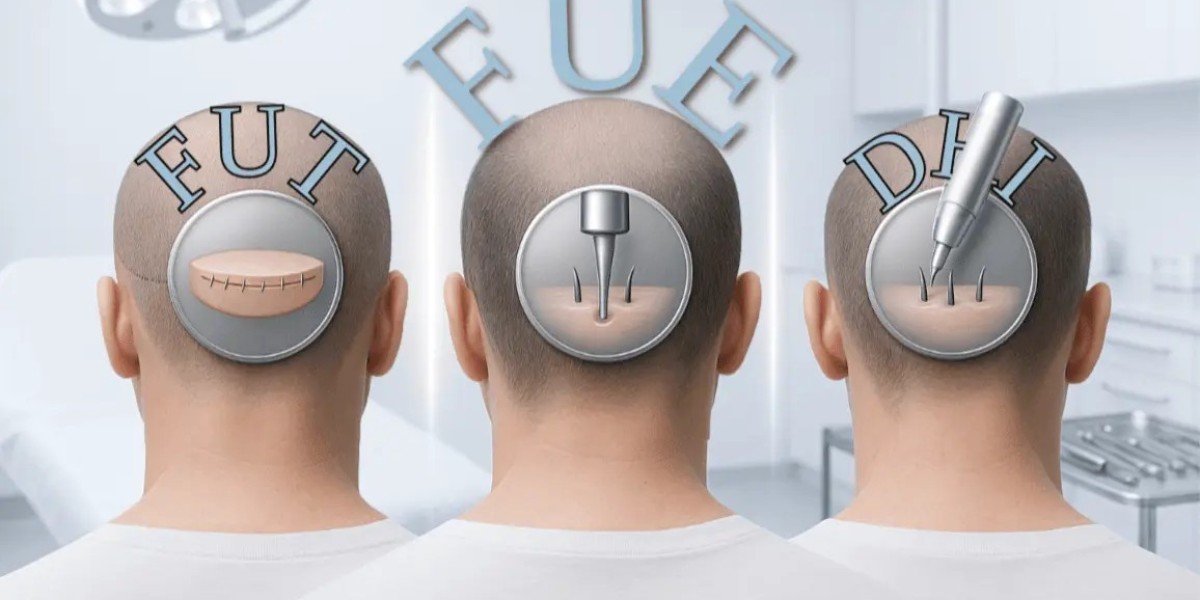

When patients come to me asking about a FUT hair transplant in India, one of the first questions I hear is, “Is FUT still relevant when FUE has become so popular?”
My answer is simple: FUT is not the right procedure for everyone, but it can still be an excellent hair restoration option for carefully selected patients.
In hair transplantation, I do not believe in choosing a technique simply because it is currently popular. The procedure should be selected after evaluating the patient's hair-loss pattern, donor density, scalp characteristics, expected future hair loss, number of grafts required and personal preferences.
What Is FUT Hair Transplant?
FUT stands for Follicular Unit Transplantation. In this technique, a strip of hair-bearing skin is removed from the donor area, usually at the back of the scalp. The strip is then carefully dissected under magnification into individual follicular unit grafts, which are subsequently transplanted into areas affected by hair loss.
The donor area is closed with sutures, leaving a linear scar. With appropriate surgical planning and closure techniques, the scar can often be kept relatively fine and less noticeable, although no hair transplant technique should be described as completely scarless.
Why Consider FUT Hair Transplant in India?
FUT can be particularly useful when a patient needs a relatively large number of grafts and has suitable donor characteristics.
One of the important advantages of FUT is that a substantial number of grafts can be harvested in a single session. It also does not require complete shaving of the donor area, which can be an important consideration for some patients.
In my practice, I have also seen situations where combining FUT and FUE can be considered for patients who require extensive restoration. The decision, however, should always be individualized rather than based simply on the number of grafts.
FUT vs FUE: Which Is Better?
There is no universal answer.
FUT involves strip harvesting and produces a linear donor scar, while FUE involves individually extracting follicular units and produces multiple small extraction scars distributed across the donor area. Both techniques ultimately involve transplanting follicular unit grafts into recipient areas.
I generally discuss the following factors with patients before recommending either technique:
- Extent and pattern of hair loss
- Donor hair density
- Scalp laxity
- Number of grafts required
- Previous hair transplant surgery
- Future hair-loss expectations
- Hairstyle preferences
- Whether the patient wants to avoid shaving
- Long-term donor-area preservation
The goal is not simply to transplant as many hairs as possible. The goal is to use the available donor hair intelligently and create a result that remains natural as you age.
Who May Be a Good Candidate for FUT?
FUT may be considered for patients who:
- Require a larger number of grafts
- Have adequate donor hair
- Prefer not to shave the donor area
- Have suitable scalp laxity
- Are comfortable with the possibility of a linear scar
- Need long-term donor management
- Have been properly evaluated for the cause and progression of hair loss
However, being a candidate for FUT does not automatically mean FUT is the best option. A proper consultation is necessary before making that decision.
What Happens During a FUT Hair Transplant?
The procedure generally involves several carefully planned stages.
First, I assess the donor and recipient areas and design the hairline according to the patient's facial proportions, age and anticipated future hair loss.
The donor area is then prepared and local anesthesia is administered. A strip of hair-bearing scalp is carefully removed from the donor region. The donor wound is closed, while the harvested tissue is dissected under magnification into individual follicular units.
The recipient sites are then created according to the planned hairline, density and direction of growth. The prepared grafts are finally placed into these recipient sites.
Every stage matters. Hair transplantation is not simply about moving grafts from one part of the scalp to another. It is a surgical procedure requiring planning, precision and an understanding of hair growth and facial aesthetics.
FUT Hair Transplant Recovery
Recovery varies from patient to patient.
Because FUT involves a donor incision, some patients may experience more discomfort than they would after FUE. The donor wound also requires appropriate care while it heals.
Patients should follow the specific postoperative instructions provided by their surgeon rather than relying solely on generalized internet advice. The ISHRS also emphasizes that postoperative care can vary depending on the procedure and individual patient.
Temporary shedding, commonly referred to as shock loss, can occur following hair transplantation. It can be concerning for patients, but in many cases the shedding is temporary and hair subsequently regrows.
Does FUT Leave a Scar?
Yes. FUT leaves a linear scar because a strip of scalp is removed.
This is one of the most important points I discuss with patients before surgery. The objective is not to promise a scarless procedure but to plan and execute the surgery in a way that aims for a cosmetically acceptable scar.
The final appearance of a scar depends on several factors, including surgical technique, wound closure, individual healing characteristics and scalp laxity.
If someone tells you that FUT is completely scarless, I would recommend being cautious. Similarly, FUE should not be marketed as completely scarless either.
Is FUT Hair Transplant Permanent?
The transplanted follicles are generally selected from the donor region because they have greater resistance to the effects of androgenetic hair loss. However, a hair transplant does not stop the progression of existing non-transplanted hair loss.
This is why I consider long-term planning extremely important.
Before recommending surgery, I evaluate the existing hair loss and discuss whether medical management may also be appropriate. In younger patients especially, restoring the hairline without considering future hair loss can create an unnatural appearance later.
How Much Does FUT Hair Transplant Cost in India?
There is no single price for FUT hair transplantation in India.
The cost can vary depending on:
- Number of grafts required
- Extent of hair loss
- Complexity of the case
- Surgeon’s experience and qualifications
- Surgical facility
- Whether additional procedures are required
I would strongly advise patients not to choose a hair transplant solely on the basis of the lowest quoted price.
The person performing the surgical steps, the quality of graft handling, donor management and long-term planning can have a much greater impact on your outcome than a small difference in price.
Choosing a FUT Hair Transplant Surgeon in India
For me, this is one of the most important parts of the entire process.
Hair transplantation is surgery. It requires medical judgment, careful donor management and appropriate surgical training. The ISHRS specifically advises patients to verify the qualifications and experience of the physician performing their hair restoration procedure.
When evaluating a surgeon, I recommend asking:
- Who will actually perform the surgical parts of the procedure?
- What qualifications and hair-restoration training does the surgeon have?
- How many FUT procedures has the surgeon performed?
- What will happen to my donor area?
- What is the expected number of grafts?
- What will happen if I lose more hair in the future?
- What type of scar can I realistically expect?
- Can I see genuine results from patients with a similar degree of hair loss?
These questions can help you make a more informed decision.
My Approach to FUT Hair Transplant
At Crown – The Hair Transplant Experts, I do not believe that every patient should receive the same hair transplant technique.
Some patients may be better suited to FUE. Others may benefit from FUT, while selected patients may require a combination of techniques.
My approach is to first understand why the patient is losing hair, how much donor hair is available, how much hair needs to be restored and what the patient's long-term expectations are.
A natural hairline, appropriate graft distribution and preservation of the donor area are more important than simply maximizing the number of grafts transplanted.
Final Thoughts
FUT hair transplant in India remains a valuable surgical option when it is performed on the right patient and planned properly.
FUE may be more popular today, but that does not mean FUT has become obsolete. Each technique has advantages and limitations, and the correct choice depends on the individual patient.
If you are considering a hair transplant, I recommend getting a proper assessment before deciding between FUT and FUE. The right procedure should be based on your hair loss, donor capacity, future requirements and aesthetic goals—not simply on what is trending.
Dr. Mayank Singh
MBBS, MS, MCh
Diplomate, American Board of Hair Restoration Surgery (ABHRS)
Crown – The Hair Transplant Experts, New Delhi







