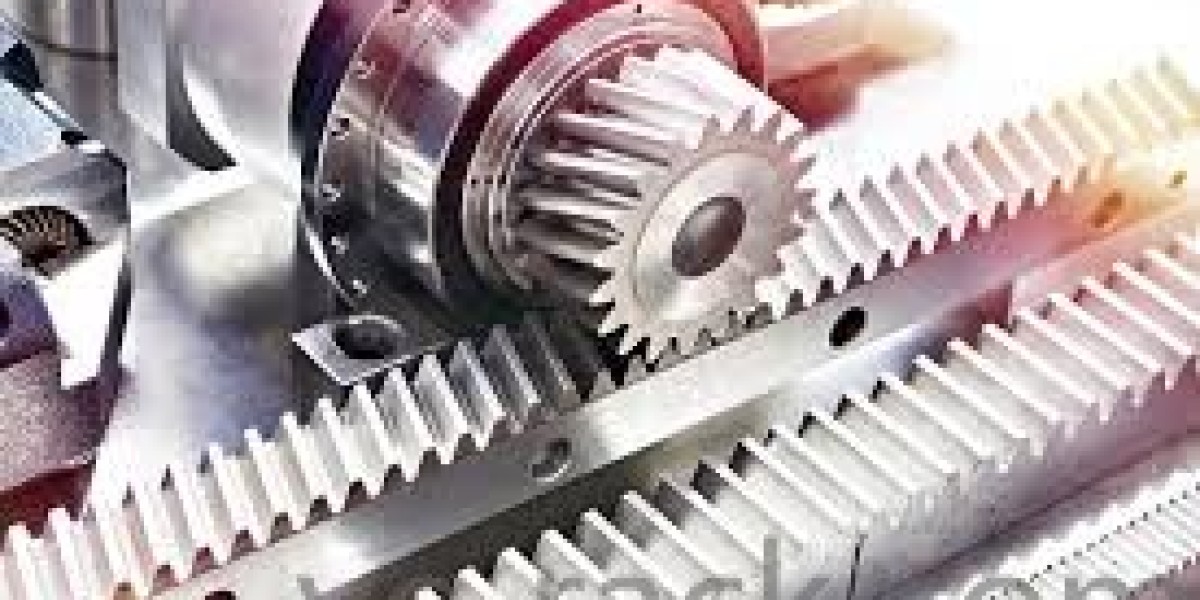

Modern industrial machinery requires transmission components that can support controlled movement under repeated operating conditions. A Helical Ground Rack combines angled tooth geometry with precision finishing to support progressive engagement and consistent contact with a mating pinion. This combination is relevant to equipment that requires smooth linear movement, reliable force transmission, and predictable mechanical behavior. Its performance, however, depends on more than the design itself; material quality, machining accuracy, installation, and maintenance all contribute to the result.
The angled tooth arrangement allows contact to develop gradually as the pinion rotates. Instead of engaging across the entire tooth width at the same instant, the contact progresses along the working surface. This can help reduce abrupt engagement and support smoother movement. In applications involving repeated positioning or continuous operation, progressive contact may contribute to more stable transmission behavior when the entire assembly is properly configured.
Grinding provides an additional level of manufacturing refinement. After the basic tooth profile has been produced through machining, a controlled finishing process can improve the working surfaces and dimensional consistency. This is important because tooth contact directly influences how force passes through the transmission system. Surface irregularities or geometric deviations may create uneven contact, increasing friction and localized stress.
Material selection establishes the foundation for reliable production. Industrial transmission components must withstand repeated loading and contact while maintaining their intended dimensions. Steel is frequently considered for these applications because its mechanical characteristics can be adapted through appropriate material selection and processing. Manufacturers need to evaluate the working load, operating environment, expected service conditions, and maintenance requirements before determining a suitable material.
Heat treatment may be used to improve selected mechanical properties. It can help increase resistance to surface wear and repeated contact, but the process may also affect dimensional stability. Any changes introduced during thermal processing must be considered during later machining and grinding. Coordinating these operations helps manufacturers maintain the intended tooth geometry while achieving suitable material characteristics.
Zhejiang Yuchen Transmission Technology Co., Ltd. focuses on manufacturing mechanical transmission components for industrial equipment. Consistent process management is important because the final component reflects the combined quality of multiple production stages. Material preparation, initial machining, finishing, and inspection must work together to achieve reliable results. Clear production procedures also help reduce variation between components.
Tooth geometry has a direct influence on engagement. The tooth profile, spacing, angle, and alignment determine how the mating pinion interacts with the rack. If these features are inconsistent, the contact pattern may become concentrated in certain areas. This can result in uneven loading, increased friction, and changes in operating noise. Precision machining and grinding help maintain the intended geometry and improve contact consistency.
Quality inspection helps verify the result of the manufacturing process. Dimensional checks evaluate important component features, while tooth profile inspection helps assess the accuracy of the working geometry. Surface inspection can identify finishing irregularities that may affect contact. Combining these procedures at suitable stages provides a more complete assessment of production quality and helps identify potential issues before assembly.
Installation accuracy is essential for realizing the benefits of precision manufacturing. The component should be mounted on a stable surface and aligned correctly with its mating pinion. An uneven mounting base or insufficient structural rigidity may cause misalignment under load. This can lead to inconsistent contact and unnecessary wear. Equipment designers should consider support structures, mounting arrangements, and maintenance access as part of the complete system.
Lubrication is another factor that influences service performance. Moving tooth surfaces experience friction, and suitable lubrication helps manage contact during operation. The appropriate approach depends on the load, operating frequency, temperature, and surrounding environment. Contamination from dust or metal particles should be minimized because it can affect surface condition. Regular inspections help identify unusual noise, vibration, or visible wear before more serious problems develop.
These transmission components can support different industrial applications. Automated production lines use linear movement to position tools and workpieces. Packaging machinery requires coordinated mechanical movement to maintain process timing. Material-handling systems may use linear drives to move platforms and carriers, while specialized machine tools depend on stable transmission to support controlled positioning. Each application requires a component suited to its operating conditions.
Before selecting a component, engineers should assess the complete transmission arrangement. Important considerations include the required movement, operating load, movement frequency, installation space, mating gear compatibility, and environmental exposure. Maintenance procedures and replacement requirements should also be considered. Evaluating these factors together helps prevent problems that may arise when a component is selected without considering the rest of the mechanical system.
A Helical Ground Rack should be chosen according to its intended role within the complete drive assembly. Its angled tooth design and precision finishing can support smooth engagement, but reliable operation also depends on material suitability, dimensional consistency, mounting accuracy, and regular maintenance. Zhejiang Yuchen Transmission Technology Co., Ltd. provides manufacturing-focused transmission solutions for industrial applications. To explore its product range, visit https://www.yc-rack.com/product/spur-gear-rack/