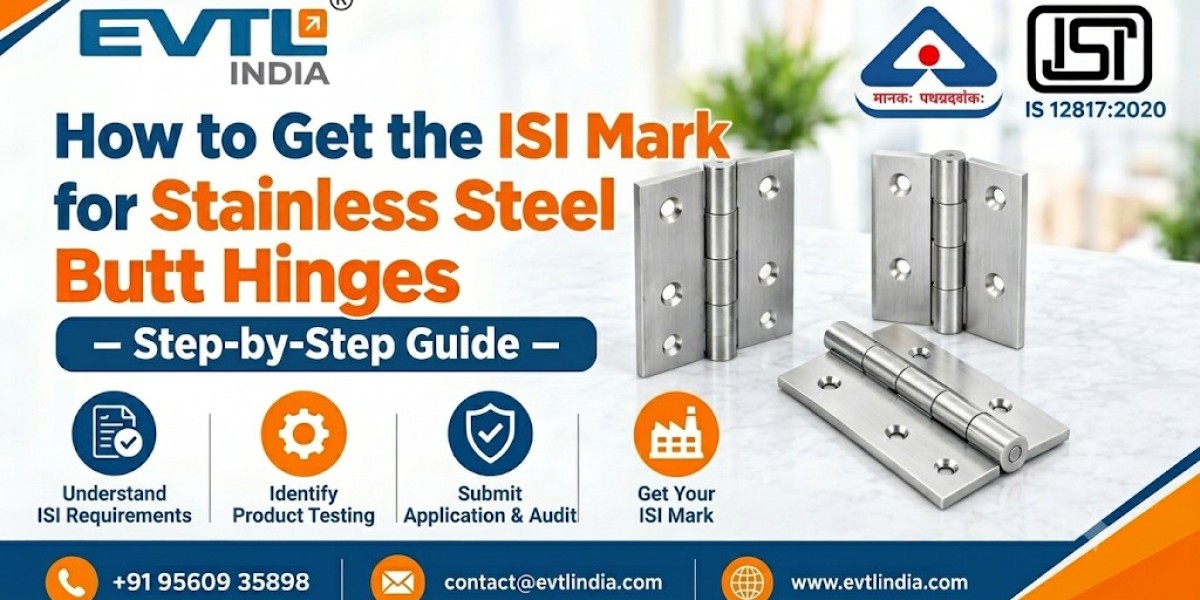

If you make stainless steel butt hinges, you have probably heard that the ISI mark is now a must. But where do you begin, and how much time will it take? The process of BIS ISI Mark Certification for Stainless steel butt hinges feels big when you look at it all at once. It feels small when you break it into weeks. So here is a simple week-by-week plan that any first-time manufacturer can follow.
First, Why Is the ISI Mark Needed?
The government has issued the Hinges (Quality Control) Order. It says these hinges can be made, imported and sold in India only if they follow the Indian Standard and carry the ISI mark. The mark is allowed only for factories that hold a BIS license.
Selling without it can lead to legal action and stopped stock. Buyers like builders and dealers also trust certified hinges more.
Week 1: Learn the Rules and Check Your Hinge
Start by reading the rulebook. The BIS IS Standard for Stainless steel butt hinges is IS 12817:2020. It explains the types of hinges, the steel to use, the size limits, the making and the finish.
Key points to remember:
- Flap steel must follow IS 6911 and pin steel must follow IS 6528.
- Length, width and thickness must stay within the given limits.
- Knuckles must be straight, and sharp edges must be removed.
- The surface must be smooth and ready to resist rust.
- BIS has issued Amendment No. 2. Other stainless steel can be used if the maker and the buyer agree, but you must declare the standard and grade. Rust resistance and finish are also checked with more care.
This week’s task: Take one hinge from your line and compare it with every point above. Write down what is missing.
Week 2: Get Your Factory and Papers Ready
BIS does not only test your hinge. It also checks if you can make the same quality again and again. So please arrange:
- Proper machines and a clean production area
- A small testing corner with measuring tools
- A trained person who can do basic tests
- A register for daily test results
- Safe storage for raw material and finished hinges
Now collect your documents:
- Factory address proof (rent agreement or ownership paper)
- GST certificate
- Partnership deed or MOA, if it applies
- Udyam registration
- Process flow chart of how you make the hinge
- List of machines and testing tools
- ID and address proof of the owner or director
Tip: Names and addresses must match on every paper.
Week 3: Study the Guide and Apply
BIS has made a guide for license holders. The BIS Product Manual for Stainless steel butt hinges tells you which tests to do, how often to do them and what tools your factory should have. Read it before you apply. It will also help you answer the officer’s questions later.
Then fill in the online form on the BIS portal, upload your documents and pay the fee. Check each field twice, because corrections later waste time.
Week 4: Face the Factory Visit
After your application is accepted, a BIS officer visits your factory. The officer will:
- Check your machines and testing tools
- Read your test records
- See how you store raw material
- Take samples of your hinges
Keep your staff calm and ready. Show your records neatly. If your factory is clean and organised, the visit goes smoothly.
Weeks 5 and 6: Lab Tests and the License
Your samples now go to a BIS-recognized lab. The lab checks:
- Material: Is the steel the right type and grade?
- Size: Are length, width and thickness within limits?
- Making: Are knuckles and edges as per the rule?
- Finish: Is the surface smooth and even?
- Rust resistance: Can the hinge fight corrosion?
If everything is fine, BIS grants the license, and you can print the ISI mark. For an Indian factory with ready papers, the whole process usually takes about 30 to 35 working days. Foreign makers apply under the Foreign Manufacturers Certification Scheme (FMCS), which can take around 180 days.
What to Do After You Get the License
- Use the ISI mark in the correct way
- Keep testing your hinges regularly
- Keep test records safe
- Allow BIS officers to take samples
- Renew the license on time
Quick Answers to Common Questions
Can I print the ISI mark before the license?
No. Use it only after BIS gives you the license.
What if a test fails?
Fix the problem and send new samples. That is why you should test your own hinges first.
Do traders need a license?
Traders do not need one, but they should sell only hinges that carry the ISI mark.
Where Most Applicants Lose Time
- Starting the application before the factory is ready
- Wrong or mismatched documents
- Using steel that does not match the declared grade
- Missing test records
- Not following the latest amendment
How EVTL India Can Help
If you want a smoother journey, the team at EVTL India can walk with you at every step. We help you to:
- Check if your product comes under the order
- Prepare and file all documents
- Set up your in-house testing corner
- Book lab tests and prepare for the factory visit
- Reply to BIS questions
- Handle renewal and later changes
You focus on making good hinges, and we handle the paperwork. You can also check the BIS Registration for Stainless steel butt hinges page for more details.
Conclusion
EVTL India is one of the leading BIS consultant in India, helping manufacturers get their BIS licenses hassle-free.
Getting the ISI mark is not magic. It is a clear path: learn the rules, prepare your factory and papers, apply, pass the visit and the tests, and then use the mark with care. When you take it week by week, the work feels light and the license comes faster. Start this week, and give your buyers the trust they are looking for.
Contact EVTL India
? +91 95609 35898
? contact@evtlindia.com
? www.evtlindia.com




