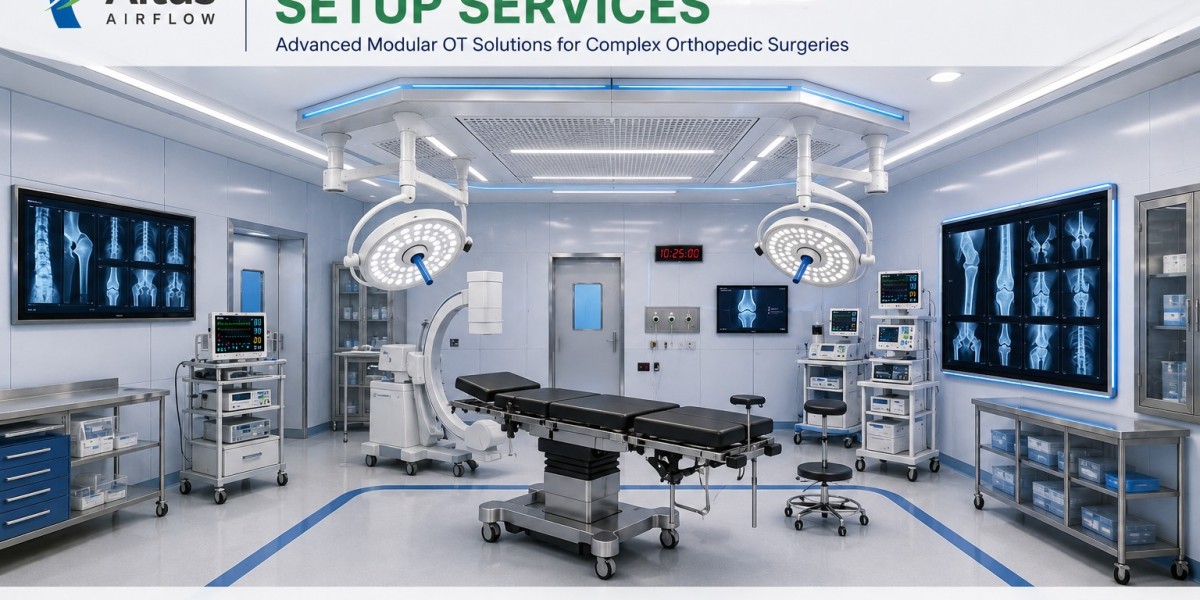

Introduction
Quality assurance is an essential part of developing a major orthopedic modular operation theatre. Before a hospital accepts the completed facility, every component must be inspected, installed, tested, and verified against approved engineering drawings and project specifications. This process helps ensure that the operating theatre provides a hygienic environment, reliable infrastructure, and suitable conditions for complex orthopedic procedures.
Modular Major Orthopedic OT Setup Services include several quality assurance activities, such as material inspection, modular panel installation checks, HVAC performance testing, HEPA filter verification, electrical safety inspections, medical gas testing, equipment integration, and final commissioning. Each stage must be properly documented to establish that the completed work meets the agreed requirements.
A systematic quality assurance process also helps identify installation defects before handover, reduces future maintenance problems, and improves coordination between hospital representatives, engineers, contractors, and equipment suppliers.
1. Review Approved Drawings and Project Specifications
Quality assurance begins with reviewing the approved project drawings and technical specifications. Before installation starts, the project team should confirm that all construction activities follow the agreed design.
The review should include architectural layouts, modular wall and ceiling drawings, HVAC arrangements, electrical plans, medical gas layouts, equipment positioning, and service connection details.
For a major orthopedic OT, particular attention should be given to surgical table positioning, operating light supports, C-arm imaging equipment, anesthesia workstations, and other specialized medical devices.
The quality team should compare the installation work with the approved drawings at different project stages. Any design changes should be reviewed and approved by the relevant technical representatives before implementation.
This process helps prevent incorrect installations and ensures that all teams work with consistent project information.
2. Inspect Material Quality Before Installation
Material inspection helps confirm that the components supplied for the operating theatre meet the required specifications.
The quality team should inspect modular wall panels, ceiling panels, doors, flooring, viewing windows, sealants, and other construction materials before installation.
Important inspection parameters include material thickness, dimensions, surface finish, coating quality, structural properties, and product documentation.
The team should also check for scratches, dents, corrosion, cracks, transportation damage, and manufacturing defects.
Materials used inside the operating theatre should support regular cleaning and disinfection. Smooth, properly finished surfaces and suitable joint arrangements help reduce areas where dust and moisture can accumulate.
Material inspection reports should be maintained so that any non-conforming component can be identified and replaced before it affects installation quality.
3. Verify Modular Wall and Ceiling Installation
Modular wall and ceiling systems form the main interior structure of the operating theatre. Their installation must be checked carefully to maintain alignment, finishing quality, and compatibility with other technical systems.
The inspection team should verify panel dimensions, vertical alignment, joint finishing, corner connections, door openings, and service cut-outs.
Particular attention should be given to ceiling arrangements because they may accommodate surgical lights, HVAC diffusers, HEPA filter housings, medical pendants, and other equipment supports.
The team should also inspect the sealing of panel joints and connections. Poor sealing may create gaps that collect dust or make routine cleaning difficult.
All installed components should match the approved drawings and material specifications before the project moves to the next stage.
4. Check Surface Finish and Hygiene Requirements
The interior finish of a major orthopedic OT must support regular cleaning and infection prevention procedures.
Quality checks should cover wall surfaces, flooring, doors, ceiling panels, corners, and joints. The team should look for uneven finishes, damaged coatings, open gaps, rough edges, and other defects.
Flooring should be inspected for proper installation, surface continuity, and suitable connections with adjacent wall finishes.
The project team should also verify that the selected materials are compatible with the hospital's intended cleaning and disinfection procedures.
Properly finished surfaces make routine maintenance easier and help maintain the condition of the operating theatre during regular hospital use.
5. Perform HVAC Installation Quality Checks
HVAC installation is one of the most important technical areas in a major orthopedic operating theatre. The system must be installed according to the approved ventilation design and applicable healthcare requirements.
The quality team should inspect air handling units, ductwork, filter housings, supply air diffusers, return air arrangements, insulation, and control systems.
Duct connections should be checked for proper fitting and sealing. The team should also verify that the HVAC installation does not interfere with modular ceiling panels, surgical lighting, or other equipment.
For orthopedic theatres, the ventilation requirements should be established according to the room classification, intended procedures, applicable guidance, and approved project specifications.
The NABH revised OT air-conditioning guidance identifies orthopedic joint replacement theatres as Type A operating theatres and provides recommendations for ventilation and airflow arrangements. Actual project requirements should be confirmed against the applicable guidelines and hospital specifications.
6. Verify HEPA Filter Quality and Installation
HEPA filtration supports the controlled air environment required in an operating theatre. Quality assurance should therefore include verification of filter specifications and installation condition.
The team should check filter identification, dimensions, manufacturer documentation, compatibility with the filter housing, and correct installation.
Where required, filter integrity testing should be conducted using an appropriate aerosol-based method to identify leakage through the filter media or around its sealing arrangement.
The filter housing should also be inspected to confirm that the filter is properly seated and that there are no installation gaps.
Testing records should be maintained as part of the HVAC quality documentation. Filter performance should not be assumed from the manufacturer's certificate alone when on-site integrity verification is required.
7. Conduct Airflow and Environmental Performance Testing
After HVAC installation, the operating theatre should undergo appropriate performance testing.
The quality team should verify the environmental parameters specified in the approved design. These may include airflow direction, air velocity, air changes, room pressure relationships, temperature, and relative humidity.
For theatres designed with unidirectional airflow, measurements should confirm that the airflow arrangement performs according to the approved engineering requirements.
Pressure relationships should also be checked to confirm that the intended airflow direction between the OT and adjoining spaces is maintained.
Testing should be performed using suitable calibrated instruments, and the results should be recorded in a formal report.
Any deviations should be investigated and corrected before final commissioning. Airflow performance must be established through actual measurements rather than visual inspection alone.
8. Inspect Electrical Installation and Safety Systems
Electrical quality assurance helps ensure that the operating theatre's power infrastructure is safe and compatible with the installed medical equipment.
The inspection should cover distribution panels, wiring, sockets, switches, control panels, cable routes, earthing, and backup power arrangements.
The team should confirm that electrical connections match the approved drawings and equipment manufacturers' specifications.
Depending on the installation, testing may include:
Electrical continuity verification
Insulation resistance testing
Earthing and bonding checks
Functional testing of switches and control panels
UPS and emergency power verification
Inspection of equipment power connections
All tests should be completed by qualified personnel using appropriate procedures.
The results should be documented so that the hospital's engineering team can review the electrical system before handover.
9. Verify Medical Gas Pipeline Installation
Medical gas systems must be installed and tested according to applicable technical standards and the approved project requirements.
The quality team should inspect pipeline routing, identification labels, outlet positioning, terminal connections, and accessibility.
Where applicable, testing should verify pipeline integrity, pressure performance, gas identity, cross-connection prevention, and outlet functionality.
The installation should also be checked against the equipment layout to confirm that medical gas outlets are positioned conveniently for the surgical and anesthesia teams.
Medical gas testing should be performed by qualified specialists. The relevant reports should be included in the final project documentation.
10. Check Surgical Equipment Integration
Major orthopedic theatres use specialized equipment that must be properly integrated with the modular structure and facility infrastructure.
The quality team should verify the installation of surgical tables, operating lights, C-arm imaging systems, anesthesia workstations, monitors, medical pendants, and other specified equipment.
Each installation should be checked against the equipment manufacturer's requirements and approved engineering drawings.
Important checks include mounting stability, electrical connections, movement clearances, cable management, accessibility, and service connections.
Ceiling-mounted equipment requires particular attention to structural supports and installation accuracy.
Equipment suppliers should participate in installation inspections and functional testing where their technical expertise is required.
11. Inspect Doors, Control Panels, and Other OT Components
Doors and control systems are important parts of the completed modular operating theatre.
The quality team should check door alignment, opening and closing functions, frame finishing, seals, locking arrangements, and automatic operating systems where applicable.
Control panels should be inspected for correct installation, display functionality, labelling, and integration with the relevant systems.
Other components, including viewing windows, service panels, equipment supports, and accessories, should also be examined.
Every component should be checked for visible damage, secure installation, and compatibility with the approved project specifications.
12. Maintain Installation Checklists and Quality Records
Documentation is essential for demonstrating that each installation stage has been inspected and verified.
Modular Major Orthopedic OT Setup Services should include systematic quality records covering material inspections, installation checks, HVAC testing, electrical verification, medical gas testing, and equipment integration.
The quality documentation may include:
Approved engineering drawings
Material inspection reports
Modular panel installation checklists
HVAC testing and balancing reports
HEPA filter documentation and integrity test results
Electrical safety inspection reports
Medical gas testing records
Equipment installation and commissioning reports
Non-conformance and corrective action records
Final inspection and handover documents
The project team should maintain updated records and ensure that all required approvals are obtained.
Clear documentation improves traceability and helps hospital representatives understand the work completed before accepting the facility.
13. Conduct Non-Conformance Checks and Corrective Actions
Quality assurance should include a formal process for identifying and correcting defects.
A non-conformance may involve incorrect panel dimensions, damaged materials, poor joint sealing, incomplete electrical connections, HVAC performance deviations, or equipment installation problems.
When an issue is identified, the quality team should record its details, assign responsibility, and establish an appropriate corrective action.
The corrected work should then be inspected again to confirm that the issue has been resolved.
This process prevents incomplete or defective work from moving into the final handover stage.
Regular inspections and timely corrective actions also help reduce unnecessary rework and project delays.
14. Complete Final Commissioning and Performance Verification
Final commissioning confirms whether the installed systems operate according to their intended functions and approved requirements.
The commissioning process should cover the modular OT structure, HVAC system, electrical infrastructure, medical gas services, control panels, and integrated equipment.
Testing may include airflow balancing, pressure verification, filter integrity checks, environmental measurements, electrical safety tests, and equipment-specific functional checks.
The responsible technical specialists should review the test results and confirm whether the systems meet the applicable acceptance criteria.
Where a third-party inspection or independent validation is specified, it should be completed before handover.
The final commissioning report should clearly identify completed tests, results, observations, and any corrective actions taken.
15. Prepare the Final Handover and Maintenance Documentation
Before project handover, the company should conduct a final inspection with the hospital's engineering and project representatives.
The team should verify that all agreed work is complete, outstanding defects have been resolved, and the required testing records are available.
The handover package should include relevant drawings, equipment manuals, warranties, material details, inspection reports, commissioning certificates, and maintenance instructions.
Hospital personnel should also receive guidance about HVAC operation, filter maintenance, control systems, and other relevant infrastructure.
Equipment-specific operating and maintenance training should be provided by the appropriate suppliers or qualified specialists.
A complete handover helps the hospital manage the facility and plan preventive maintenance after project completion.
16. How Does Quality Assurance Improve Project Handover?
A systematic quality assurance process helps ensure that the hospital receives a completed operating theatre that has been inspected and tested against agreed requirements.
It reduces the possibility of hidden installation defects, incomplete documentation, and unresolved technical issues.
It also improves communication between project teams and hospital representatives because inspection records provide evidence of completed work.
By verifying every major system before acceptance, the project team can support a smoother transition from construction to hospital operations.
Conclusion
Quality assurance before project handover involves much more than a final visual inspection. It requires systematic material verification, modular panel checks, HVAC and HEPA filter testing, airflow measurements, electrical safety inspections, medical gas verification, equipment integration, and documented commissioning.
These activities help identify defects, verify technical performance, and ensure that the completed major orthopedic operating theatre meets the approved project requirements.
Altus Airflow focuses on modular operation theatre engineering and coordinated healthcare infrastructure solutions, with attention to installation quality, technical integration, and project handover requirements.
Frequently Asked Questions
1. What quality assurance steps are included in Modular Major Orthopedic OT Setup Services before project handover?
Modular Major Orthopedic OT Setup Services include approved drawing verification, material inspection, modular panel quality checks, HVAC and HEPA filter testing, airflow measurements, electrical safety inspections, medical gas verification, equipment integration checks, final commissioning, and handover documentation. These activities help confirm that the completed OT meets the agreed technical specifications.
2. Why is HVAC testing important before major orthopedic OT handover?
HVAC testing verifies airflow distribution, filtration performance, temperature, humidity, and pressure relationships according to the approved design. It helps identify ventilation problems before the operating theatre is accepted.
3. What documents should hospitals receive during modular orthopedic OT handover?
Hospitals should receive relevant approved drawings, material inspection reports, HVAC testing records, HEPA filter documentation, electrical verification reports, medical gas test records, equipment manuals, commissioning reports, and maintenance instructions.
4. How is HEPA filter quality verified in a modular major orthopedic OT?
HEPA filter quality is verified through specification checks, manufacturer documentation, installation inspection, and integrity testing where required. Appropriate on-site testing helps identify filter media leakage or improper sealing around the filter housing.
5. Who is responsible for final quality inspection before OT handover?
The project quality team, installation engineers, relevant technical specialists, equipment suppliers, and hospital representatives may participate in final inspection. Each party verifies the systems and components within its area of responsibility.
6. How does proper quality assurance reduce maintenance problems after handover?
Quality assurance identifies installation defects, unsuitable materials, incomplete connections, and system performance issues before the hospital accepts the facility. Proper testing and documentation also help hospital teams plan maintenance and monitor system performance.