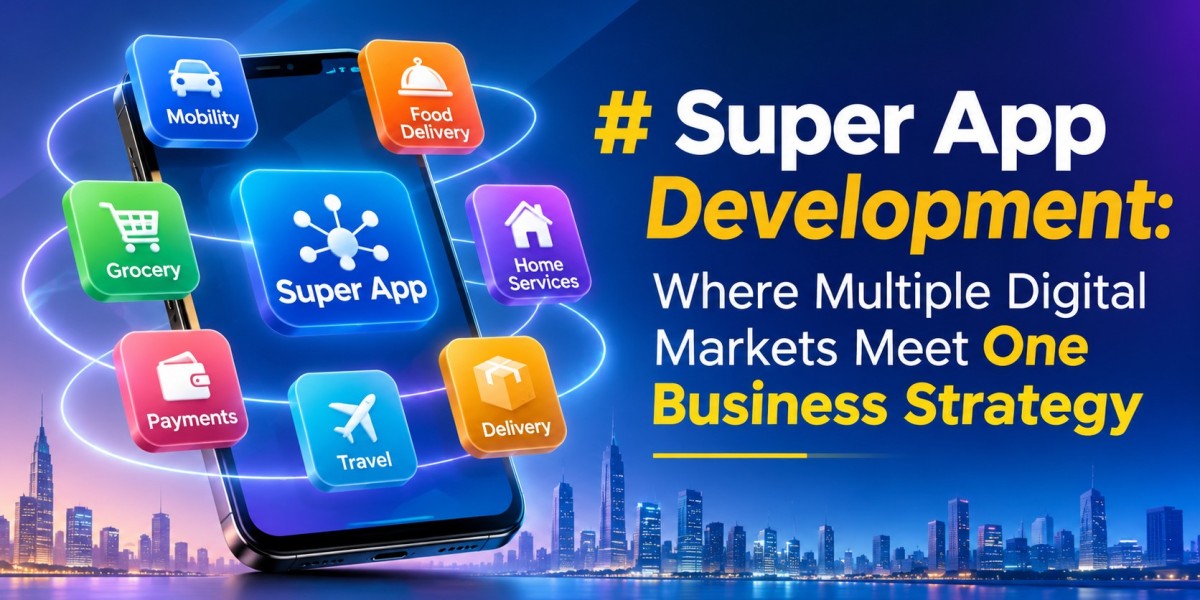

A customer books a ride to work, orders lunch during a break, purchases groceries in the evening, and schedules a home repair over the weekend. Each activity represents a different business transaction, but customers increasingly expect these experiences to be convenient, connected, and accessible through digital channels.
For entrepreneurs, this behaviour raises an important business question: what if multiple everyday services could operate within one digital ecosystem?
This is the thinking behind super app development. Rather than building independent applications for every service category, businesses can establish a unified platform that connects different industries, service providers, and customer requirements. The concept is attracting attention as digital commerce, mobile payments, artificial intelligence, and on-demand services continue to evolve.
However, developing a successful super app requires more than combining existing applications. It requires identifying where different markets intersect and creating a business model that makes those connections commercially valuable.
The Customer Is No Longer Thinking in Separate Applications
Traditional digital businesses were often developed around one primary transaction. A transportation company focused on ride bookings, a restaurant marketplace concentrated on food ordering, and an e-commerce business managed product purchases.
This separation created specialized platforms, but it also resulted in fragmented customer experiences.
Today's digital business environment is moving towards greater integration. Customers want fewer barriers between discovering a service, placing an order, completing a payment, and receiving fulfilment.
This shift creates room for platforms that connect related activities.
Consider a mobility company that already has a substantial customer base. It could introduce airport transfers, vehicle rentals, parcel delivery, and food delivery as complementary services. Instead of acquiring an entirely new audience for every business vertical, the company can explore additional services through an existing digital relationship.
That is where the super app model becomes commercially interesting: one customer relationship can support multiple transaction categories.
Five Market Developments Creating Demand for Super Apps
The expansion of super apps is connected to several changes in the digital economy. Businesses considering this model should understand the developments influencing platform investment.
1. Quick commerce is changing everyday purchasing
Consumers increasingly expect convenient access to groceries, household essentials, and other frequently purchased products. Quick commerce is pushing businesses to rethink inventory visibility, order allocation, and last-mile fulfilment.
Integrating grocery ordering and food delivery into a broader platform can help businesses serve multiple everyday purchasing requirements.
2. Mobility is expanding beyond passenger transportation
Ride-hailing is no longer the only digital service associated with transportation businesses. Car rentals, bike taxis, courier services, logistics, and roadside assistance create additional possibilities.
A mobility-led super app can connect these services through shared customer accounts, location intelligence, and operational infrastructure.
3. Digital payments are becoming part of the customer journey
Payment convenience is essential when multiple services operate within one ecosystem. Integrated payment gateways, digital wallets, transaction histories, and loyalty programmes can create a more consistent purchasing experience.
Businesses can also explore partnerships with licensed financial service providers where regulations permit.
4. AI is transforming platform intelligence
Artificial intelligence is moving beyond basic chatbots. Businesses are exploring personalized recommendations, predictive demand forecasting, intelligent dispatch, automated customer assistance, and operational analytics.
These capabilities can help a super app understand customer preferences while improving coordination across different service categories.
5. Digital service marketplaces are expanding
Customers are using digital channels to discover professionals for cleaning, repairs, beauty services, healthcare appointments, and other requirements.
Bringing selected service marketplaces into an existing ecosystem can create additional transaction opportunities without depending entirely on one industry.
The Technology Behind a Connected Business Ecosystem
A super app must support multiple business workflows without making the customer experience complicated.
For example, food delivery requires restaurant management, menu administration, order processing, and delivery coordination. Ride-hailing requires driver onboarding, location tracking, fare calculation, and trip management. Home services need professional profiles, appointment scheduling, service pricing, and booking management.
Although these services have different operational requirements, they can share a central technology foundation.
A scalable development architecture should consider:
Unified identity management: One customer account to access multiple services.
Centralized administration: A common management environment for monitoring different business verticals.
Service-specific modules: Independent workflows for transportation, delivery, commerce, and bookings.
Integrated payments: Consistent transaction processing across eligible services.
API connectivity: Integration with external payment gateways, maps, notifications, and business systems.
Data analytics: Consolidated reporting to understand customer engagement and service performance.
A modular architecture is particularly important because it allows businesses to introduce new service categories without rebuilding the entire platform.
AI: The Competitive Layer Beyond Basic Integration
Connecting services creates the foundation of a super app. Intelligence is what can make the ecosystem more responsive.
Imagine a customer who frequently orders groceries and restaurant meals. An AI-powered recommendation engine could suggest relevant products or services based on permitted usage patterns.
Similarly, a delivery business could use predictive analytics to identify demand peaks, while a transportation operator could apply intelligent dispatch and route optimization to improve resource utilization.
Other emerging applications include:
AI-assisted customer support across multiple verticals.
Personalized offers based on relevant purchasing behaviour.
Predictive inventory and demand insights.
Automated service-provider allocation.
Natural-language search and conversational service discovery.
However, AI implementation should address a genuine operational or customer problem. Adding artificial intelligence simply as a promotional feature does not necessarily create business value.
Revenue Potential: How Can Businesses Monetize a Super App?
One of the most attractive aspects of this model is the flexibility to introduce different revenue streams.
A multi-vendor marketplace can earn commissions from eligible restaurant, retailer, or service-provider transactions. Transportation businesses can generate revenue through ride fares and booking fees. Subscription programmes can offer premium customer benefits, while merchant promotions and advertising can create additional income.
A hybrid monetization strategy may combine these approaches.
For example, a business could begin with commissions from food delivery and later introduce subscriptions, promotional placements, and additional service fees.
Nevertheless, revenue diversification does not automatically guarantee profitability. Each vertical must be evaluated according to customer acquisition costs, fulfilment expenses, partner incentives, transaction volumes, and customer retention.
The Expansion Mistake That Businesses Should Avoid
A common mistake in super app planning is introducing too many services before establishing a reliable customer base.
Imagine launching transportation, grocery delivery, food ordering, home assistance, and digital payments simultaneously. Each category requires different partners, operational teams, customer acquisition strategies, and service standards.
Without sufficient demand and operational readiness, this approach can increase costs and weaken the overall customer experience.
A more practical expansion strategy follows three stages:
Establish: Begin with one high-demand service category and develop a dependable customer and partner network.
Connect: Introduce complementary services that share the existing customer base or operational infrastructure.
Expand: Use transaction data, customer feedback, and market research to determine which additional verticals deserve investment.
This approach allows entrepreneurs to test the business model before committing substantial resources to a larger ecosystem.
The Next Super App Will Be Built Around Business Relevance
The future of super apps is not about offering every possible service under one icon. It is about understanding which services customers naturally use together and building a commercially sustainable platform around those requirements.
For entrepreneurs, the combination of quick commerce, mobility, digital payments, AI-powered personalization, and on-demand services creates several directions worth exploring.
Businesses that approach this model with a clear market strategy, modular technology, and realistic expansion plans can establish a stronger foundation for long-term growth.
With spotnrides, businesses can explore super app development service designed to bring multiple service categories together through a unified digital ecosystem.
The next step in digital business expansion may not be another standalone application. It may be a connected platform that gives customers more reasons to return.
Strengthen the spotnrides conversion sectionAdd a sharper spotnrides value proposition