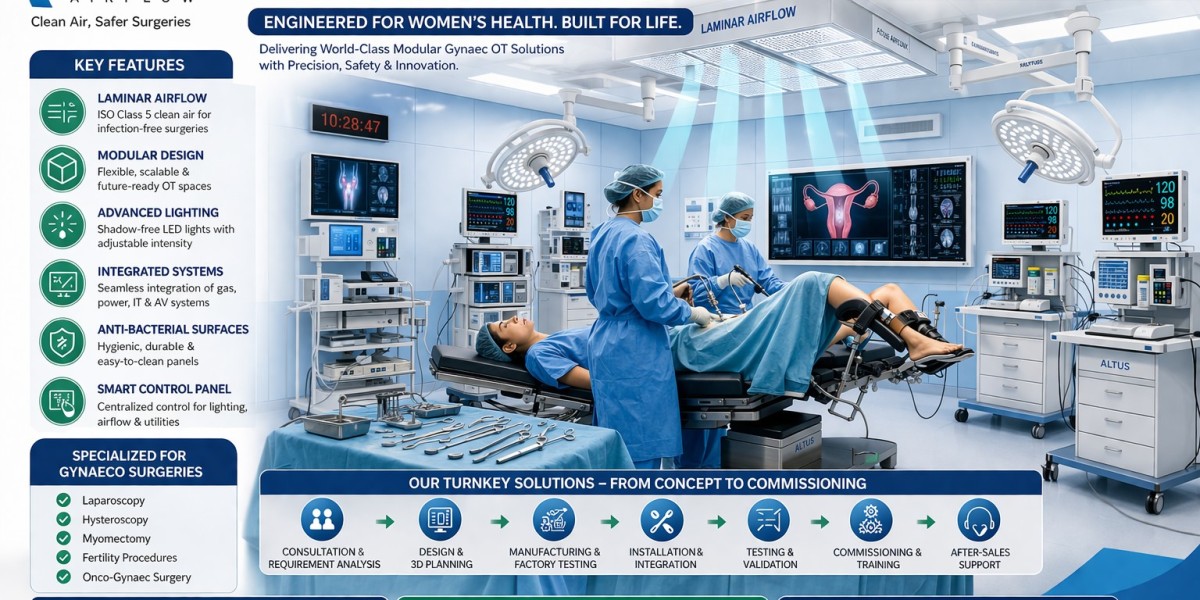

Introduction
The quality and reliability of modular operation theatre components play an important role in maintaining a hygienic, safe, and efficient surgical environment. Before delivering components to a hospital, manufacturers must verify that every material meets the required technical specifications, durability expectations, and cleanliness standards. Proper testing helps prevent installation defects, material failures, and long-term maintenance issues.
Modular Gynaec OT Manufacturers should follow a systematic material testing process to ensure that wall panels, ceiling systems, doors, flooring, lighting arrangements, and other modular components are suitable for gynaecological operating theatres. These tests help confirm that the materials can withstand regular cleaning, disinfectant exposure, equipment integration, and continuous hospital operations.
Material testing should begin during procurement and continue through manufacturing and final factory inspection. A structured quality process allows hospitals to receive components that are ready for installation and support the required OT environment.
Why Is Material Testing Important for Modular Gynaecological Operation Theatres?
A modular gynaecological operation theatre requires materials that support hygiene, durability, easy cleaning, and safe clinical operations. Components are regularly exposed to disinfectants, moisture, equipment movement, and demanding operational conditions.
Without proper testing, unsuitable materials may develop corrosion, surface damage, cracks, coating failures, or dimensional inconsistencies. These problems can affect installation quality and make routine cleaning more difficult.
Material testing helps manufacturers identify defects before dispatch. It also ensures that the components supplied for the project match approved drawings, specifications, and quality requirements.
1. Material Composition and Specification Verification
The first step is verifying whether the selected materials match the approved project specifications. Manufacturers should check material grades, thickness, composition, surface properties, and supplier documentation.
For example, stainless steel components should be checked for the specified grade and material composition. Galvanized steel panels should be verified for their base material and coating specifications. Other materials, such as compact laminates and specialized wall finishes, should also be examined against their technical datasheets.
Material certificates and inspection records help establish traceability. If a component does not match the approved specification, it should be identified and corrected before manufacturing or delivery.
2. Surface Finish and Cleanability Testing
Surface quality is particularly important in a gynaecological operating theatre because all exposed surfaces must support regular cleaning and disinfection.
Manufacturers should inspect wall panels, doors, work surfaces, and other exposed components for scratches, dents, uneven finishes, visible pores, and manufacturing imperfections. Surfaces should be smooth and suitable for the cleaning procedures specified for the facility.
Cleanability assessments should consider whether dirt, moisture, and contaminants can accumulate around joints, corners, edges, and panel connections. Poorly finished surfaces may create difficult-to-clean areas.
Rounded internal corners, properly finished edges, and carefully sealed joints can support better hygiene management. The final surface should also be compatible with the cleaning and disinfecting products intended for hospital use.
3. Corrosion Resistance Testing
Corrosion resistance is another important quality parameter, particularly for metal components used in modular OT construction.
Manufacturers should verify that stainless steel, coated steel, and other metallic materials can withstand the environmental conditions expected inside the operating theatre. Exposure to moisture and cleaning chemicals may affect unsuitable materials over time.
Depending on the material and project specification, suitable corrosion evaluation methods may include salt spray testing, coating assessment, and material-grade verification.
The test method should be selected according to the material type and applicable technical standard. Manufacturers should document the results and reject components that show unacceptable corrosion or surface deterioration.
4. Dimensional Accuracy and Tolerance Testing
Every modular component must match the approved engineering drawings to ensure proper installation. Even small dimensional variations can create alignment problems between wall panels, ceiling systems, doors, and service openings.
Manufacturers should measure panel height, width, thickness, door dimensions, cut-outs, and connection points before dispatch.
Inspection tools such as calibrated measuring instruments, thickness gauges, and appropriate templates can help verify dimensional accuracy.
Particular attention should be given to components designed for integration with:
OT doors and access systems
Medical gas outlets
Electrical switches and sockets
Modular ceiling panels
Surgical lighting arrangements
HVAC grilles and return air openings
Accurate dimensions reduce on-site modifications and support a better-finished installation.
5. Structural Strength and Load Testing
Some modular OT components must support equipment, accessories, and operational loads. Their structural strength should therefore be verified before delivery.
Manufacturers should assess the strength of support frames, ceiling structures, mounting arrangements, brackets, and other load-bearing components according to their intended application.
Where required, load testing should confirm that the component can safely withstand the specified load without unacceptable deformation or failure.
The testing process should also examine the quality of welds, fasteners, joints, and mechanical connections. Components designed to support surgical lights or ceiling-mounted equipment require particular attention to their approved structural and installation requirements.
6. Coating Thickness and Adhesion Testing
Painted and coated surfaces need to maintain their finish under regular hospital cleaning conditions. Poor coating quality may result in peeling, cracking, discoloration, or corrosion of the underlying material.
Manufacturers should verify coating thickness using suitable measuring instruments. Adhesion testing can help determine whether the coating is properly bonded to the base material.
Visual inspection should identify uneven coating, bubbles, pinholes, scratches, and exposed metal surfaces.
The selected coating system should also be compatible with the cleaning and disinfecting chemicals expected in the OT. This helps maintain the appearance and performance of modular panels during regular use.
7. Joint Sealing and Leakage Inspection
Panel joints and component connections must be properly finished to prevent gaps and difficult-to-clean areas.
Manufacturers should inspect sealants, gaskets, corner joints, and panel connections for uniform application and proper adhesion. Poor sealing may allow moisture and dust to collect in concealed areas.
Testing should confirm that the selected sealing materials are compatible with the adjacent surfaces and the intended cleaning environment.
Door frames, service openings, wall-to-ceiling connections, and other junctions should receive particular attention. Proper joint finishing supports hygiene management and helps maintain the integrity of the modular OT structure.
8. HEPA Filter and HVAC Component Verification
Air quality is an important part of the operating theatre environment. Manufacturers and project suppliers should verify the technical specifications of HEPA filters and associated HVAC components before delivery.
HEPA filters should be checked for model identification, dimensions, rated performance, manufacturer documentation, and compatibility with the approved filtration system.
Where required, filter integrity testing should be performed using an appropriate method, such as an aerosol-based leak test, in accordance with the applicable standard and project requirements.
HVAC-related components, including air diffusers, grilles, duct connections, and filter housings, should also be inspected for dimensional accuracy and manufacturing quality.
These checks help ensure that the supplied components are suitable for the planned airflow arrangement. Actual airflow performance must still be verified during site commissioning after installation.
9. Electrical Component Safety Testing
Electrical components used in modular operation theatres must be checked for safety, compatibility, and reliable operation.
Manufacturers should inspect control panels, switches, sockets, wiring accessories, cable connections, and electrical enclosures against the approved electrical drawings and applicable safety requirements.
Depending on the equipment and installation design, testing may include insulation resistance, continuity, earthing verification, and functional checks.
Components should also be checked for secure connections, proper identification, suitable enclosures, and correct mounting dimensions.
Electrical safety verification is essential before delivery, but final installation testing must also be completed by qualified personnel at the project site.
10. Door, Hardware, and Mechanical Component Testing
OT doors and associated hardware must operate smoothly and fit correctly within the modular structure.
Manufacturers should inspect door dimensions, frame alignment, hinges, handles, locking arrangements, seals, and automatic operating mechanisms where applicable.
Functional testing should confirm that doors open and close correctly without unnecessary friction or misalignment. Sealing arrangements should also be checked according to the approved door design.
Other mechanical components, such as access panels, service covers, and equipment supports, should be inspected for proper movement, secure fixing, and dimensional compatibility.
These checks help prevent operational difficulties after the OT becomes functional.
11. Final Factory Inspection and Documentation
Before dispatch, manufacturers should conduct a final inspection covering all supplied components. This inspection should confirm that the products match approved specifications and that earlier testing records are complete.
Modular Gynaec OT Manufacturers should maintain proper documentation to demonstrate material quality, testing results, and manufacturing compliance. This gives hospitals and project teams a clear record of the components being supplied.
The documentation may include material certificates, inspection reports, dimensional records, coating test results, filter documentation, electrical test reports, and product identification details, depending on the project scope.
Each component should be labelled appropriately to support identification, transportation, and installation. Any rejected or non-conforming component should be corrected or replaced before dispatch.
12. How Does Material Testing Improve Installation Quality?
Material testing helps reduce unexpected issues during installation by identifying defects before components reach the hospital.
When panels, doors, ceiling systems, and service components are manufactured according to approved specifications, installation teams can work with greater accuracy. Proper dimensional verification also reduces unnecessary cutting, drilling, and modifications at the site.
Testing records help project engineers confirm that the supplied components meet the agreed requirements. This supports coordination between manufacturing, HVAC, electrical, medical gas, and installation teams.
A reliable inspection process also makes it easier to investigate quality concerns and plan future maintenance.
13. How Should Hospitals Evaluate Manufacturers' Testing Capabilities?
Hospitals should evaluate a manufacturer's quality procedures before selecting a supplier for a modular gynaecological operation theatre project.
The manufacturer should be able to explain its material selection process, testing methods, inspection stages, and documentation practices. Hospitals can request relevant certificates and sample quality reports to understand how components are verified.
It is also useful to check whether the manufacturer follows a documented quality management process and uses calibrated testing instruments where required.
The evaluation should consider the manufacturer's ability to coordinate modular panels, HVAC components, electrical systems, doors, and other OT infrastructure. A systematic approach to manufacturing and inspection can help reduce project delays and improve the consistency of delivered components.
14. What Are the Common Material Testing Mistakes to Avoid?
Some quality issues occur when manufacturers rely only on visual inspection or perform testing without considering the actual application of each component.
Common mistakes include using materials that do not match approved specifications, ignoring coating thickness, overlooking dimensional tolerances, and failing to inspect joints and concealed surfaces.
Another mistake is treating factory inspection as a substitute for site commissioning. Material quality, component functionality, HVAC performance, and electrical safety require different verification stages.
Manufacturers should use appropriate test methods for each material and maintain clear inspection records. Testing should be planned according to the project specifications rather than applying the same procedure to every component.
Conclusion
Material testing is an essential part of manufacturing reliable modular gynaecological operating theatre components. Composition verification, surface inspection, corrosion resistance, dimensional checks, structural testing, coating evaluation, joint inspection, and electrical and HVAC component verification help identify quality issues before delivery.
A structured testing process supports better installation accuracy, hygiene management, operational reliability, and long-term maintenance. Hospitals should therefore select manufacturers that follow documented quality procedures and provide appropriate inspection records.
Altus Airflow focuses on modular OT engineering and coordinated infrastructure solutions, with attention to material quality, project specifications, and the technical requirements of modern healthcare facilities.
Frequently Asked Questions
1. What material testing procedures should Modular Gynaec OT Manufacturers perform before delivering OT components?
Modular Gynaec OT Manufacturers should perform material composition verification, surface finish inspection, corrosion resistance testing, dimensional checks, structural strength assessment, coating adhesion testing, joint sealing inspection, and relevant electrical and HVAC component verification. These procedures help ensure that supplied components meet approved project specifications.
2. Why is corrosion resistance testing important for modular OT materials?
Corrosion resistance testing helps determine whether metal components can withstand moisture, cleaning chemicals, and regular hospital use. It supports material durability and helps prevent premature deterioration.
3. How do manufacturers check the quality of modular OT wall panels?
Manufacturers inspect panel material, thickness, dimensions, surface finish, coating quality, structural properties, and joint compatibility. They also verify that the panels match approved drawings and project specifications.
4. Should HEPA filters be tested before delivery for modular operation theatres?
Yes. HEPA filters should be checked for specifications, dimensions, documentation, and compatibility with the approved filtration system. Where required, integrity testing should also be performed using an appropriate test method.
5. What documents should hospitals request before accepting modular OT components?
Hospitals should request relevant material certificates, dimensional inspection reports, coating test records, filter documentation, electrical test reports, and final quality inspection records. The exact documents depend on the project scope and component requirements.