
Introduction
A customized gynaecological operating theatre must be designed and manufactured to support surgical hygiene, patient safety, efficient workflow, and reliable environmental control. Modular Gynaec OT Manufacturers have an important responsibility to ensure that every component, from wall and ceiling panels to HVAC systems and electrical infrastructure, meets the required technical and quality specifications.
Gynaecological procedures require a well-organized operating environment where medical equipment, surgical lighting, ventilation, and staff movement work together. Production standards help manufacturers maintain consistency, reduce installation defects, and deliver an operating theatre that meets the hospital's functional requirements.
A systematic production process should begin with approved engineering drawings and material specifications, continue through manufacturing and quality inspections, and finish with installation, testing, and commissioning.
1. Follow Approved Design and Engineering Specifications
Production quality begins before manufacturing starts. Manufacturers should first understand the hospital's clinical requirements, room dimensions, surgical procedures, equipment list, and infrastructure limitations.
The engineering team should prepare detailed drawings covering wall and ceiling layouts, door positions, flooring, HVAC arrangements, electrical connections, medical gas outlets, and equipment mounting locations.
These drawings should be reviewed and approved before production begins. Any changes to dimensions, materials, or equipment positions should be documented to prevent inconsistencies between the design and manufactured components.
For customized gynaec OTs, planning should also consider the movement of surgeons, anaesthesia teams, nurses, patients, and medical equipment. Proper coordination helps create an organized working environment.
2. Maintain Material Quality Standards
The materials used in a modular OT should support hygiene, durability, and routine cleaning. Manufacturers should select materials according to their intended application and the approved technical specifications.
Common material considerations include:
Wall panels: Panels should have durable, smooth, and easy-to-clean surfaces. Suitable options may include stainless steel, powder-coated galvanized steel, or other approved modular panel systems.
Ceiling panels: Ceiling components should provide stable support for integrated lighting, filtration systems, pendants, and other approved equipment.
Flooring: Flooring should be seamless or have properly treated joints, with suitable resistance to cleaning chemicals, mechanical stress, and routine hospital use.
Doors and windows: Doors should provide appropriate sealing, smooth operation, and compatibility with the required room pressure conditions.
Joint sealants and covings: These should help minimize gaps and difficult-to-clean corners where dust and contaminants may accumulate.
Manufacturers should verify product specifications, material certificates, surface finishes, and relevant test reports before using materials in production.
3. Follow ISO 9001 Quality Management Principles
ISO 9001 provides a framework for managing quality processes across an organization. For modular OT production, its principles can support consistent manufacturing procedures, documentation, inspection, corrective actions, and continual improvement.
Manufacturers should establish documented procedures for material procurement, production planning, component inspection, product handling, and dispatch.
Quality responsibilities should be clearly assigned to production supervisors, engineers, and inspection teams. Defects identified during manufacturing should be recorded and corrected before components move to the next stage.
A structured quality management process helps reduce avoidable errors and improves consistency across customized projects.
4. Consider ISO 14644 Requirements Where Applicable
ISO 14644 is a series of standards related to cleanrooms and associated controlled environments. Relevant parts may be used when a project specifies cleanroom classification, airborne particle measurement, or performance testing.
Manufacturers should understand that ISO 14644 is not a universal certificate for every modular OT product. Its application depends on the project's intended cleanliness classification and testing requirements.
Where applicable, production and project planning should consider:
The specified cleanliness classification.
Suitable wall and ceiling finishes.
Properly sealed panel joints.
Compatible doors and service openings.
Airflow arrangements and filtration interfaces.
Particle measurement and environmental testing requirements.
The hospital and engineering team should define the required classification and verification procedure before the project is executed.
5. Maintain HEPA Filtration and Airflow Compatibility
Air filtration is an important part of the operating theatre environment. Manufacturers must ensure that the modular ceiling, air supply arrangement, filter housings, and HVAC system are designed to work together.
HEPA filters should be selected according to the filtration performance specified in the project. EN 1822 is a relevant standard for classifying and testing high-efficiency air filters.
Production and installation quality should address filter housing dimensions, sealing arrangements, accessibility, and the prevention of air bypass around the filter.
The National Guidelines for Infection Prevention and Control in Healthcare Facilities also emphasize filtered ventilation, positive pressure, and regular monitoring of HEPA filter efficiency in operating theatres.
6. Follow Healthcare Ventilation and HVAC Requirements
The HVAC system must be planned according to the operating theatre's functional requirements and applicable healthcare ventilation guidance.
Manufacturers should coordinate with HVAC engineers to determine air handling capacity, filtration stages, supply and return air positions, pressure relationships, temperature control, and humidity management.
The system should be designed to maintain the environmental conditions specified for the project. Air changes, fresh air requirements, pressure differentials, and filtration arrangements should not be selected using generic figures without considering the applicable standard and hospital design brief.
Production quality also involves ensuring that ducts, access panels, filter housings, and ceiling openings match the approved HVAC drawings.
7. Ensure Proper Laminar Airflow Integration
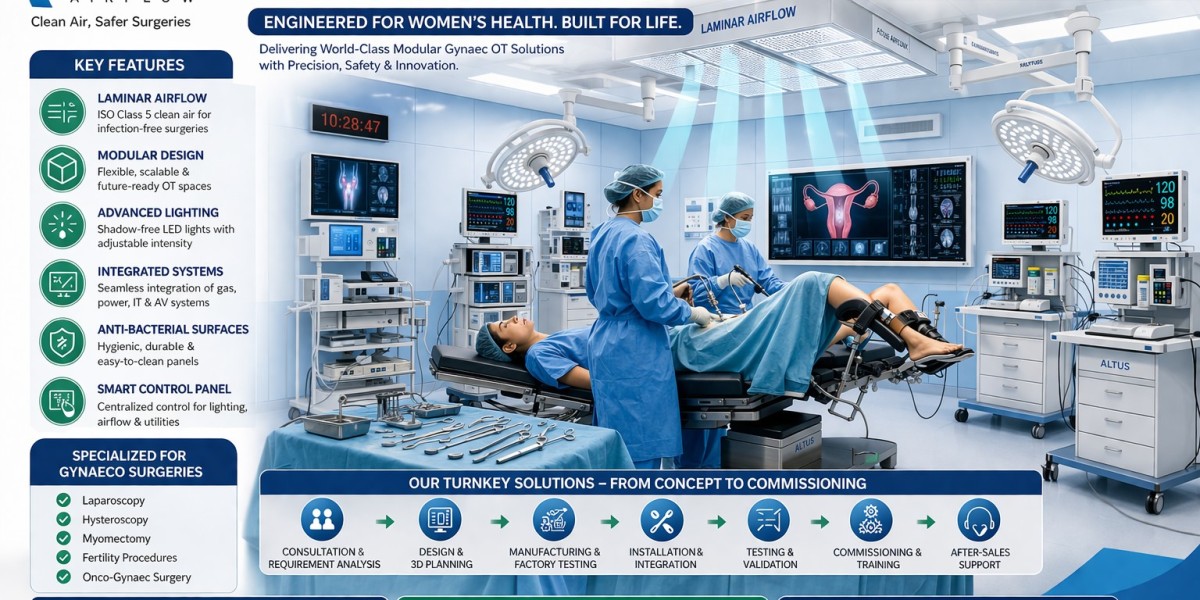
Some customized gynaecological operating theatres include laminar airflow arrangements to provide controlled air distribution over a designated surgical area.
The system's effectiveness depends on more than the filter itself. Ceiling design, airflow direction, supply area, equipment positioning, and the relationship between supply and return air all influence performance.
Manufacturers should coordinate the airflow system with surgical lights, ceiling pendants, and other equipment. Poor positioning can obstruct airflow or create turbulence.
Modular Gynaec OT Manufacturers should therefore verify the dimensions and installation requirements of the airflow system during the engineering and production stages.
The completed system should be inspected and tested against the approved airflow design. Filter integrity, air distribution, and room pressure relationships should be checked wherever required by the project specification.
8. Maintain Precision in Panel Manufacturing
Accurate manufacturing is essential for creating a properly fitted modular operating theatre. Incorrect panel dimensions or poorly finished edges can lead to gaps, installation difficulties, and hygiene concerns.
Production teams should verify panel measurements, thickness, surface finish, edge treatment, structural support, and equipment cut-outs.
Factory inspections should also confirm that wall panels and ceiling components match the approved drawings. Openings for control panels, electrical points, medical gas services, and other integrated equipment should be prepared accurately.
For customized projects, manufacturers should maintain clear identification and records for each component to support correct dispatch and installation.
9. Follow Electrical and Medical Gas Safety Requirements
Electrical and medical gas infrastructure must be coordinated carefully with the modular OT structure.
Electrical planning should consider surgical lights, general lighting, control panels, equipment sockets, UPS connections, communication systems, and other specified services. Electrical work should follow applicable Indian requirements and relevant safety standards.
Medical gas systems should be designed and installed by appropriately qualified personnel. Where applicable, ISO 7396-1 provides requirements for medical gas pipeline systems, including design, installation, testing, and commissioning.
Manufacturers should coordinate service routes, outlet positions, access panels, and equipment connections with the hospital's engineering team. Electrical and medical gas systems must undergo the appropriate inspections and safety tests before handover.
10. Integrate Gynaecological Equipment During Production Planning
A customized gynaec OT requires equipment integration to be considered early rather than after the modular structure has been manufactured.
The design team should review the requirements for operating tables, surgical lights, anaesthesia equipment, monitors, medical gas outlets, storage units, and other specialty-specific equipment.
Equipment dimensions, ceiling support requirements, electrical connections, and maintenance access should be included in the approved drawings.
This approach helps prevent clashes between equipment and modular components. It also supports better staff movement and access to essential services during procedures.
11. Conduct Factory Quality Inspections
Factory inspections help identify manufacturing defects before components are transported to the hospital.
Inspection procedures should be based on the approved quality plan and project specifications. They may include checking:
Panel dimensions and surface finish.
Door frames, hardware, and sealing arrangements.
Ceiling panel alignment and equipment openings.
Control panel assembly and functionality.
Filter housing dimensions and compatibility.
Electrical components and wiring identification.
Material documentation and product traceability.
Where the contract requires pre-dispatch inspection, the manufacturer should arrange it before shipment. Any deviations should be documented and resolved before dispatch.
12. Follow Controlled Installation Procedures
Production standards must continue through installation. Properly manufactured components can still produce poor results if they are installed incorrectly.
The installation team should follow approved drawings and coordinate with civil, electrical, HVAC, plumbing, and medical gas contractors.
Wall and ceiling panels should be aligned correctly, joints should be sealed as specified, and service openings should be finished properly. Doors, flooring, lighting, control panels, and equipment supports should be checked during installation.
A coordinated installation process reduces rework and helps protect the quality of the completed modular OT.
13. Complete Testing and Commissioning
Testing and commissioning confirm whether the installed operating theatre systems function according to the approved design.
Depending on the project scope, checks may include:
HVAC operation and airflow distribution.
HEPA filter integrity and installation checks.
Room pressure differential measurements.
Temperature and humidity monitoring.
Electrical safety and functional testing.
Medical gas pipeline testing.
Door operation and sealing.
Lighting and control panel functionality.
Testing should be carried out by qualified personnel using appropriate procedures and equipment. Results should be documented and reviewed before the operating theatre is handed over.
Government and hospital tender specifications commonly include design, fabrication, installation, integration, testing, and commissioning as parts of a coordinated modular OT project.
14. Maintain Documentation and Traceability
Documentation is an essential part of production quality because it provides evidence of what was manufactured, installed, and tested.
Manufacturers should maintain relevant records, including approved drawings, material specifications, inspection reports, test certificates, equipment details, and installation records.
At project completion, the hospital should receive applicable as-built drawings, commissioning reports, operating instructions, warranty details, and maintenance information.
Clear documentation makes it easier for hospital engineering teams to operate the systems, arrange servicing, and identify the specifications of installed components.
15. Provide Maintenance and After-Sales Support
Production quality should be supported by suitable maintenance guidance and after-sales assistance.
Manufacturers should explain routine inspection requirements for modular panels, door seals, flooring, HVAC systems, filters, control panels, and other installed components.
Maintenance schedules should follow equipment manufacturer recommendations and the hospital's operating procedures. Any repair or replacement should preserve the original design requirements and system performance.
Ongoing support helps hospitals maintain the functionality and hygiene of customized operating theatres.
Conclusion
Production standards are essential for building customized gynaecological operating theatres that meet hospital requirements for hygiene, safety, durability, and reliable performance. From material selection and precision panel manufacturing to HVAC integration, filtration, electrical safety, equipment coordination, and final commissioning, every stage requires proper engineering and quality control.
Hospitals should evaluate manufacturers based on their production procedures, technical documentation, material verification, installation capabilities, and maintenance support. Altus Airflow focuses on modular operating theatre infrastructure and controlled-environment solutions designed to support efficient, hygienic, and well-coordinated surgical spaces.
Frequently Asked Questions
1. What production standards should Modular Gynaec OT Manufacturers follow?
Modular Gynaec OT Manufacturers should follow documented quality management procedures, approved engineering specifications, relevant cleanroom requirements where applicable, suitable material standards, healthcare ventilation guidance, and electrical and medical gas safety requirements. They should also conduct factory inspections, installation checks, and final commissioning.
2. Why is ISO 9001 important for modular OT manufacturing?
ISO 9001 provides a quality management framework that supports consistent production processes, material inspection, documentation, corrective actions, and continual improvement. It helps manufacturers establish systematic quality procedures across customized OT projects.
3. How does ISO 14644 apply to customized gynaec OTs?
ISO 14644 may apply when a project specifies cleanroom classification or airborne particle measurement. It helps define relevant cleanliness and testing requirements, depending on the classification and project specifications.
4. What materials should be used in customized gynaecological operating theatres?
Suitable materials may include stainless steel, powder-coated galvanized steel, approved modular wall and ceiling panels, hygienic flooring, and compatible joint sealants. The selection should consider cleanability, durability, chemical resistance, and the intended application.
5. What quality tests should be completed before handing over a modular gynaec OT?
Testing may include HVAC performance, airflow distribution, HEPA filter integrity, room pressure differentials, temperature and humidity monitoring, electrical safety, medical gas system checks, door operation, and control panel functionality. The exact tests should follow the approved project specifications and applicable requirements.