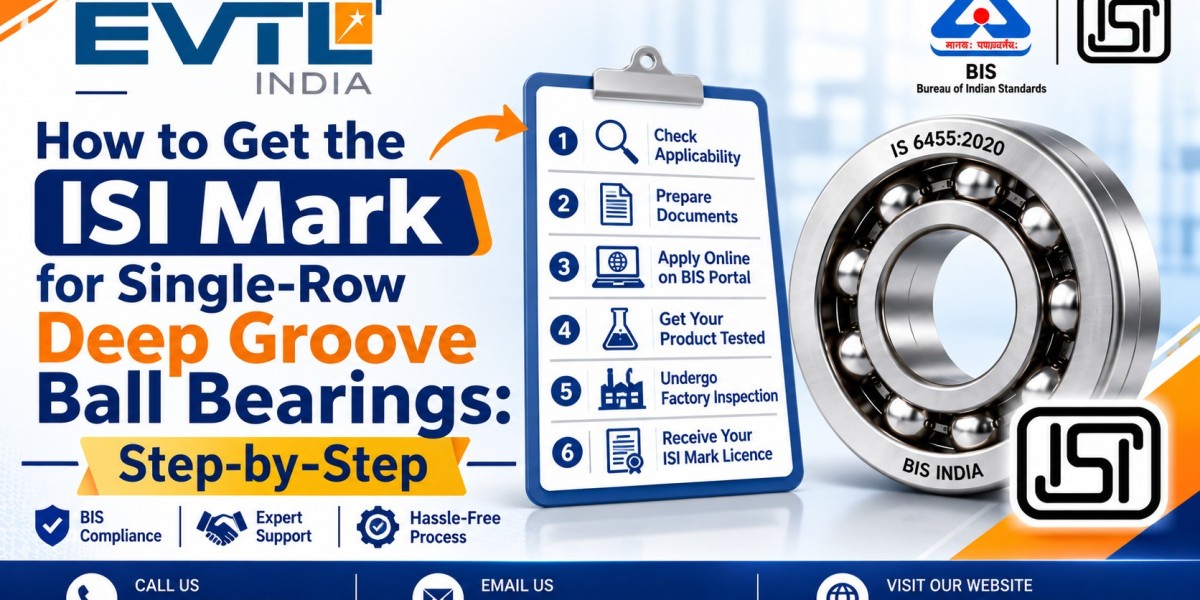

You have a factory that makes bearings, or you plan to bring them into India. Then one question comes up fast: how do I put the ISI mark on my product? The answer is not hard, but it has many small steps, and missing one can stall your file for weeks. In this guide, we walk through each step in plain words. We also cover one big update that many sellers do not know about yet.
First, Know What the ISI Mark Means
The ISI mark is a sign from the Bureau of Indian Standards (BIS). It tells buyers that a product was tested and that the factory follows quality rules. For these bearings, getting the BIS ISI Mark For Single-Row Deep Groove Ball Bearings is compulsory in India. You cannot make, import or sell them without it.
Single-row deep groove ball bearings are used in fans, motors, pumps, gearboxes, washing machines and vehicles. Since a weak bearing can spoil a whole machine, the government wants every one of them to meet a standard.
Step 1: Check Which Standard Applies
Before you do anything, find out which rule book you must follow. The old standard was IS 6455:2020. BIS has now revised it as IS 6455:2026, and the last date to follow the new version was 27 August 2026. That date is over, so all new work must follow the revised standard.
Some changes you should know:
- The maker must declare the load ratings of the bearing.
- Sizes from IS 5669 are also allowed.
- Rules for ring and cage materials are updated.
- A test for the tiny inside gap (radial internal clearance) is added.
- Hardness can be checked on the Vickers scale.
- Rust-preventive oil and country of origin marking are now part of the rules.
Step 2: Get Your Papers Ready
Gather your documents before you start. This saves time later. You will usually need:
- Business registration and owner’s ID proof
- Factory address proof
- Factory layout and list of machines
- Manufacturing process chart
- List of testing equipment in your factory
- Authorized Indian Representative papers (only for foreign makers)
Step 3: Apply Online
Next comes BIS Registration for Single-Row Deep Groove Ball Bearings, which is done on the Manak Online portal of BIS. You fill in your company details, factory details and product details, and you upload your documents. Check every line twice. A wrong name, a wrong address or a missing paper is the most common reason for delay.
Step 4: Test Your Product in a Lab
BIS needs proof that your bearing is good. So you send samples to a BIS-recognized lab. The lab checks things like:
- Size of the bearing
- Material of the rings and cage
- Hardness
- Radial internal clearance
- Working at higher temperature
- Protection against rust
- Marking on the product
Keep the lab report safe, because you will need it for the next step.
Step 5: Prepare for the Factory Visit
After the application and test reports, a BIS officer visits your factory. The officer looks at how you make the bearings, whether your machines are in good condition, and whether you have the right test equipment and records. A tidy factory with clear records makes the visit smooth.
Step 6: Receive Your License
If your product passes the test and your factory passes the visit, BIS grants you a license under the ISI mark scheme. You will get a license number, often shown as a CM/L number. Only after this can you start using the mark.
Step 7: Put the Mark on Your Product
Now you can print or engrave the ISI mark along with your license number on the bearing or its pack, as the rules ask. Do not use the mark before the license is in your hand. Using it early is a serious offence.
Step 8: Keep Your License Alive
Getting the license is not the end. To keep it, you must:
- Test your product regularly
- Keep proper records
- Allow BIS visits at any time
- Renew the license on time
Old license holders also need to send their load rating and designation details to BIS under the revised standard.
Should You Take Expert Help?
You can apply on your own, but the process has many forms, tests and rules. One small mistake can send your file back and cost you weeks. Expert help is a smart choice if:
- This is your first BIS application
- You are a foreign maker and need an Authorized Indian Representative
- You already hold an old license and must move to the revised standard
- You want to avoid delays and repeat visits
A good BIS Consultant for Single-Row Deep Groove Ball Bearings will:
- Tell you which version of the standard applies to you
- Check your papers before you submit them
- Guide you on lab testing
- Prepare your factory for the BIS visit
- Help with renewals and later updates
Whether you take help or not, read the BIS IS Standard for Single-Row Deep Groove Ball Bearings closely, so you know exactly what your product must meet.
Conclusion
EVTL India is one of the leading BIS Consultant in India, helping manufacturers obtain their BIS licenses hassle-free. Our team supports you at every step, from checking the standard and filing papers to lab tests, factory visits and renewals. If you also need to update an old license for the revised rules, we can help with that too.
The ISI mark takes some effort, but once you have it, you can sell your bearings in India with full trust. Talk to our team today and make the process easy.
? +91 95609 35898
? contact@evtlindia.com
? www.evtlindia.com
Frequently Asked Questions
1. Is the ISI mark compulsory for ball bearings in India?
Yes. A government Quality Control Order says these bearings must follow the Indian Standard and carry the ISI mark under a BIS license.
2. Which standard should I follow now?
You should follow IS 6455:2026. BIS fixed 27 August 2026 as the last date to follow the revised version, and that date is over.
3. Does BIS visit my factory?
Yes. A BIS officer checks your manufacturing process, test equipment and records before the license is granted.
4. Can I use the ISI mark as soon as I apply?
No. You can use the mark only after BIS grants the license. Using it earlier is a serious offence.
5. How long does the whole process take?
There is no fixed time. It depends on how complete your papers are, how soon the lab tests finish and when the factory visit happens. Ready documents help a lot.
6. I already have a license under the old standard. What now?
You must follow the revised standard, send your load rating and designation details to BIS, and show test proof for the new or changed requirements. Check your status with BIS or your consultant without delay.