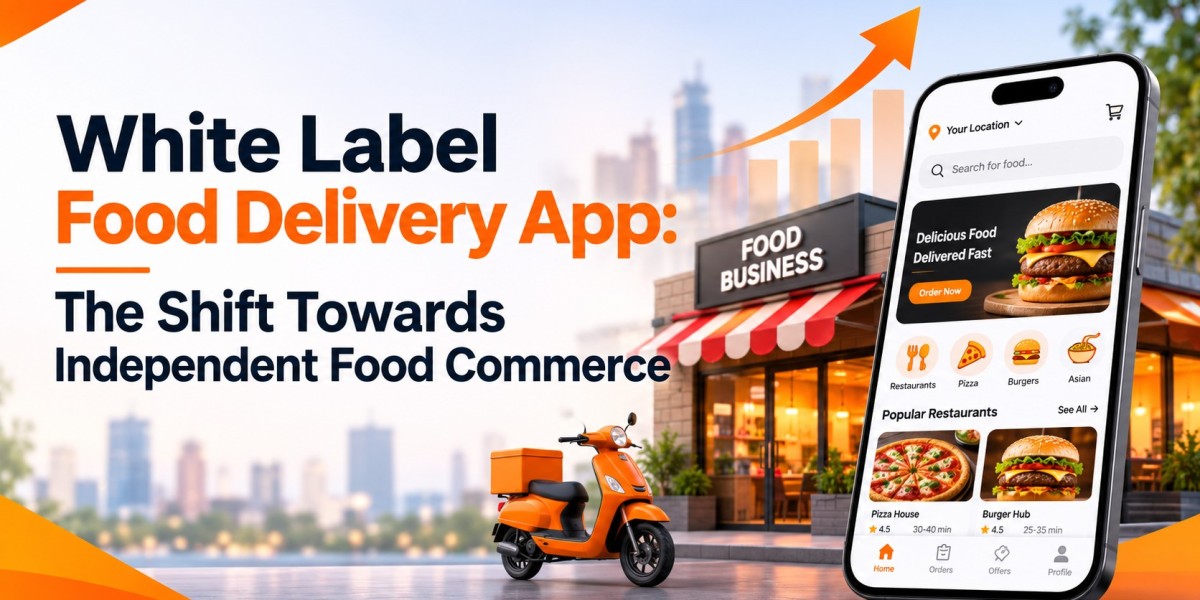

The competition in food delivery is no longer limited to restaurants offering attractive menus or faster delivery. A more significant business shift is taking place behind the ordering experience: who owns the customer relationship, who controls the purchasing journey, and who benefits from repeat transactions? These questions are influencing how restaurant groups, cloud kitchens, food entrepreneurs, and hospitality businesses approach digital expansion.
Third-party marketplaces provide access to established audiences, but they also introduce platform commissions, promotional competition, and limited control over the overall customer experience. As a result, businesses are exploring independent digital channels that allow them to establish their own identity in the online food market. A White Label Food Delivery App creates an opportunity to build that channel without developing an entire technology ecosystem from scratch.
The Economics of Food Ordering Are Changing
A restaurant can receive hundreds of online orders and still struggles to improve its margins. Discounts, delivery expenses, marketplace commissions, packaging costs, and customer acquisition expenses all influence the final profitability of an order.
This is why restaurant owners are beginning to evaluate digital ordering through a different perspective. Instead of measuring success only through order volume, businesses are paying greater attention to customer acquisition costs, repeat purchase rates, average order value, and contribution margins.
Research from India's National Council of Applied Economic Research (NCAER), reported in December 2025, highlighted the growing commission burden experienced by restaurant partners on food delivery platforms. Its findings brought renewed attention to the economics of aggregator-based ordering.
Independent ordering channels offer another way to approach this challenge. Restaurants can create branded purchasing experiences, introduce their own promotional strategies, and develop customer relationships through a channel they control.
Food Businesses Are Becoming Digital Brand Owners
The traditional restaurant model primarily depended on physical locations, walk-in customers, and telephone orders. Digital commerce has changed that relationship by allowing restaurants to reach customers beyond their immediate physical premises.
Today, a restaurant brand can build an online presence through its own ordering website and mobile application. This creates opportunities to maintain a consistent identity across menus, promotions, payment experiences, and customer communication.
The change is particularly relevant to three business categories:
Cloud kitchen operators: Businesses managing multiple virtual restaurant brands can establish individual digital identities while coordinating operations through a shared management system.
Restaurant chains: Multi-location businesses can centralize menu management, customer engagement, and order administration while maintaining location-specific availability.
Food entrepreneurs: Startups can establish a multi-vendor food ordering marketplace that brings independent restaurants together under a new commercial brand.
Each model has different operational requirements, but all benefit from having greater control over their digital ordering experience.
The Customer Journey Is Becoming More Valuable Than the Order
A completed food order represents only one transaction. The larger opportunity lies in understanding what happens before and after that purchase.
Customers may discover a restaurant through a promotional campaign, compare menu options, customize their meals, complete payment, and eventually return for another order. Every interaction creates an opportunity to improve the customer experience.
This makes customer engagement an important part of food commerce strategy.
Restaurant-owned applications can support loyalty programmes, personalized recommendations, reorder options, membership benefits, and targeted notifications. Businesses can also analyse purchasing patterns to identify frequently ordered dishes, popular combinations, and customer preferences.
NCR Voyix's 2025 Customer Experience Report highlighted consumer interest in ordering directly through restaurant-owned digital channels. This reinforces the importance of convenient ordering experiences and meaningful brand relationships.
For operators, the objective should be to make direct ordering sufficiently convenient and rewarding that customers have a reason to return.
Why the Next Competitive Advantage Will Come from Connected Operations
As digital ordering expands, managing the complete order lifecycle becomes increasingly important. A business may attract customers through marketing, but its ability to fulfil orders accurately determines whether those customers return.
Consider the relationship between different operational activities:
Menu availability must reflect actual kitchen inventory.
Order confirmation must reach the appropriate restaurant outlet.
Kitchen preparation should align with delivery availability.
Delivery assignments should account for distance and estimated preparation time.
Customers should receive accurate updates throughout the journey.
When these activities operate independently, businesses can experience avoidable delays, cancellations, and customer dissatisfaction.
An integrated food delivery system can connect restaurant administration, order processing, delivery coordination, and customer communication. Intelligent analytics can further help operators understand demand patterns and identify operational bottlenecks.
For growing food businesses, this connected approach is more valuable than simply adding another digital ordering channel.
Can Independent Ordering Support New Business Models?
The opportunity extends beyond traditional restaurant delivery. Businesses can introduce additional services around their existing food operations.
For example, corporate meal subscriptions can serve organizations requiring regular employee meals. Scheduled food ordering can support customers who prefer planning meals in advance. Cloud kitchen operators can introduce multiple cuisine brands through one operational network.
Entrepreneurs entering the multi-vendor marketplace segment can also develop partnerships with restaurants and generate income through vendor subscriptions, promotional placements, and transaction-based commissions.
These models create opportunities to serve different customer groups without depending exclusively on individual food orders.
The important consideration is selecting a business model that matches local purchasing habits, delivery economics, and available restaurant partnerships.
What Should Businesses Evaluate Before Choosing a White Label Solution?
Selecting technology is a business decision that influences future operating costs and expansion opportunities. Entrepreneurs should evaluate more than the appearance of the application.
A suitable solution should provide:
Brand customization: The ability to configure logos, colours, menus, and customer-facing experiences around the business identity.
Multi-outlet management: Centralized administration for restaurant branches, cloud kitchens, or multiple vendor accounts.
Flexible order administration: Tools to manage order receipt, preparation, cancellation, and fulfillment.
Payment flexibility: Integration with payment methods suitable for the intended market.
Customer retention tools: Loyalty programs, promotions, notifications, and purchasing insights.
Business analytics: Reports covering order activity, sales performance, customer behavior, and operational efficiency.
Businesses should also evaluate data ownership, security standards, integration possibilities, ongoing maintenance, and the flexibility to introduce new services.
From Marketplace Participation to Independent Digital Growth
The food delivery market is creating space for businesses that want greater control over how they attract customers and generate revenue. Third-party marketplaces will continue to play an important role in customer discovery, but they do not need to be the only digital sales channel for every restaurant.
A White-Label Food Delivery App gives entrepreneurs, restaurant chains, and cloud kitchen operators an opportunity to establish an independent branded ordering ecosystem with customizable business operations.
With spotneats, businesses can explore a white-label food delivery solution that brings customer ordering, restaurant management, payment processing, delivery coordination, and administrative operations together under their own brand.
The next opportunity in food commerce is not simply receiving more online orders. It is building a digital business that owns its customer experience, strengthens repeat purchasing, and creates room for long-term expansion.




