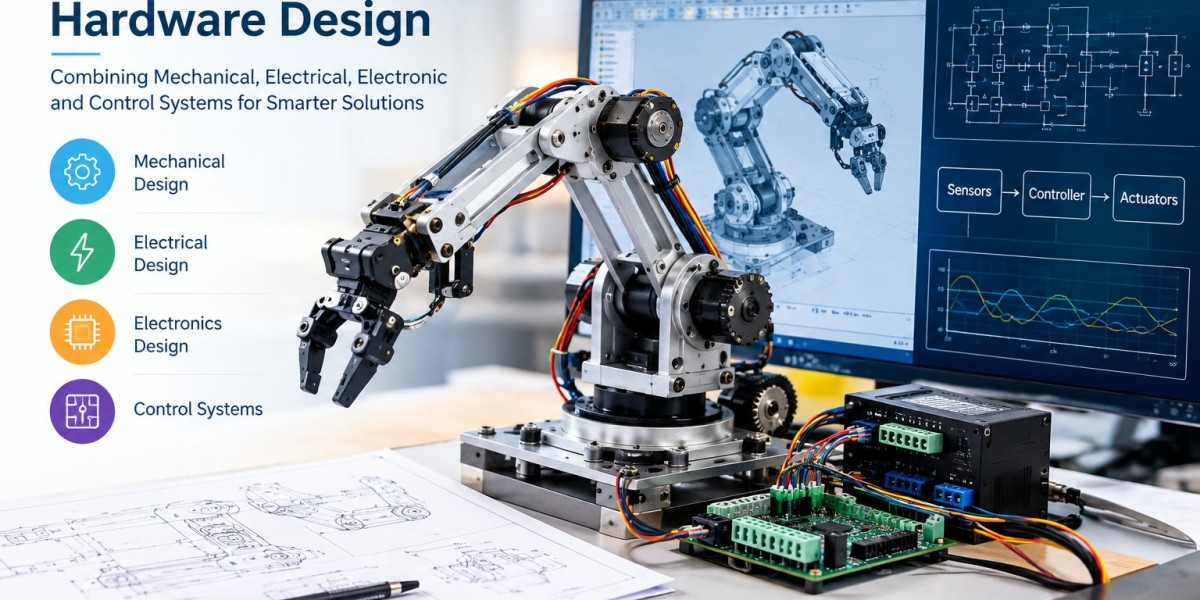

Industrial automation is transforming the way manufacturing businesses operate. Modern factories use automated machines, electronic controllers, sensors, and robotic equipment to improve production processes and maintain consistent output. These technologies require proper coordination between mechanical and electronic components. Mechatronics and Hardware Design provides the engineering foundation for developing integrated automation systems that perform complex industrial tasks.
The Connection Between Mechatronics and Automation
Mechatronics combines mechanical engineering, electronics, control systems, and embedded computing. In industrial environments, these disciplines work together to create machines that can perform operations with limited manual intervention.
For example, an automated packaging machine may use mechanical conveyors to move products, sensors to detect their position, motors to control movement, and an electronic controller to coordinate the complete process.
The performance of such equipment depends on how effectively these individual components communicate and operate together.
Hardware Components Used in Industrial Systems
Hardware selection is an important part of industrial automation development. Engineers must choose components according to machine requirements, environmental conditions, and expected operating performance.
Common hardware components include:
1. Industrial Controllers: PLCs and embedded controllers manage machine operations and process input signals.
2. Sensors: Proximity, temperature, pressure, and position sensors provide information about machine conditions.
3. Motors and Drives: These components control movement, speed, and mechanical operations.
4. Actuators: Pneumatic, hydraulic, and electric actuators convert control signals into physical actions.
5. Communication Interfaces: Industrial communication hardware allows different devices to exchange operational information.
6. Power Supply Systems: These provide the electrical power required by controllers, sensors, and other equipment.
Selecting compatible components helps create an organized and functional automation architecture.
Importance of Mechanical and Electrical Integration
Industrial machines often contain several interconnected mechanical and electrical systems. A mechanical design must provide sufficient space for electronic components, cable routing, sensors, and actuators.
At the same time, hardware designers need to consider mounting arrangements, vibration, temperature, electrical noise, and accessibility for maintenance.
Applications in Manufacturing
Integrated mechatronic systems are used in many manufacturing operations.
Automated Assembly: Machines coordinate robotic arms, sensors, and actuators to assemble different product components.
Material Handling: Conveyors and automated transfer systems move materials between production stages.
Packaging Equipment: Electronic controllers manage filling, sealing, labeling, and product movement operations.
Quality Inspection: Sensors and inspection devices help identify product defects and measure specific characteristics.
Robotic Automation: Mechanical structures, motors, sensors, and controllers work together to perform programmed movements.
These applications demonstrate how integrated engineering supports modern production environments.
Benefits of Effective Hardware Planning
A well-planned hardware architecture can improve the overall development and operation of industrial equipment.
Some important advantages include:
Better coordination between mechanical and electronic components.
Improved control over machine operations.
Easier integration of sensors and actuators.
More organized electrical connections.
Improved maintenance accessibility.
Greater flexibility for future modifications.
The actual benefits depend on system requirements, component quality, and implementation practices.
Testing and Validation of Automation Systems
Before industrial equipment is deployed, engineers must verify that its mechanical and electronic components operate correctly.
Testing may include checking sensor readings, motor operation, controller responses, communication signals, and electrical connections. Mechanical testing can also help evaluate movement accuracy, vibration, and structural performance.
Integrated system testing is especially important because individual components may work correctly on their own but behave differently when connected.
Future of Industrial Mechatronics
Smart manufacturing, robotics, industrial IoT, and connected production systems are creating new opportunities for mechatronic engineering.
Future automation equipment will increasingly depend on compact hardware, intelligent controllers, advanced sensors, and improved communication technologies. Engineering teams will need to focus on reliable integration to develop systems that can adapt to changing production requirements.
Conclusion
Mechatronics and Hardware Design plays an important role in modern industrial automation by connecting mechanical structures, electronic hardware, and control technologies. From robotic equipment and automated assembly lines to packaging and material handling systems, integrated engineering supports coordinated machine operations.
With suitable component selection, effective system integration, and proper testing, manufacturers can develop automation solutions that meet their operational and production requirements.




