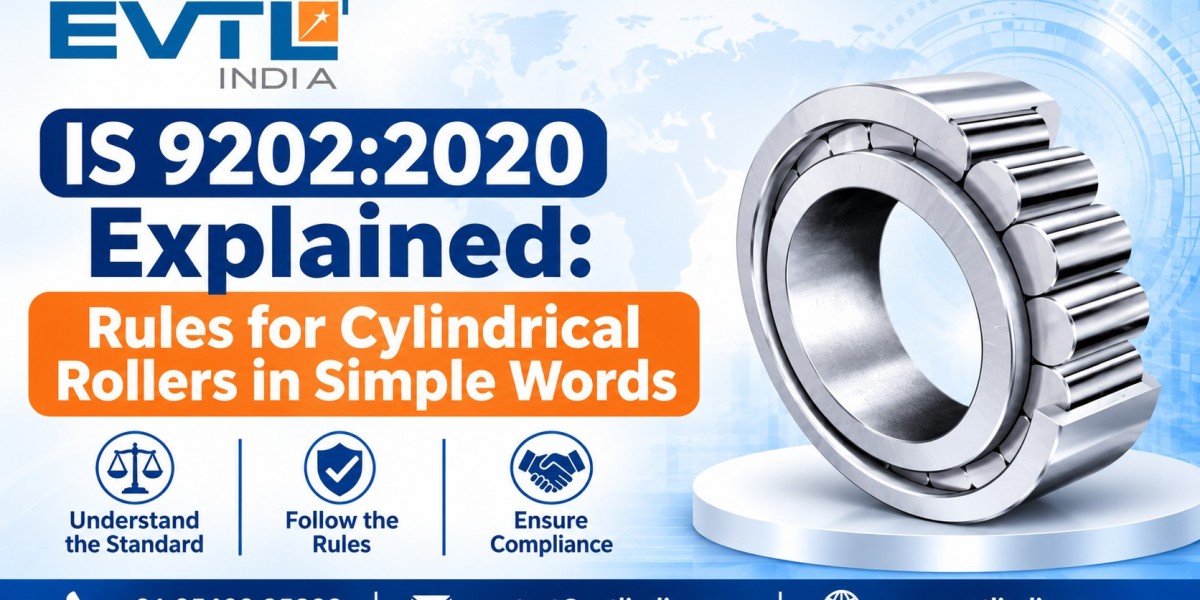

Have you ever wondered what keeps a machine running smoothly for years? A big part of the answer sits inside its bearings. And inside many bearings, small steel rollers do the hard work. In India, these rollers follow a rule book called IS 9202:2020. In this article, we explain that rule book in very simple words.
What Are Cylindrical Rollers?
Cylindrical rollers are small steel parts shaped like tiny tubes. They sit between the rings of a bearing and roll as the bearing turns. Because they are straight along their sides, they can carry heavy weight without slipping.
You will find them in gearboxes, electric motors, pumps, trucks, cranes and many factory machines. If even one roller is a little too big, too small or too rough, the whole bearing can wear out early or make noise. That is why a clear standard is needed.
What Does the Standard Say?
The rule book is made by the Bureau of Indian Standards, also called BIS. It is the first revision of an older rule and was published in December 2020. It covers these things:
- Size and naming of the rollers
- Weight of the rollers
- The type of steel to be used
- Heat treatment, which makes the steel hard
- How exact the size and shape must be
In simple words, it tells a maker how a good roller should look, what it should be made of and how exact it must be.
Why These Rules Matter
These rules are not just paperwork. They help everyone in the chain:
- Every batch of rollers has the same quality
- Rollers from different makers fit well with each other
- Machines face fewer breakdowns
- Buyers trust the product more
Who Needs to Care?
If you make, import or sell cylindrical rollers in India, this topic is for you. This includes:
- Indian roller manufacturers
- Foreign manufacturers who send rollers to India
- Importers and brand owners
- Sellers and distributors
The government has shared a draft Bearing Components and Accessories (Quality Control) Order, 2025. It says these goods must follow the standard and carry the ISI Mark under a BIS license. Rollers made only for export are left out. Small imports for research, up to 200 pieces a year, are also left out.
The draft gives time to comply: 12 months for medium and large units, 15 months for small units and 18 months for micro units. It was still a draft when we checked, so please read the final notice before you plan.
What Tests Are Done?
The BIS Testing Requirement for Cylindrical Rollers for Rolling Bearings covers many checks. Some are done in your own factory lab and some in a BIS-recognized lab.
- Material: correct steel grade, chemical mix and cleanliness of the steel
- Size: diameter, length, roundness and edge shape
- Strength: hardness, load carrying and wear resistance
- Surface: roughness, cracks, pits and rust
- Batch control: random samples and tracking from raw material to finished roller
Steps to Get Certified
To sell rollers legally under the rule, you need BIS Certification for Cylindrical Rollers for Rolling Bearings. The path is simple when you take it one step at a time:
- Register on the BIS Manak portal with company, factory and product details.
- Send samples to a BIS-recognized lab for testing.
- Submit the application with test reports and documents.
- Face a BIS factory inspection.
- Receive your license under Scheme-I.
- Start using the ISI Mark with your CM/L number.
Keep these papers ready: GST certificate, factory address proof, list of machines and test equipment, calibration certificates, process flow chart, factory layout, raw material details with test certificates and trademark proof.
The ISI Mark on Your Roller
After approval, you can put the ISI Mark on your product. The mark must be clear and long-lasting, on the roller or on its packing. Along with it, show:
- The standard number
- Your CM/L number given by BIS
- Your name or trademark
- Batch number or date, so the roller can be traced
Fees and Validity
For Indian manufacturers, the main government fees are:
- Application fee: INR 1,000
- Audit charges: INR 7,000
- License fee: INR 1,000
- Marking and testing: as applicable
Fees can change, so always check the latest BIS rates. A license is usually first given for 1 to 2 years. After that, you must renew it on time, allow factory visits and pass market sample tests. If samples fail, the license can be suspended or cancelled.
What About Foreign Manufacturers?
If your factory is outside India, you must appoint an Authorized Indian Representative, also called AIR. This person talks to BIS for you and helps keep your paperwork correct.
Common Mistakes to Avoid
- Missing calibration certificates for test equipment
- Weak records of raw material purchase and testing
- Choosing the wrong product scope in the application
- Not tracking batches properly
- Forgetting to renew the license on time
Conclusion
EVTL India is one of the leading BIS Consultant in India, helping manufacturers obtain their BIS licenses hassle-free. The team supports you with documents, application filing and lab coordination, from the first call to the final license.
If you make or sell cylindrical rollers, start early. Early planning gives you time for testing, the factory audit and any fixes.
Contact EVTL India today:
Phone: +91 95609 35898
Email: contact@evtlindia.com
Website: www.evtlindia.com




