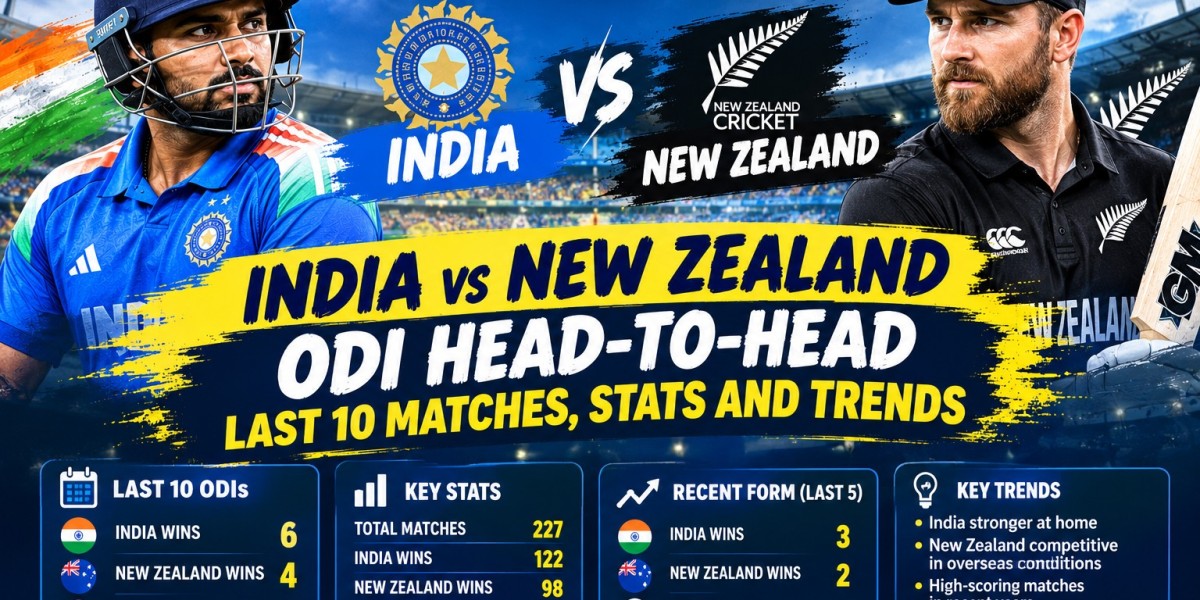

T20 head-to-head tells you who wins in 20 overs. ODI head-to-head tells you something different: who wins when a match lasts 50 overs, when the middle overs matter more than the powerplay, and when a team has time to recover from a bad start — or time to lose a match it was winning.
India and New Zealand have played ODI cricket against each other since 1975. The overall record favours India. The recent record is more interesting, because it splits in two directions at once: India have dominated New Zealand in ICC tournaments in Asia, while New Zealand won the last bilateral ODI series between the sides, in India, in January 2026.
That split is the story of this head-to-head, and it is why the November 2026 ODI series in New Zealand matters more than a simple “India lead overall” headline suggests.
Overall ODI head-to-head, frozen before November 2026
India lead by 11 wins overall. That is a clear lead, but not a dominant one — New Zealand have won 52 ODIs against India, more than most teams manage against India in this format, and the tied match and seven no-results are a reminder of how many of these fixtures have been affected by rain, especially in New Zealand.
The overall record, on its own, would suggest India should win the November series comfortably. The last 10 matches, and the last bilateral series, suggest something more competitive.
Last 10 ODI matches: the full list
These are the last 10 completed ODIs between the sides, in reverse chronological order, from January 2026 back to January 2023. There are no no-results in this last 10 — the rain-affected matches from November 2022 in New Zealand have now dropped out of the window, replaced by the January 2026 series.
Last-10 split
That 8-2 split looks like dominance, until you read it in order.
India won the first seven matches in this last-10 window, from Hyderabad in January 2023 through Dubai in March 2025, including two World Cup wins in 2023 and two Champions Trophy wins in 2025. New Zealand then won the last two matches in the window, in Rajkot and Indore in January 2026, to take the bilateral series 2-1, after India had won the first match in Vadodara.
In other words: India have won 8 of the last 10, but New Zealand have won 2 of the last 3, and the most recent bilateral series. Recent form, in ODIs, is therefore not a simple India winning streak. It is an India winning streak that ended in January 2026, with New Zealand finding a way back in the last two matches of that series.
That is a very different trend from a T20I head-to-head, where a powerplay can decide a match in six overs. In ODIs, a series can turn in the middle overs of the second and third matches, when bowlers adjust, batters tire, and the team that learns faster wins the next match, not just the first one.
Trend 1: India dominate New Zealand in ICC tournaments in Asia, but not in bilaterals
Look at where India's last-10 wins came from:
- World Cup 2023, in India: India won in Dharamsala by 4 wickets, and in Mumbai in the semi-final by 70 runs, posting 397 for 4.
- Champions Trophy 2025, in Dubai: India won in the group stage by 44 runs, with Varun Chakaravarthy taking a five-wicket haul as New Zealand, chasing 250, were bowled out for 205, and won the final by 4 wickets, chasing 252 with one over to spare, after New Zealand made 251 for 7.
Those four wins are all in Asian or neutral Asian conditions, in tournaments, with full-strength squads and high pressure. India, in those conditions, have been the better ODI team against New Zealand in recent years.
The bilateral story is different. In January 2026, in India, New Zealand lost the first ODI in Vadodara by 4 wickets, after India chased 301, reaching 306 for 6, but then won in Rajkot by 7 wickets, chasing 285 with 286 for 3, and won in Indore by 41 runs, posting 337 for 8 and bowling India out for 296.
That is a bilateral comeback, not a tournament upset. New Zealand adjusted between matches, posted 300-plus totals in the last two matches, and chased and defended successfully in consecutive games. That ability to adjust across a bilateral series is exactly what will matter in November 2026, when the teams play five ODIs in a row in New Zealand, not just one tournament match.
Trend 2: 300 is the new par, and the middle overs decide ODIs
Every match in the January 2026 series produced a first-innings total of 284 or more, and two of the three produced 300-plus totals: 300 for 8 and 306 for 6 in Vadodara, 284 for 7 and 286 for 3 in Rajkot, and 337 for 8 and 296 in Indore.
That is the ODI trend to carry into November: 50-over matches between these sides are no longer low-scoring, seaming contests decided by the new ball alone. They are high-scoring matches decided by:
- Middle-overs spin and control: Who bowls 11 to 40 overs without leaking runs, and who takes wickets in that phase, rather than just containing?
- Death-overs execution: Who scores 80-plus in the last 10 overs, and who defends a total when the batting team is set?
- Chasing under scoreboard pressure: India chased 301 in Vadodara and won, but failed to chase 338 in Indore. New Zealand chased 285 in Rajkot and won comfortably, with 7 wickets in hand. Chasing is not automatic in ODIs, even for a strong batting team, when the total is 330-plus.
In T20 cricket, a powerplay of 118 for 0 can end a match. In ODI cricket, a powerplay of 60 for 0 is just a start. The match is won in overs 20 to 40, when the ball stops swinging, the field spreads, and batters have to build an innings rather than just hit through the line.
That is why ODI head-to-head should not be read as a T20 head-to-head with more overs. It is a different skill set, and New Zealand's January 2026 comeback was built on that skill set: posting 337, defending it, and chasing 285 without panic.
Trend 3: World Cup balance is still even, despite India's recent wins
At ODI World Cups specifically, the head-to-head is balanced: 5 wins each, with 1 match abandoned, from the older World Cup record, before any new World Cup meeting.
That balance matters because it corrects a common misreading of the last 10. India won the last two World Cup meetings — Dharamsala and Mumbai in 2023 — but New Zealand won the famous 2019 semi-final in Manchester, and the overall World Cup record is still level.
In other words, India have won the recent World Cup and Champions Trophy meetings, but they have not “solved” New Zealand in ODI tournaments historically. New Zealand, in ICC events, have repeatedly beaten India when India were favourites, and that history will be in the background when these teams meet again in an ICC ODI event, even if it is not in the November bilateral series.
For the November series, the more relevant history is bilateral, not tournament: New Zealand won the last bilateral series 2-1, in India, in January 2026. That is the form line New Zealand will carry into Auckland, and the form line India will want to reverse.
This middle section is where fans usually check ODI head-to-head together, with the overall record, the last 10 list and the trends in one place, alongside official broadcasts. A platform like Cricbet99 is sometimes used for that kind of following. That platform is a gaming and betting-related service, so any related features are for adults only, where legally permitted, and following ODI head-to-head does not require using any betting feature.
What the January 2026 series tells us about November 2026
January 2026 was a three-match series in India. November 2026 is a five-match series in New Zealand, with different conditions, different squads, and a different format split.
The November ODI schedule, all at 7:30 AM IST, is:
- 1st ODI: Wednesday 4 November 2026, Eden Park, Auckland
- 2nd ODI: Saturday 7 November 2026, Wellington
- 3rd ODI: Tuesday 10 November 2026, Seddon Park, Hamilton
- 4th ODI: Friday 13 November 2026, Bay Oval, Mount Maunganui
- 5th ODI: Sunday 15 November 2026, Bay Oval, Mount Maunganui
Broadcast in India: Sony Sports Network on TV, Sony LIV for streaming.
The squads for November are split, because the Test series starts in Wellington on 19 November, and that split is itself a trend to watch:
- India, first three ODIs: Shubman Gill captains, Shreyas Iyer is vice-captain
- India, last two ODIs: Shreyas Iyer captains, Ishan Kishan is vice-captain
- India, both squads: Rohit Sharma and Virat Kohli are named in both squads, bringing ODI experience that the T20I squad, by design, did not have
- India, first-three only: Gill, KL Rahul, Anshul Kamboj and Prasidh Krishna, with Prasidh's ODI inclusion originally subject to fitness clearance, and a later report on 28 October saying he had been ruled out of the ODI series and was racing to be fit for the Tests — check the latest BCCI update before the first ODI, rather than treating either version as final
- India, last-two only: Tilak Varma, Auqib Nabi, Kumar Kushagra on a maiden call-up, and Yash Thakur come in
- New Zealand, split squads too: First three led by Mitchell Santner, with Tom Latham, Daryl Mitchell, Glenn Phillips, Rachin Ravindra, Matt Henry and Kyle Jamieson, and last two with Finn Allen, Lockie Ferguson, Tim Seifert and Mitch Hay among the changes
Jasprit Bumrah is missing from the ODI leg but selected for the Tests, and Hardik Pandya is not in the ODI squads. Those two absences change the ODI bowling and all-round balance, compared with a full-strength India ODI side, and they make the middle-overs and death-overs trends above even more important: without Bumrah, who bowls the death, and who takes wickets in the middle overs?
New Zealand, at home, with Santner leading the first three ODIs, will look to do what they did in January 2026: post 300-plus, chase 280-plus comfortably, and adjust across the series. India, with Rohit and Kohli's ODI experience, will look to do what they did in Dubai and Mumbai: win the big moments in tournaments, and now translate that into a bilateral series win away from home.
How to use this head-to-head in a preview — without cannibalising the T20I piece
If you have already published the T20I head-to-head piece, do not copy its structure or its numbers into this ODI piece. Use this ODI piece for:
- Overall ODI record: 123 matches, India 63, New Zealand 52, 1 tied, 7 no results
- Last 10 ODIs: India 8, New Zealand 2, with New Zealand winning the last two, in Rajkot and Indore, in January 2026
- Last bilateral series: New Zealand won 2-1 in India, January 2026
- ICC tournament trend: India won the last four ICC ODI meetings, in the 2023 World Cup and 2025 Champions Trophy, but World Cup head-to-head overall is still 5-5, with 1 abandoned
- November series: Five ODIs, 4-15 November, split squads, Rohit and Kohli in both India squads, Bumrah missing the ODI leg
Use the T20I piece for T20I numbers only: 34 matches, India 22, New Zealand 11, tied 1, after Wellington, and last-10 T20I split India 9, New Zealand 1. Do not mix the two. A reader who finds both pieces should get two different answers, for two different formats, not the same answer twice.
Frequently Asked Questions
What is the IND vs NZ ODI head-to-head overall?
123 matches, India 63 wins, New Zealand 52 wins, 1 tied, 7 no results, frozen before the November 2026 ODI series.
What is the last-10 ODI split?
India 8, New Zealand 2, from January 2023 to January 2026, with no no-results in that window.
What were the last three ODIs between India and New Zealand?
11 January 2026, Vadodara: India won by 4 wickets, chasing 301. 14 January 2026, Rajkot: New Zealand won by 7 wickets, chasing 285. 18 January 2026, Indore: New Zealand won by 41 runs, after posting 337 for 8.
Who won the last ODI series between the sides?
New Zealand, 2-1 in India in January 2026, after losing the first match in Vadodara and winning in Rajkot and Indore.
What is the ODI World Cup head-to-head?
5 wins each, with 1 match abandoned, from the World Cup record before any new World Cup meeting. India won the last two World Cup meetings, in Dharamsala and Mumbai in 2023, but New Zealand won the 2019 semi-final in Manchester.
When is the next IND vs NZ ODI series?
4-15 November 2026 in New Zealand: Auckland on 4 November, Wellington on 7 November, Hamilton on 10 November, and Mount Maunganui on 13 and 15 November, all at 7:30 AM IST, on Sony Sports Network and Sony LIV in India.
Does T20I form in October predict ODI form in November?
No, not directly. T20I form is about powerplay tempo and death bowling in 20 overs. ODI form is about middle-overs control, 300-plus totals, and adjusting across a five-match series. Use the ODI head-to-head above for ODI previews, and the T20I head-to-head separately for T20I previews.
Final thoughts
ODI head-to-head between India and New Zealand is not a story of one team dominating the other. It is a story of two teams who beat each other in different contexts: India in recent ICC tournaments in Asia, New Zealand in the last bilateral series in India, and a level record at World Cups overall.
The last 10 ODIs — India 8, New Zealand 2 — flatter India if you read them without order. Read them in order, and you see a seven-match India winning streak, followed by a two-match New Zealand comeback that won a series.
November 2026, with five ODIs in New Zealand, split squads, Rohit and Kohli back in ODI colours, and Bumrah missing the ODI leg, will tell us which trend is stronger: India's tournament dominance, or New Zealand's bilateral comeback.
That is why this head-to-head matters, and why it should be kept separate from the T20I head-to-head. In 50 overs, the team that learns fastest across five matches usually wins the series — and in January 2026, that team was New Zealand, even though India had won the first match.
Note for readers: Cricbet99 is a gaming and betting-related platform. Any betting-related features are for adults only, where legally permitted, and should be used responsibly. Check the rules that apply in your location before using such services.




