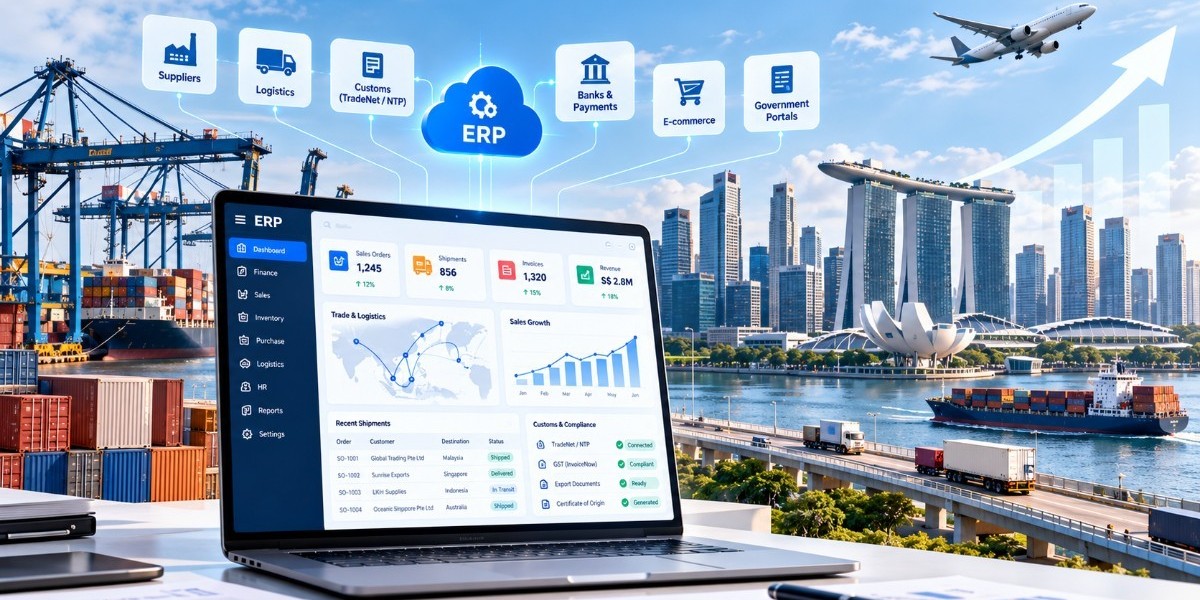

Singapore has built its economy on trade, connectivity and efficiency. For a small, open market, every shipment, invoice and customs declaration needs to move quickly and accurately. Behind that speed sits a growing layer of business software, and at the centre of it is Enterprise Resource Planning (ERP).
When ERP systems are properly integrated with banks, logistics partners, e-commerce platforms and government portals, they do more than tidy up the back office. They help companies scale, enter new markets and stay compliant. That is why demand for ERP development services in Singapore keeps rising among SMEs and larger enterprises alike.
Why Integration Matters More Than the ERP Itself
Many businesses already own some kind of accounting or inventory tool. The real gains appear when those tools stop working in isolation. ERP integration connects finance, procurement, inventory, sales, HR and reporting, and then links that core to external systems.
In practice, this means:
- A sales order automatically triggers stock checks, invoicing and shipping documents
- Supplier invoices flow into accounts payable without manual re-entry
- Management sees live margins, cash positions and inventory levels
- Compliance data is generated from the same records used to run the business
For a country with a large base of small firms (official figures show about 356,600 SMEs with fewer than 200 workers in 2024), reducing admin effort at this scale has a real effect on national productivity.
Supporting Singapore’s Trade Ecosystem
Singapore has long been a pioneer in trade digitisation. TradeNet, launched in January 1989, was the world’s first national single window for trade permits. Its successor, the Networked Trade Platform (NTP), connects businesses, logistics providers, financial institutions and government agencies so they can transact and share trade documents digitally.
ERP integration lets a company plug into this environment instead of working around it. Singapore Customs has noted that APIs are used to help businesses and ICT solution providers connect to the NTP securely. A well-built ERP can:
- Prepare customs declarations from existing order and shipment data
- Reduce duplicate entry of product codes, quantities and values
- Track permits and shipment status in one dashboard
- Keep an audit trail for traders, auditors and banks
Faster, cleaner documentation shortens the time goods spend waiting, which lowers costs and improves delivery reliability. Across thousands of traders, that adds up to a stronger trade hub.
Using Free Trade Agreements More Effectively
Singapore has an extensive network of free trade agreements, including the Regional Comprehensive Economic Partnership (RCEP). These agreements can reduce tariffs, but only if a business can prove where its goods come from and keep the right records.
An integrated ERP helps by:
- Storing bills of materials and supplier origin data
- Linking product records to tariff classifications
- Generating the data needed for certificates of origin
- Separating dutiable, FTA-eligible and non-eligible stock
Companies that do this well can price more competitively in overseas markets. This is one area where tailored ERP development services in Singapore add value, because origin rules and product structures differ by industry.
Compliance as a Growth Enabler
Compliance can look like a burden, but strong systems turn it into an advantage. Singapore charges GST at 9%, and exports are generally zero-rated, which means businesses must classify transactions correctly and keep clear evidence of export.
E-invoicing is also changing. IRAS has announced that all GST-registered businesses will be required to submit invoice data through InvoiceNow, with full adoption by April 2031. Businesses registering for GST voluntarily have already been brought in. IRAS says direct submission can bring benefits such as faster GST audits and quicker refunds.
An ERP that already supports InvoiceNow and Peppol-based e-invoicing prepares you for what is coming. It also helps with CPF payroll rules, which changed in 2026 when the monthly Ordinary Wage ceiling rose to S$8,000. Updating one system is far easier than updating several disconnected spreadsheets.
Faster Payments, Better Cash Flow
Trade growth depends on cash flow. Integration with banking and payment tools, including PayNow Corporate and PayNow QR, allows receipts to be matched to invoices automatically. Finance teams spend less time reconciling and more time analysing. Faster collections also reduce the working capital strain that often limits small exporters.
For businesses that deal with trade finance, the NTP’s multi-bank trade finance portal and shared permit data are designed to make financing applications more consistent and help banks validate real trade activity. An ERP that holds clean, structured transaction data fits naturally into this process.
Data That Drives Better Decisions
Economic growth at company level comes from good decisions: which markets to enter, which products to stock, which customers to prioritise. Integrated ERP gives leaders reliable data instead of month-old reports. Typical insights include:
- Profitability by product, customer and country
- Inventory turnover and slow-moving stock
- Supplier performance and lead times
- Forecasts based on live order and sales trends
Enterprise Singapore has been supporting thousands of firms with capability-building and internationalisation projects, and digital foundations such as ERP make it easier to take advantage of that support.
What to Look for in an ERP Partner
Choosing among providers of ERP development services in Singapore is easier with a clear checklist:
- Local compliance knowledge: GST, CPF, InvoiceNow and customs workflows
- Integration experience: banks, logistics platforms, e-commerce channels and government systems
- Scalability: the ability to support more users, entities and currencies
- Security: role-based access, data protection and reliable backups
- Change management: training and long-term support, not just installation
Ask for examples of similar projects and be clear about whether you need a ready-made cloud ERP, a customised build, or a hybrid.
The Bigger Picture
Singapore’s competitiveness depends on frictionless business, from the port to the invoice. ERP integration is a practical way for companies of any size to contribute to that efficiency. It shortens paperwork cycles, improves trade compliance, speeds up payments and supports smarter expansion.
Businesses that invest early in the right ERP development services in Singapore will be better prepared for new regulations, new markets and tougher competition. The result is stronger companies, and in turn, a more resilient economy.