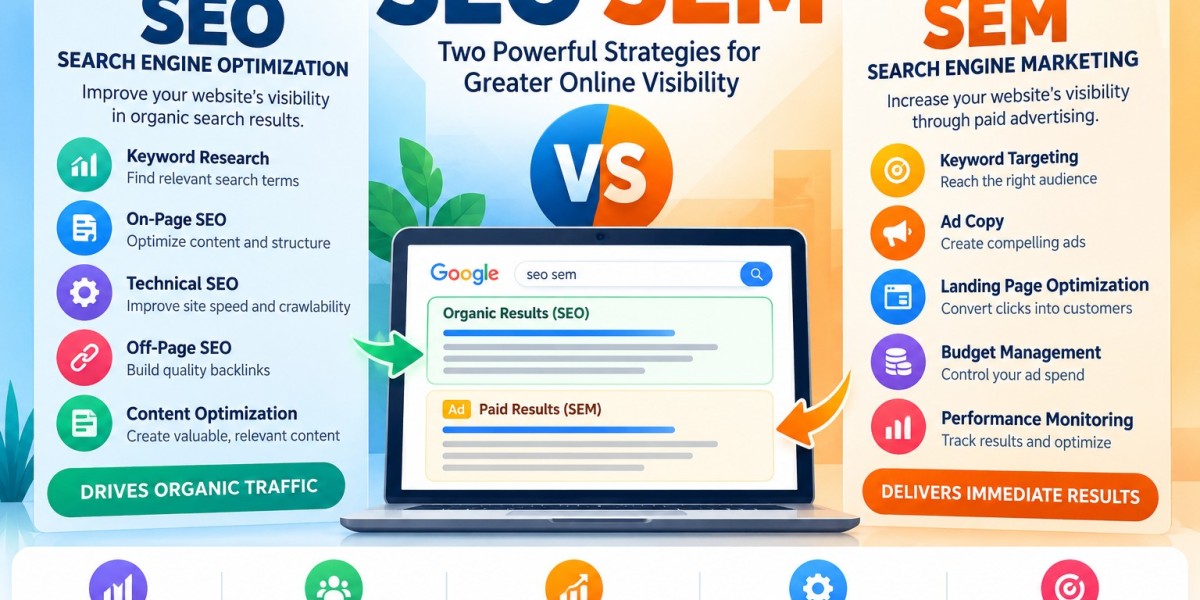

Every business wants to attract more customers through search engines, but achieving consistent online visibility requires the right marketing approach. Understanding SEO SEM is essential for businesses looking to increase website traffic, generate qualified leads, and improve their online presence. While search engine optimization focuses on attracting organic visitors, search engine marketing often refers to paid advertising strategies that deliver immediate visibility. Both approaches can support long-term business growth when used effectively.
What Is SEO and How Does It Work?
Search Engine Optimization (SEO) is the process of improving a website's visibility in organic search engine results. Its primary goal is to help websites rank for relevant keywords without paying for individual clicks.
SEO involves several important activities, including keyword research, content optimization, technical improvements, and link building.
Key Components of SEO
1. On-Page SEO
On-page SEO focuses on optimizing individual website pages. It includes improving page titles, meta descriptions, headings, internal links, and keyword placement.
2. Technical SEO
Technical SEO ensures search engines can efficiently crawl, understand, and index website content. Important factors include website speed, mobile usability, structured data, and proper URL structures.
3. Off-Page SEO
Off-page SEO involves activities outside the website that help establish its reputation and authority. Earning relevant backlinks from trustworthy websites is an important part of this strategy.
4. Content Optimization
Creating informative and relevant content helps websites address search intent and attract visitors interested in specific products or services.
SEO generally requires ongoing effort, but successful optimization can generate valuable traffic over time.
What Is SEM and How Does It Work?
Search Engine Marketing (SEM) is a digital marketing strategy used to increase website visibility through search engines. Although the term historically includes both organic and paid search activities, SEM commonly refers to paid search advertising today.
Businesses use platforms such as Google Ads to display advertisements for relevant searches.
Advertisers select keywords, set budgets, create advertisements, and choose landing pages where potential customers can learn more or complete an action.
Important Components of SEM
Keyword Targeting: Advertisers identify search terms that potential customers use when looking for products or services.
Ad Copy: Compelling headlines and descriptions encourage users to click advertisements.
Landing Page Optimization: Relevant landing pages help turn paid visitors into leads or customers.
Budget Management: Businesses control advertising expenditure through daily budgets and bidding strategies.
Performance Monitoring: Metrics such as click-through rate, conversion rate, and cost per acquisition help evaluate campaign effectiveness.
SEM can generate visibility quickly, making it useful for product launches, promotional campaigns, and businesses seeking immediate leads.
SEO vs SEM: What Are the Main Differences?
Although SEO and SEM share the goal of improving search visibility, they differ in several important ways.
Factor | SEO | SEM (Paid Search) |
|---|---|---|
Traffic source | Organic search results | Paid advertisements |
Cost | Investment in optimization | Advertising spend and management |
Results | Usually gradual | Can begin shortly after launch |
Long-term value | Can continue generating traffic | Depends on ongoing ad activity |
Targeting | Keywords and search intent | Keywords, location, audience signals |
Placement | Organic search listings | Sponsored search placements |
Both approaches have advantages. SEO helps businesses establish organic visibility, while SEM offers greater control over paid exposure and campaign budgets.
Benefits of Combining SEO SEM Strategies
Businesses do not necessarily have to choose between organic optimization and paid advertising. Combining both can create a more comprehensive search marketing strategy.
1. Increase Search Engine Visibility
Using organic and paid marketing together creates additional opportunities for a business to appear in search results.
A website may rank organically for valuable keywords while also running targeted advertisements to reach potential customers.
2. Generate More Qualified Leads
SEO attracts visitors searching for relevant information, services, and products.
SEM allows businesses to focus advertising budgets on searches with strong commercial intent.
Together, these methods can help reach customers at different stages of their buying journey.
3. Improve Keyword Research
Paid advertising campaigns can provide useful information about keyword performance.
Businesses can analyze search terms that generate conversions and use these insights to improve their organic content strategies.
Similarly, SEO research can identify valuable topics and keywords for paid campaigns.
4. Support Short-Term and Long-Term Growth
Paid search advertising can help businesses generate traffic while their organic search presence develops.
As SEO performance improves, businesses may gain an additional source of website traffic that does not require payment for each click.
5. Make Better Marketing Decisions
Combining organic and paid search performance data can help businesses understand customer behavior more effectively.
Marketers can evaluate which keywords attract visitors, which landing pages generate conversions, and where additional improvements are needed.
How to Create an Effective SEO SEM Marketing Strategy
Building a successful search marketing strategy requires careful planning and consistent optimization.
Step 1: Identify Business Goals
Start by determining what your business wants to achieve.
Common objectives include increasing website traffic, generating leads, improving online sales, and building brand awareness.
Clear goals make it easier to choose appropriate marketing channels.
Step 2: Conduct Keyword Research
Identify keywords that match your products, services, and target audience.
Focus on search intent rather than search volume alone. Keywords with strong commercial relevance may generate more valuable traffic than broad informational terms.
Step 3: Optimize Website Content
Create helpful content that answers customer questions and explains your products or services.
Use descriptive headings, relevant internal links, optimized images, and clear calls to action.
Content should prioritize user needs instead of repeating keywords unnecessarily.
Step 4: Launch Targeted Paid Campaigns
Develop paid search campaigns around high-intent keywords.
Create relevant advertisements, select appropriate landing pages, and establish realistic budgets.
Monitor campaign performance regularly to identify opportunities for improvement.
Step 5: Improve User Experience
Website usability affects both organic search performance and paid advertising results.
Ensure your website loads efficiently, works properly on mobile devices, and provides simple navigation.
Landing pages should communicate their value clearly and make it easy for visitors to take action.
Step 6: Monitor and Adjust Performance
Use tools such as Google Search Console, Google Analytics, and Google Ads to evaluate search marketing performance.
Track relevant metrics, including organic clicks, advertising costs, conversions, and cost per acquisition.
Use these insights to refine your strategy.
Common SEO and SEM Mistakes to Avoid
Even well-funded marketing campaigns can underperform when businesses overlook basic optimization practices.
Some common mistakes include:
Targeting broad keywords without considering search intent.
Publishing low-quality or duplicate content.
Ignoring technical website problems.
Sending paid traffic to irrelevant landing pages.
Running advertising campaigns without conversion tracking.
Failing to analyze performance data.
Expecting immediate organic ranking improvements.
Avoiding these problems helps businesses use their marketing resources more effectively.
Which Is Better for Small Businesses: SEO or SEM?
The best approach depends on business goals, competition, available resources, and marketing budgets.
For businesses that want sustainable organic visibility, SEO is an important long-term investment. It helps develop useful website content and improve search engine accessibility.
For businesses looking to generate leads quickly, paid search marketing may be more suitable because campaigns can begin attracting visitors shortly after activation.
However, using both methods can provide a balanced approach. A small business might begin with a focused paid campaign while gradually investing in organic optimization.
Over time, performance data can help determine the most effective allocation of resources.
Conclusion
SEO and SEM are valuable digital marketing approaches that help businesses increase search visibility and connect with potential customers. SEO focuses on earning organic traffic through website improvements and quality content, while paid search marketing provides additional opportunities to reach targeted audiences through advertisements.
A successful search marketing strategy should consider both immediate business objectives and long-term growth opportunities. By combining keyword research, website optimization, targeted advertising, and performance analysis, businesses can build a stronger online presence and improve their ability to attract qualified customers.