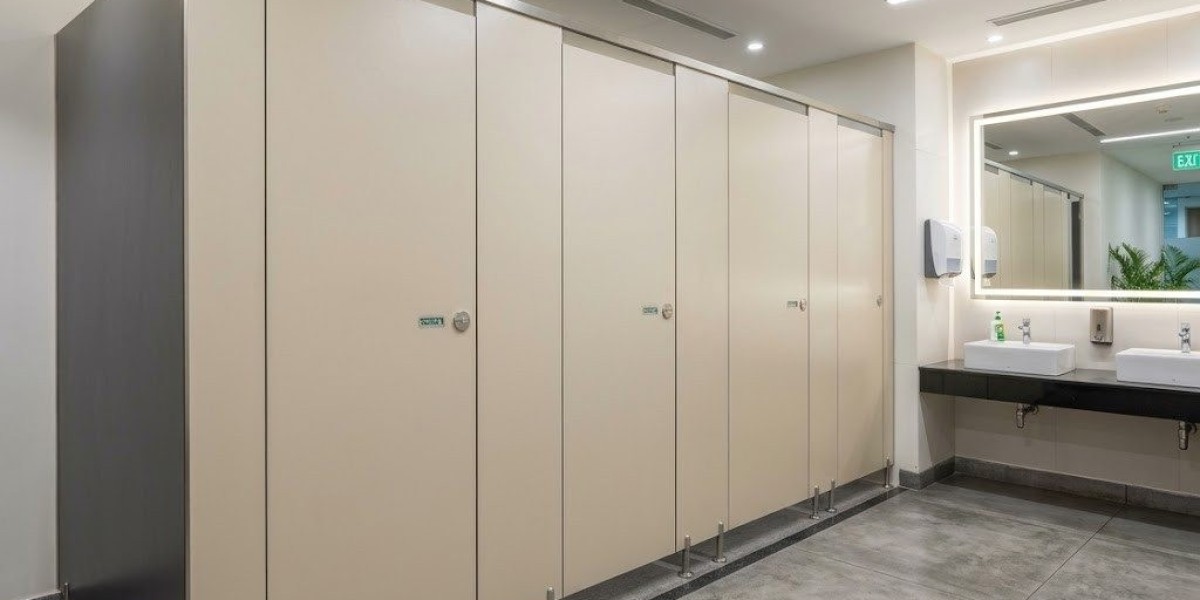

Selecting the right material for toilet partitions can influence a commercial washroom's appearance, maintenance requirements and long-term performance. In offices, malls, hospitals, schools, hotels and industrial facilities, the chosen partition system must suit both the environment and the expected level of use.
HPL (high-pressure laminate) is one option commonly considered for commercial washroom applications. Other options may include compact laminate, moisture-resistant board systems with suitable finishes, metal partitions and masonry partitions.
Each material has its own advantages and limitations. The best choice depends on site conditions, project budget, design preferences and the manufacturer's specifications.
1. What Are HPL Toilet Partitions?
HPL toilet partitions use high-pressure laminate panels as part of a cubicle or partition system. They are available in a variety of colours, patterns and surface finishes, making them suitable for projects where appearance and practical maintenance are important.
For commercial applications, buyers should verify the specific panel construction, thickness, edge treatment and suitability for exposure to moisture. Not every HPL product has the same properties, so product specifications should guide the final decision.
Common applications include office washrooms, educational institutions, retail spaces and other commercial facilities where a coordinated interior finish is desired.
2. HPL vs Compact Laminate
HPL-faced boards and solid compact laminate panels are related but not identical constructions.
Factor | HPL-faced board system | Solid compact laminate |
|---|---|---|
Construction | Laminate surface bonded to a core material | Dense laminate panel throughout |
Moisture suitability | Depends on the core and edge protection | Often selected for demanding washroom conditions when appropriately specified |
Appearance | Wide range of decorative finishes | Wide range of colours and textures |
Selection priority | Verify core material and moisture protection | Verify thickness, grade, fixing details and application suitability |
For areas with regular water exposure or intensive use, compact laminate may be worth evaluating. However, the right choice should be based on the actual product specification and installation environment rather than the material name alone.
3. HPL vs Metal Toilet Partitions
Metal partitions may be suitable for facilities that prioritise a simple, functional design. Their performance depends on the metal type, coating, construction and the conditions in which the system will be used.
HPL systems offer more decorative finish options and can help coordinate the cubicles with the overall interior design. Metal systems may appeal to projects with different durability, maintenance or budget priorities.
Compare both options on corrosion protection, cleaning requirements, privacy, hardware quality and expected usage. In humid environments, check the manufacturer's guidance regarding corrosion resistance and maintenance.
4. HPL vs Moisture-Resistant Board Systems
Some partition systems use engineered boards with protective decorative surfaces. These can be suitable for particular interior applications when the core material and finish are appropriate for the intended environment.
However, moisture resistance varies considerably between products. Exposed edges, damaged finishes and unsuitable installation details can affect performance.
Before choosing a board-based system, confirm:
The core material and its moisture-related limitations.
Edge sealing and protection details.
Recommended cleaning methods.
Suitable locations and environmental conditions.
Warranty coverage and maintenance requirements.
Do not assume that a decorative surface alone makes the entire panel waterproof.
5. HPL vs Masonry Partitions
Masonry partitions are built as permanent structures and may be considered when a project requires fixed walls. They generally involve different construction, finishing and maintenance considerations compared with modular cubicle systems.
Modular partitions can offer more flexibility in layout changes and may simplify the replacement of individual components, depending on the system design. Masonry construction may be appropriate for projects where permanent walls align with the building plan.
Compare installation time, floor-space requirements, plumbing coordination, future modifications and total project cost before deciding.
6. Which Material Is Best for Different Applications?
The most suitable material depends on the intended use.
Corporate offices: Consider appearance, privacy, ease of maintenance and the overall interior scheme.
Shopping malls: Evaluate durability, cleaning routines and expected visitor traffic.
Schools and colleges: Prioritise robust construction, practical hardware and an appropriate layout.
Hospitals: Follow the facility's hygiene, cleaning and operational requirements.
Industrial facilities: Assess humidity, exposure to chemicals, cleaning practices and actual site conditions.
Hotels and premium commercial spaces: Consider finish coordination alongside performance and maintenance.
A product selected for a dry office environment may not be the best choice for a washroom with frequent water exposure. Match the material to the real operating conditions.
7. Questions to Ask Before Ordering Toilet Partitions
Before finalising a purchase, ask the manufacturer or supplier:
What is the exact panel construction and thickness?
Is the material suitable for the project's moisture and usage conditions?
Which hinges, locks, handles and brackets are included?
What custom sizes and finishes are available?
Are transport and installation included in the quotation?
What cleaning and maintenance procedures are recommended?
What warranty and after-sales support are provided?
Getting these details in writing helps avoid confusion between quotations and allows a fair comparison of products.
8. Find the Right Toilet Partition Solution for Your Project
Toilet Cubicle India manufactures and supplies HPL toilet cubicles, toilet partitions, washroom partitions, urinal partitions, shower cubicles and modular washroom solutions for commercial and institutional projects.
Businesses comparing toilet partition manufacturers can review available systems, finishes, hardware options and project requirements before deciding on a specification.
The ideal solution should meet the project's design goals while remaining appropriate for the washroom environment, daily usage and maintenance plan.
Conclusion
HPL, compact laminate, metal, board-based and masonry partitions serve different project requirements. There is no single material that is automatically best for every commercial washroom.
Compare construction, moisture suitability, durability, appearance, hardware, maintenance and installation costs before placing an order. A clear specification and a knowledgeable supplier can help you choose a toilet partition system that fits your building and its long-term needs.




