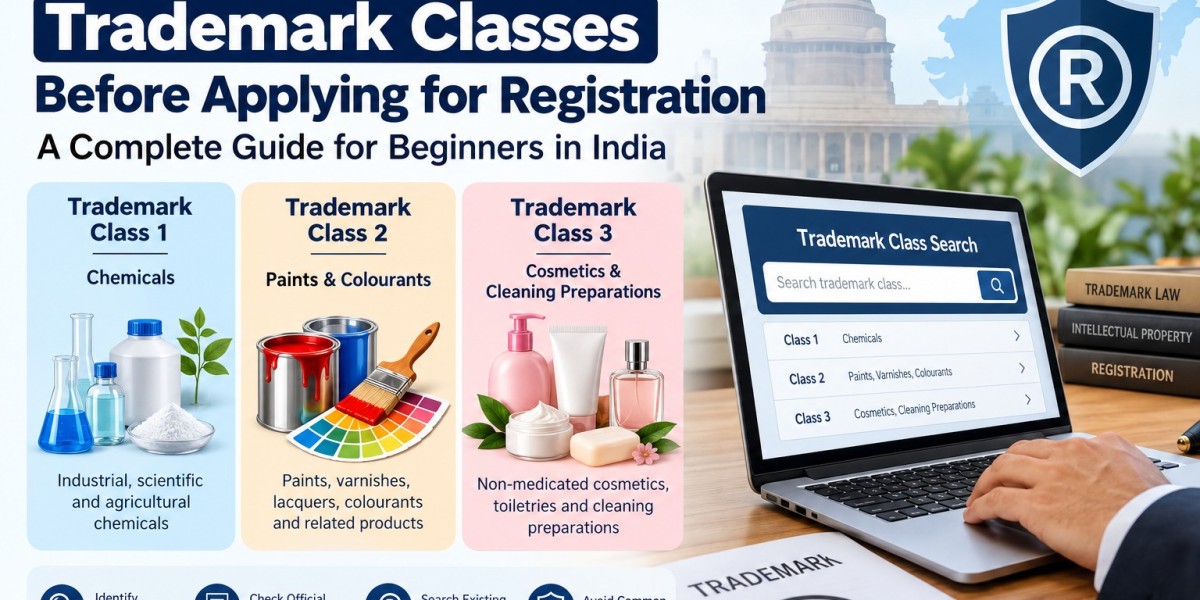

Trademark registration is an important step in protecting your brand name, logo, and business identity in India. However, before submitting a trademark application, you must identify the correct class for your products or services. A Trademark Class Search helps you determine which category applies to your business under the Nice Classification system. Understanding the differences between Trademark Class 1, Trademark Class 2, and Trademark Class 3 is particularly useful for businesses dealing with chemicals, paints, cosmetics, and cleaning products.
Selecting the appropriate class can help you prepare an accurate application and reduce the risk of avoidable objections.
Quick Summary
- India follows the Nice Classification system for trademark applications.
- There are 45 trademark classes: Classes 1–34 cover goods, while Classes 35–45 cover services.
- Trademark Class 1 generally covers specified industrial and scientific chemicals.
- Trademark Class 2 generally covers paints, varnishes, and colourants.
- Trademark Class 3 generally covers non-medicated cosmetics and cleaning preparations.
- A Trademark Class Search helps identify the appropriate category for your goods or services.
- Choosing the correct class does not guarantee trademark registration.
What Is a Trademark Class Search?
A Trademark Class Search is the process of identifying the correct category for the goods or services covered by a trademark application.
India uses the Nice Classification system, administered by the World Intellectual Property Organization (WIPO). This system divides goods and services into 45 classes, allowing trademark applications to be organised according to the products or services they cover.
For example, an industrial chemical manufacturer may need to investigate Class 1, a paint manufacturer may need Class 2, and a cosmetics brand may need Class 3.
The correct class depends on the actual goods or services you intend to protect. If your business offers products across multiple categories, you may need to apply in more than one class.
How to Search Trademark Classes Online in India
Follow these steps before submitting your trademark application.
Step 1: Visit the Official Trademark Website
Visit the Intellectual Property India website to access official trademark resources and search facilities.
You can also consult the World Intellectual Property Organization website for information about the Nice Classification system.
Step 2: Identify Your Products or Services
Prepare a detailed list of the products you manufacture, sell, or plan to introduce. If you provide services, describe their nature and purpose.
Avoid selecting a class simply because another company in your industry uses it. Classification depends on the specific goods or services covered by your application.
Step 3: Search Using Relevant Keywords
Enter descriptive keywords associated with your products or services into the available classification search tools.
Try alternative terms, synonyms, and technical descriptions. Official classifications may use terminology that differs from everyday business language.
For example, a company selling industrial chemicals should search for its specific chemical products rather than relying only on the general word "chemicals."
Step 4: Review the Official Class Description
Read the relevant class heading and detailed description. Confirm that your products or services fall within the category.
Pay attention to exclusions and distinctions between similar products. For instance, non-medicated skincare preparations and medicinal skincare products may belong to different classes.
Step 5: Search Existing Trademarks
After identifying the likely class, search for identical and similar trademarks.
Review the available information about the mark, proprietor, application status, and goods or services. A trademark may create a conflict even if its spelling is not identical to your proposed name.
Step 6: Finalise the Appropriate Class
Select the class or classes that accurately describe your intended goods or services. Prepare a clear list before filing your application.
If your business operates across several product categories, consider professional guidance to determine the appropriate classification.
Understanding Trademark Class 1
Trademark Class 1 generally covers chemicals used in industry, science, photography, agriculture, horticulture, and forestry, along with other specified products included in the official classification.
Examples may include:
- Industrial chemicals used in manufacturing
- Chemical preparations for scientific research
- Certain chemical fertilisers
- Unprocessed artificial resins
- Unprocessed plastics
- Certain chemical additives used in industrial processes
- Specified chemical preparations for agricultural applications
Who Should Consider Trademark Class 1?
Class 1 may be relevant to industrial chemical manufacturers, chemical suppliers, scientific chemical businesses, and companies producing certain chemical preparations.
However, not every product containing chemicals belongs to Class 1. Finished cleaning preparations, cosmetics, medicines, and paints may fall under different classes depending on their nature and purpose.
Always check the precise product description before selecting this class.
Understanding Trademark Class 2
Trademark Class 2 generally covers paints, varnishes, lacquers, colourants, and certain products used for painting, decoration, printing, or protection against corrosion.
Examples may include:
- Paints and varnishes
- Lacquers
- Certain colourants
- Certain printing inks
- Specified anti-rust preparations
- Certain protective coatings
Who Should Consider Trademark Class 2?
Class 2 may be relevant to paint manufacturers, coating businesses, colourant suppliers, and brands selling products covered by this category.
For example, a company manufacturing decorative wall paints should examine Class 2 when preparing its trademark application.
However, products used to remove paint or clean painted surfaces may fall into another class. The classification depends on the product itself rather than the general industry.
Understanding Trademark Class 3
Trademark Class 3 generally covers non-medicated cosmetics and toiletry preparations, as well as specified cleaning, polishing, and abrasive preparations.
Examples may include:
- Non-medicated skincare creams
- Makeup and cosmetic preparations
- Perfumes and certain fragrances
- Non-medicated shampoos
- Soaps and toiletry preparations
- Household cleaning preparations
- Polishing and abrasive preparations
Who Should Consider Trademark Class 3?
Class 3 may be relevant to cosmetics manufacturers, skincare brands, personal-care businesses, and companies selling certain household cleaning products.
For example, a brand selling non-medicated face creams, makeup, and perfumes should investigate the relevant Class 3 descriptions.
Medicinal preparations may instead fall under Class 5, depending on their nature and classification. Businesses should therefore distinguish between cosmetic and medicinal products before applying.
Comparison of Trademark Class 1, Class 2, and Class 3
| Trademark Class | Main Category | Examples |
|---|---|---|
| Class 1 | Specified industrial, scientific, and agricultural chemicals | Industrial chemicals, certain fertilisers, unprocessed resins |
| Class 2 | Paints, varnishes, colourants, and related products | Paints, lacquers, certain inks |
| Class 3 | Non-medicated cosmetics and cleaning preparations | Makeup, non-medicated skincare, soaps, household cleaners |
This table provides a general overview. Always consult the detailed official classification to confirm the correct class for a particular product.
Common Mistakes to Avoid During Trademark Class Search
Applicants should avoid these common mistakes:
1. Selecting a class based only on the business name: The correct category depends on the actual goods or services.
2. Searching only exact product names: Use synonyms and technical descriptions to identify the relevant classification.
3. Ignoring similar trademarks: Search for alternative spellings and phonetically similar marks.
4. Assuming one class covers every product: Businesses selling chemicals, paints, and cosmetics may need to consider multiple classes.
5. Using vague descriptions: Clearly identify the goods or services you want to protect.
6. Confusing class selection with trademark availability: Finding the correct class does not guarantee that your proposed mark is available or registrable.
Frequently Asked Questions
1. What is Trademark Class Search?
Trademark Class Search helps applicants identify the correct category for their goods or services under the Nice Classification system before submitting a trademark application.
2. How many trademark classes are there in India?
India uses 45 classes. Classes 1–34 cover goods, while Classes 35–45 cover services.
3. What products fall under Trademark Class 1?
Class 1 generally covers specified industrial, scientific, agricultural, horticultural, and forestry chemicals, along with other goods listed in the official classification.
4. What is the difference between Class 2 and Class 3?
Class 2 generally covers paints, varnishes, colourants, and related products. Class 3 generally covers non-medicated cosmetics, toiletries, and specified cleaning preparations.
5. Can I register a trademark in multiple classes?
Yes. If your business offers goods or services covered by different classes, you may apply in multiple classes, subject to the applicable requirements and fees.
6. Does the correct class guarantee trademark registration?
No. The application remains subject to examination and other applicable procedures. Existing trademarks and legal restrictions may affect the outcome.
Conclusion
Conducting a Trademark Class Search before applying for registration helps you identify the appropriate category for your products or services. Understanding Trademark Class 1, Trademark Class 2, and Trademark Class 3 can be particularly useful for businesses dealing with chemicals, paints, cosmetics, and cleaning preparations.
Review official classification descriptions, search for potentially conflicting trademarks, and prepare accurate goods or services descriptions before filing. Careful preparation can help reduce avoidable errors and support a more effective trademark protection strategy.