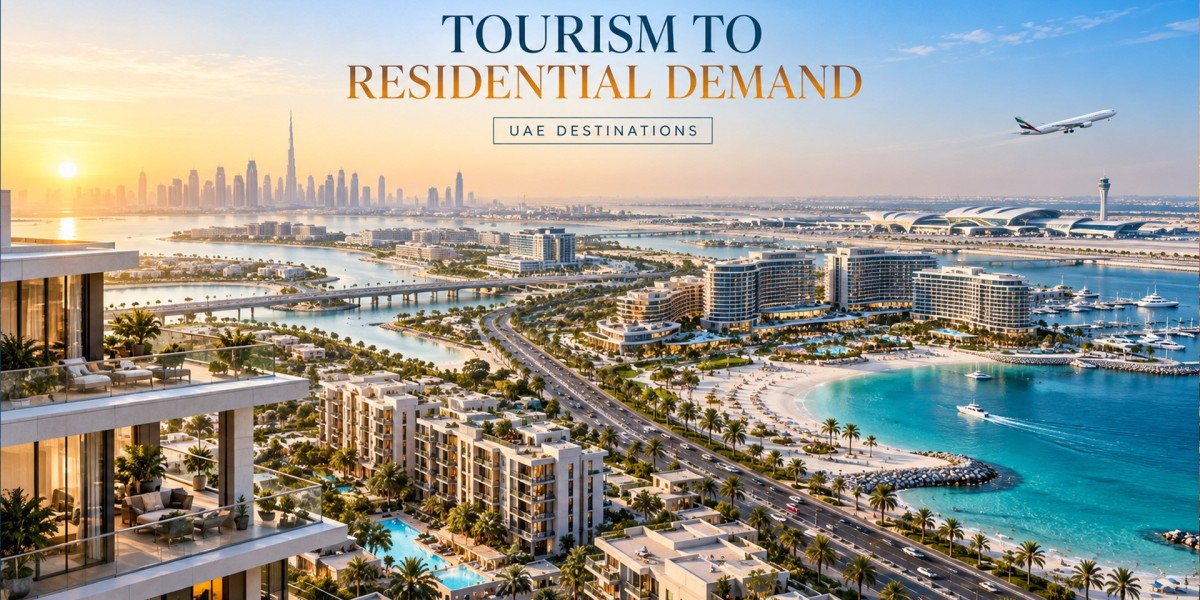

Tourists do not automatically become tenants or property buyers. But successful destinations create jobs, infrastructure, hospitality, international awareness and repeat visitation — all of which can gradually broaden the residential market around them.
Tourism statistics are frequently used in property marketing.
Visitor numbers rise, a new hotel opens or an airline adds a route, and the conclusion quickly becomes that nearby real estate must therefore appreciate.
The relationship is more complicated.
Tourism can be an important contributor to residential property demand in emerging UAE destinations, but its influence works through several channels and develops over time.
Understanding those channels makes tourism data far more useful to property investors.
Tourism growth can support residential demand by creating employment, expanding hospitality and leisure infrastructure, improving transport links, increasing international awareness and encouraging repeat visitors to spend longer periods in a destination. These factors can strengthen the environment around housing, but tourism growth alone does not guarantee rental yields or property-price appreciation.
Visitor Numbers Are a Starting Point, Not the Investment Conclusion
A growing visitor economy tells investors that more people have a reason to enter the destination.
That matters.
But a visitor spending three nights in a resort is not automatically a future apartment tenant.
To understand the property connection, investors need to ask what happens around that tourism growth.
Does it create:
Hotels?
Restaurants?
Employment?
Air routes?
Road infrastructure?
Events?
Longer stays?
International business activity?
Those secondary effects are where residential relevance becomes more interesting.
Tourism becomes a property driver when it begins changing the economy and everyday life of the destination, not merely increasing the number of hotel check-ins.
1. Hospitality Growth Creates Employment
A growing hotel market needs people.
New resorts can generate demand for:
Hotel management
Food and beverage
Housekeeping
Engineering
Marketing
Events
Security
Retail
Transport
These employees need places to live.
The effect is not limited to staff employed directly by hotels. Hospitality expansion can also support suppliers, professional services, logistics and other businesses.
That broadens the potential long-term residential demand base.
2. Growing Destinations Attract Supporting Businesses
A successful tourism economy encourages private businesses to follow the visitor.
These may include:
Restaurants
Cafés
Retail
Wellness operators
Tour companies
Property management
Events businesses
Professional services
As the business environment becomes more diversified, the residential market can begin to depend less on tourists themselves and more on the people and companies serving them.
3. Tourism Can Improve Transport Connectivity
Destinations competing for international visitors need to be accessible.
This can encourage:
Airport expansion
New routes
Road improvements
Transfers
Public and private transport services
Those improvements benefit residents as well as visitors.
Ras Al Khaimah provides a current example.
RAKTDA's March 2026 destination information states that Ras Al Khaimah International Airport is undergoing expansion, including arrival-hall work and a new terminal, after exceeding one million passengers in 2025 for the first time.
The airport recorded a significant increase in passenger traffic and expanded its international route network.
That kind of connectivity can make both tourism and residential ownership easier.
4. Repeat Visitors Can Become Second-Home Buyers
People rarely buy a second home in a destination they dislike visiting.
Tourism therefore creates an important first stage of familiarity.
A repeat visitor may gradually learn:
Neighbourhoods
Restaurants
Roads
Beaches
Hotels
Local services
The perceived risk of owning a home in the destination can fall as familiarity increases.
This is particularly relevant in leisure markets where property buyers are motivated by both lifestyle and investment.
5. Hospitality Can Improve the Residential Lifestyle
Hotels do more than provide accommodation.
They can introduce:
Restaurants
Spas
Beach clubs
Meeting venues
Events
Wellness
Retail
Residents living nearby may benefit from a destination with more places to eat, socialise and spend time.
This can increase the lifestyle appeal of surrounding property even for owners who never intend to rent to tourists.
6. International Hospitality Brands Can Increase Destination Awareness
Global hotel operators bring their own international audiences.
A traveller may first hear of a destination because a familiar hospitality brand opens there.
That exposure can help:
Put the location on international travel itineraries
Build confidence
Generate media attention
Increase repeat visitation
In emerging residential markets, greater awareness can also place local property in front of international buyers who previously concentrated on better-known cities.
7. Tourism Can Support Short-Stay Residential Demand
Where appropriately regulated, holiday-home accommodation can form another layer of the visitor economy.
Some travellers prefer apartments because they provide:
More living space
Kitchens
Multiple bedrooms
A more residential experience
This can create opportunities for suitable investment properties.
However, investors should model:
Licensing
Management
Cleaning
Seasonality
Vacancy
Operating costs
rather than assuming tourism growth automatically creates profitable holiday homes.
8. Conferences and Events Can Broaden the Visitor Mix
Leisure tourists are only one part of destination demand.
MICE — meetings, incentives, conferences and exhibitions — can bring business travellers and groups outside traditional holiday periods.
RAKTDA reported strong growth in MICE and weddings activity during 2025 alongside wider visitor growth.
A more diverse visitor base can help destinations avoid relying completely on one travel segment.
9. Tourism Can Encourage Larger Mixed-Use Masterplans
As destinations grow, development often moves beyond isolated hotels.
Masterplans may begin to combine:
Hospitality
Residential property
Retail
Offices
Public spaces
Dining
Entertainment
That can create more complete places for both residents and visitors.
Al Marjan Island in Ras Al Khaimah is a clear example of this convergence.
Ras Al Khaimah Provides a Useful Current Case Study
RAKTDA announced that Ras Al Khaimah welcomed more than 670,000 visitors during the first half of 2026, its strongest first-half performance on record.
The emirate is also working towards a long-term ambition of exceeding 3.5 million annual visitors by 2030.
At the same time, new hotels, infrastructure and large-scale developments continue to advance.
These facts do not guarantee residential returns.
They do show that RAK's property market is evolving alongside a broader destination economy rather than operating independently from it.
Al Marjan Island Shows How Hospitality and Housing Can Develop Together
Marjan's current masterplan identifies more than:
18,000 planned residential units
8,500 planned hotel guestrooms
alongside beaches, waterfront public spaces and leisure infrastructure.
This scale creates an environment where visitor and residential demand increasingly interact.
People may:
Visit as tourists
Return regularly
Work in the destination
Purchase second homes
Become long-term residents
at different stages.
Hospitality Anchors Can Accelerate International Attention
Major resorts can also reshape the visibility of an emerging destination.
Wynn Al Marjan Island is one example. The project is expected to open in 2027 and is positioned as a major hospitality, entertainment and meetings destination.
The property implications should not be exaggerated.
But the broader effect can include:
Employment
Visitor awareness
Infrastructure investment
Hospitality supply
International interest
These are legitimate market fundamentals to monitor.
What Should Property Investors Actually Track?
Instead of simply watching tourist numbers, investors can monitor:
Visitor growth
International vs domestic visitor mix
Hotel openings
Airport and road connectivity
Employment creation
Residential supply
Short-term rental regulation
Service infrastructure
Those indicators provide a more balanced understanding of whether tourism is genuinely strengthening the residential environment.
Avoid Converting Tourism Headlines Into Guaranteed ROI
One of the most important disciplines is separating destination growth from individual property performance.
An apartment can still underperform because of:
Overpricing
Poor layout
Weak management
High operating costs
Large competing supply
even within a destination recording strong tourism growth.
Tourism can strengthen the tide. Investors still need to choose the right boat.
Why Developer and Property Selection Still Matter
Emerging markets often attract a significant volume of new development.
That makes differentiation increasingly important.
Buyers should continue assessing:
Developer
Location
Property type
Layout
Furnishing
Ownership costs
Rental audience
For a closer examination of how these wider forces are influencing one of the UAE's fastest-evolving northern markets, this Ras Al Khaimah property investment guide explores the emirate's broader demand drivers.
Final Thoughts: Tourism Is Most Valuable When It Builds a Place People Want to Stay
Tourism alone does not create a residential market.
What matters is what tourism leaves behind.
Better connectivity.
Employment.
Restaurants.
Hotels.
International awareness.
Infrastructure.
Repeat visitors.
When these elements begin reinforcing one another, an emerging destination can gradually become somewhere people do more than visit.
They begin to work there, spend longer periods there and, eventually, live or own homes there.
Focus Keyword: tourism growth residential property demand