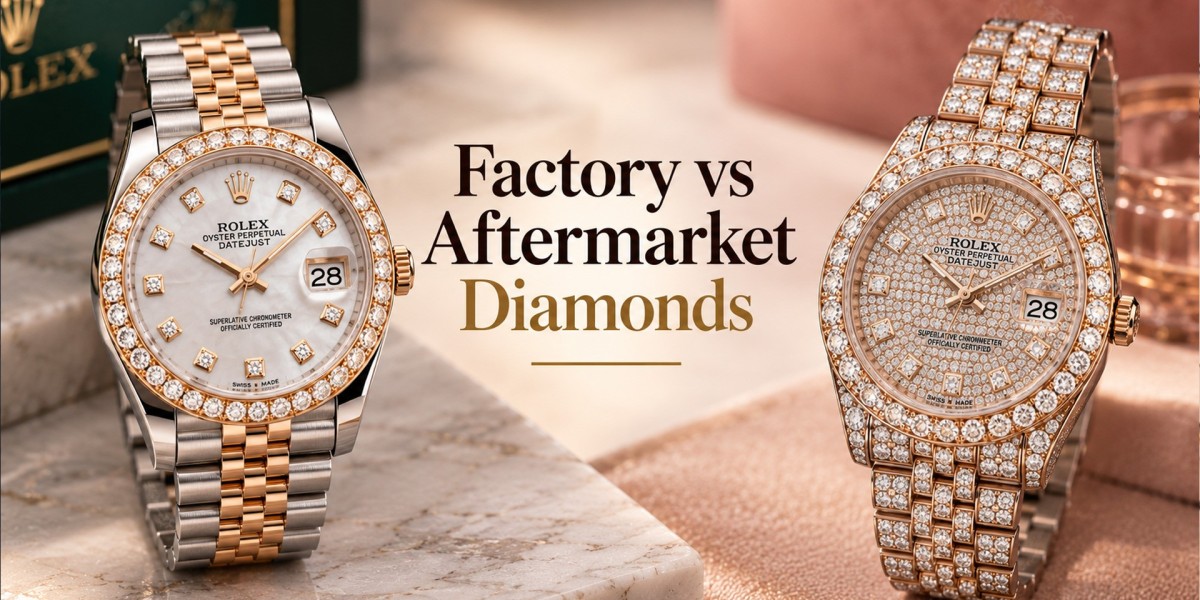

Diamonds can completely change the character of a women's Rolex. A restrained Datejust can become a jewellery-led statement watch; a Lady-Datejust can move from everyday elegance to something far more formal. But two diamond Rolex watches that appear similar in photographs may have very different histories. One may have left Rolex with factory-set stones. The other may be an authentic Rolex that was modified with diamonds later.
Both can appeal to buyers. They are simply different products, and understanding that difference matters for authentication, servicing, resale and fair comparison.
Factory-Set and Aftermarket Are Not the Same Thing
A factory diamond-set Rolex is a watch whose gem-setting forms part of the manufacturer's original reference or configuration.
An aftermarket diamond Rolex begins as another configuration and is modified later by a third party.
The underlying watch may still be genuine.
The diamond setting is simply not manufacturer-original.
| Factor | Factory-Set | Aftermarket-Set |
|---|---|---|
| Original configuration | Specified by Rolex | Modified after original sale |
| Gem-setting | Manufacturer-applied | Third-party applied |
| Reference consistency | Matches factory configuration | May differ from original reference specification |
| Service considerations | Manufacturer-original configuration | Modification can create additional servicing questions |
| Resale audience | Often favoured by originality-focused buyers | May appeal strongly to buyers who prioritise visual style |
An Authentic Rolex Can Still Have Aftermarket Diamonds
This distinction is important.
A watch should not automatically be described as fake simply because diamonds were added after manufacture.
There are two separate questions:
Is the underlying Rolex authentic?
Is the diamond-setting original to the Rolex factory configuration?
The answer to the first can be yes while the answer to the second is no.
Clear language prevents unnecessary confusion.
Buyer insight: Authenticity and originality are related, but they are not identical. A genuine watch can contain later modifications.
Why Buyers Should Start With the Reference Number
Before assessing diamonds, establish the exact reference.
Then determine how that reference was originally configured.
Check:
case material;
bezel type;
dial;
bracelet;
factory gem-setting where applicable.
This creates a baseline against which the current watch can be assessed.
Factory Diamond Dials and Aftermarket Diamond Dials Are Different
A diamond dial can be original to the reference, a later genuine service replacement or an aftermarket dial.
Those categories should not be blended together.
Ask:
Was this dial supplied with the watch originally?
Was it replaced during documented service?
Is it a genuine Rolex dial fitted later?
Is it an aftermarket dial?
Was an original dial retained?
Each answer creates a different collector and resale story.
The Bezel Deserves the Same Level of Scrutiny
Aftermarket diamond bezels are common because the bezel can dramatically change the appearance of a watch.
A buyer should determine:
whether the exact reference was factory diamond-set;
whether the current bezel is original;
whether the original bezel is included;
whether the case was altered to fit the replacement;
whether the modification is reversible.
A removable aftermarket bezel with the original bezel retained can be a different proposition from a permanently modified case.
Case Gem-Setting Is a More Significant Modification
Adding diamonds to the case or lugs may require metalwork that cannot simply be reversed by changing one component.
Ask:
Was metal removed?
Were holes cut into the original case?
Who performed the work?
Can the case ever be returned to factory configuration?
These questions become important for buyers who may later prefer the original appearance.
Bracelet Diamonds Need Their Own Assessment
Some Rolex configurations include factory diamond-set bracelets.
Other watches are modified later.
Inspect:
individual links;
setting consistency;
bracelet condition;
clasp;
link count;
signs that links were altered or drilled;
whether original links remain available.
A highly modified bracelet can have a very different resale audience from a factory bracelet.
Stone Quality Is Not the Only Question
Buyers sometimes focus entirely on whether aftermarket diamonds are high quality.
That matters aesthetically, but it does not answer the originality question.
Even excellent diamonds installed by a skilled jeweller remain aftermarket if Rolex did not originally configure the watch that way.
The distinction should be transparent.
Why Factory Gem-Setting Often Appeals to Collectors
Originality-focused collectors generally value the coherence of a factory configuration.
The reference, metal, dial, bezel and stones belong to one documented product specification.
This can make future comparison easier because buyers are able to identify other examples of the same configuration.
Why Some Buyers Deliberately Choose Aftermarket Diamonds
Not every buyer is collecting for originality.
Some want:
stronger visual impact;
a customised aesthetic;
a particular colour or setting unavailable from the manufacturer;
a different entry point into a diamond watch.
An aftermarket-set Rolex can satisfy that preference.
The important point is that the modification should be accurately described.
Style insight: Aftermarket does not automatically mean undesirable. It means customised. The buyer needs to decide whether customised or factory-original better matches their priorities.
Servicing Can Become More Complicated
Manufacturer service policies and acceptance can be affected by non-original modifications.
Before buying a heavily customised watch, ask:
where it has previously been serviced;
whether any service provider declined work;
whether original components remain available;
whether modifications must be removed for future servicing.
This is particularly important if significant case work has been performed.
Documentation Should Match the Watch's Story
Original papers identify the watch as it was originally sold.
If the current configuration differs, that does not invalidate the papers.
It simply means the watch changed later.
A clear seller should explain:
original configuration;
later modifications;
when changes were made;
whether original components are retained.
Do Papers Prove the Diamonds Are Factory-Set?
Not necessarily.
Documentation may help identify the original watch, but the present physical configuration still needs to be compared with the reference.
A watch can have original papers and later aftermarket diamonds.
How Diamond Modifications Can Affect Resale
Aftermarket modifications can reduce the number of originality-focused buyers interested in the watch.
That does not mean there is no resale market.
It means the resale audience may be different.
Factory-set references may be easier to compare against similar examples, while custom watches often require a buyer who specifically appreciates the modification.
Price Comparison Must Be Like for Like
Do not compare:
a factory diamond Lady-Datejust;
an ordinary Lady-Datejust with aftermarket bezel;
a fully aftermarket-set case and bracelet;
as though they are equivalent simply because they all contain diamonds.
Compare the actual configuration.
What Should You Ask the Seller?
A useful checklist includes:
What is the full Rolex reference?
Which diamond components are factory-set?
Which are aftermarket?
Are original parts included?
Was the case modified?
Has the watch been serviced since modification?
Are box and papers included?
How many bracelet links are present?
Buyers comparing sizes, configurations and broader women's Rolex options can review this guide to women's Rolex watches in Dubai before assessing an individual factory-set or customised watch.
Frequently Asked Questions
Is an aftermarket diamond Rolex fake?
Not automatically. The underlying watch may be authentic while the diamonds or modified components were added later.
Are factory diamonds always more valuable?
No universal rule applies. Reference, material, condition, demand and completeness all matter, although originality-focused collectors often prefer factory configurations.
Can a genuine Rolex dial be fitted later?
Yes. A later genuine replacement can still be a service or replacement component rather than the dial originally sold with the watch.
Can aftermarket diamonds affect servicing?
They can, particularly if the case or other components were significantly modified. Buyers should understand future service options before purchasing.
Do box and papers prove factory diamond-setting?
No. They support the watch's history but should be checked against the present physical configuration.
Should I avoid aftermarket diamond watches?
Not if you genuinely prefer the customised appearance and understand the implications. The key is transparent description and appropriate pricing.
Final Considerations
Diamond Rolex buying becomes much easier when factory-original and customised watches are treated as separate categories. Both can be visually impressive, and both can appeal to genuine buyers, but they should not be described or valued as though the history is identical. The strongest purchase is the one whose configuration is clearly understood before money changes hands.