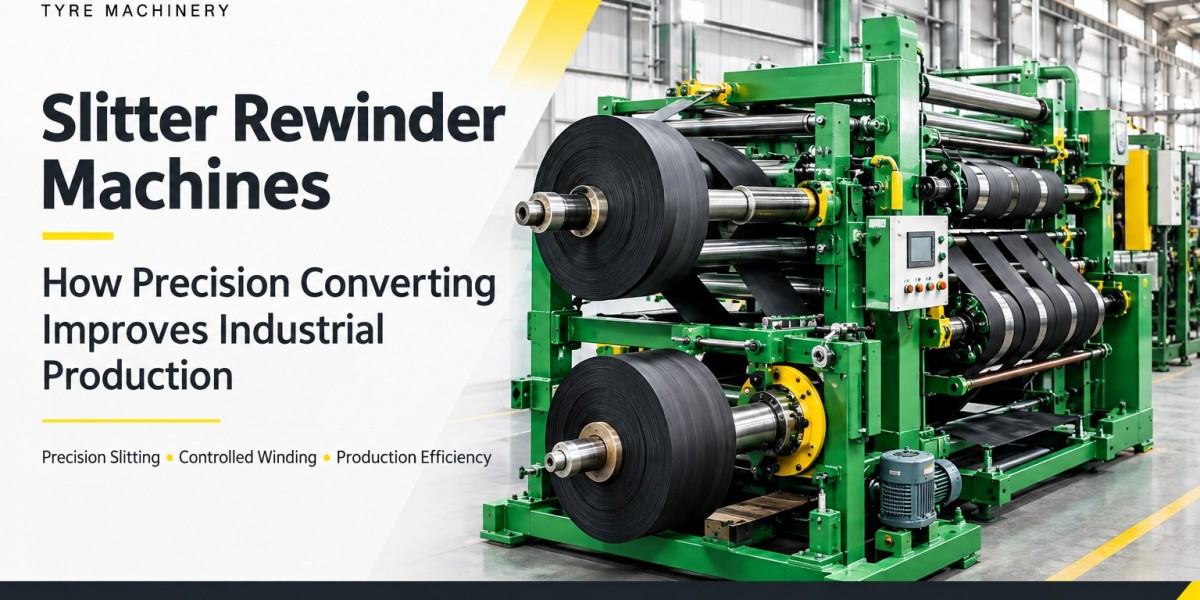

In tyre manufacturing, a parent roll of rubberized fabric is rarely used as it arrives. Cap ply, chafer fabric, and calendered liner must be cut to defined widths and wound onto spools or cassettes that feed the next station. If strip widths vary, or a roll is wound tight on one side and loose on the other, the fault usually appears later, at the tyre-building machine, where it costs more to correct.
Slitter Rewinder Machines sit at this transition point between material preparation and assembly. This article explains how precision slitting and controlled winding affect production efficiency, how to diagnose common roll defects, and how to choose equipment based on the material and the line rather than on speed alone.
Production challenge | Likely downstream effect | Engineering response |
Inconsistent strip width | Pieces that do not match the build specification | Fixed cutter setup verified against measured samples |
Uneven winding tension | Loose, telescoped, or stretched rolls | Controlled braking, drive response, and traverse arrangement |
Material drifting off-centre | Skewed edges, liner off-centre in the cassette | Material centering and edge guiding before the winding station |
Heavy manual roll handling | Stoppages and operator-dependent results | Automatic winding systems and accessible controls |
Wrinkling in calendered sheet | Distorted material entering the next process | Winding synchronised with line speed |
Understanding Precision Slitting and Winding
Precision converting is a chain of dependent steps: unwinding, splicing, centering, cutting, tension control, and winding. A weakness at any point shows up in the next one. A web that enters the cutters slightly off-centre will produce strips of uneven edge quality, and no winding unit can fully correct that.
Cutting technology is the first design decision. Empire Techno Engineers describes its expertise as covering crush, shear, and floating cutter systems, and says it can offer machines with either of two cutting systems on the same frame. In general terms, crush cutting presses a blade against a hard roll, while shear cutting uses overlapping blades. The better choice depends on the thickness, reinforcement, and coating of the material. The best results come from treating cutting, alignment, and winding as one system, not as separate purchases.
How Precision Converting Improves Industrial Production
Consistent Strip Width and Material Alignment
Strip width is a dimensional input to the tyre-building process. The cap strip slitter described on the company’s website cuts rubber-coated cap material into 6, 8, or 12 strips, depending on customer requirements, at a fixed width. Those strips are spiral wound onto 8 to 16 winding stations, with published strip widths from 8 mm to 25 mm. For cap ply slitting, every strip must match, because the strips are applied together.
Alignment matters just as much. The chafer slitting machine on the company’s website includes a material centering system ahead of its winding station. Edge guiding and centering keep the web on its intended path, so the cutters work on correctly positioned material and the strips land squarely on each spool.
Web Tension Control and Uniform Roll Winding
Excess tension stretches coated fabric and changes its dimensions. Too little tension produces loose rolls that telescope in storage or transit. Good web tension control keeps the force steady as the roll diameter grows, which is why the design of the winding station deserves as much attention as the cutting section.
Two published examples show the principle. The chafer slitter uses surface winding according to product thickness, with liner fed onto each spool and an independent pneumatic brake on each liner roll to maintain uniform tension. The cap strip slitter gives each PVC shell its own traverse unit, so strips are laid across the spool in an orderly way. Both are practical routes to uniform roll winding.
Integrating Wind-Up Units With the Production Line
Winding is often the stage most exposed to line conditions. The inner liner wind-up unit is designed for calender lines running up to 30 metres per minute and can be retrofitted to an existing line. Its scope covers an inlet conveyor, an online cutter, two wind-up stations, and a movable conveyor between them. Each station is synchronised with the calender so the product is not pulled or dimensionally changed, and the liner is centred to within ±2 mm in the cassette. The unit supports both captive and non-captive cassettes, with manual and automatic modes. Dual arrangements like this are generally used so a full cassette can be handled without stopping the upstream process.
Material Waste Reduction and Production Efficiency
Waste rarely comes from one dramatic failure. It accumulates from small issues such as a worn cutter, a slightly skewed web path, or a brake that responds inconsistently. Automatic winding systems and clear controls reduce the operator-to-operator variation that causes these issues, which supports material waste reduction and steadier production efficiency. Equipment cannot remove every source of loss, but stable, repeatable settings make the remaining causes easier to find.
Published feature | Where it appears | Production relevance |
Material centering before the winding station | Chafer slitter with surface wind-up | Consistent strip position on each spool |
Independent pneumatic brake on each liner roll | Chafer slitter with surface wind-up | Supports uniform winding tension |
Individual traverse unit per PVC shell | Cap strip slitter | Supports orderly layering of strips |
Double unwinder and stand-alone splicing station | Cap strip slitter | Supports material changes with less interruption |
PLC control, touch panel, manual and automatic modes | Chafer slitter with surface wind-up | Easier operation and setup |
Winding synchronised with the calender line | Inner liner wind-up unit | Avoids pulling or dimensional change |
Troubleshooting Common Slitting and Winding Problems
Even well-specified Slitter Rewinder Machines depend on disciplined setup and observation. The most useful habit is to treat each defect as a symptom with a short list of checks, in a fixed order, before touching the line speed.
Why Do Finished Rolls Telescope or Wrinkle?
Telescoping usually points to low or inconsistent winding tension, or to a roll that was not wound square on its core. Wrinkles more often come from uneven tension across the web, a misaligned roller, or incoming material with its own distortion. Check the web path and centering first, then confirm brake and drive behaviour as the roll diameter changes.
What Causes Uneven Strip Edges or Width Variation?
Worn cutters, loose blade positioning, and a wandering web are the usual suspects. Inspect the cutting elements, confirm the set width against a measured sample, and verify that the cutting method suits the material. Rubber slitting machinery is sensitive to edge condition, so a quick check of the first strips from every setup pays off.
How Can Unplanned Downtime Be Reduced?
Keep a simple fault log. Repeated stops at the same point, such as a splice, a roll change, or a transfer, tend to reveal whether the cause is mechanical, procedural, or related to the material. Preventive maintenance, accessible controls, and standard setup sheets then address the causes with evidence instead of guesswork.
How to Choose the Right Slitting and Winding Equipment
Start With the Material and Required Output
When comparing Slitter Rewinder Machines, begin with the material rather than the brochure. The company’s published specifications illustrate why one configuration cannot serve every job: the cap strip slitter lists a parent roll width of 60 to 300 mm, while the chafer slitter lists 800 mm, with different line speeds, winding stations, and cutter types. Define the material, thickness, reinforcement, required strip width, number of strips, and expected output before requesting a quotation.
Check Winding, Integration, and Maintenance Needs
Next, consider what the finished roll must do. Spool or shell size, maximum winding diameter, number of stations, and cassette type all affect handling downstream. If the unit connects to a calender line or tyre-building machine, ask about synchronisation, controls, floor space, and loading height. Maintenance access, including how easily cutters and brakes can be reached, often decides how reliable the machine feels after a year of operation.
Consider Total Cost of Ownership
Purchase price is one input. Cutter wear, spare parts, changeover time, operator training, and material lost during setup all shape the real cost. A machine matched to the application and easy to maintain often performs better over time than one chosen for maximum advertised speed.
Selection criterion | Questions to ask the supplier | Why it matters |
Material compatibility | Is the cutting method suited to this fabric, coating, and thickness? | Edge quality without damage or deformation |
Strip and roll specification | Which widths, strip counts, and winding diameters are supported? | Fit with downstream process requirements |
Tension and alignment | How are centering and winding tension handled? | Roll quality and stable feeding |
Line integration | Can it be synchronised with the existing line and controls? | Fewer integration problems at commissioning |
Operation and changeover | What is the loading height, and which manual and automatic modes exist? | Operator workload and downtime |
Maintenance access | How are cutters, brakes, and drives inspected or replaced? | Long-term availability and running cost |
Conclusion
Slitter Rewinder Machines deliver value when cutting, alignment, tension, and winding are specified together and matched to the material and the line. The result is more consistent strips, cleaner rolls, and fewer surprises at the tyre-building stage.
Empire Techno Engineers Private Limited, which says it has worked in demanding slitting and rewinding applications since 1980, offers tyre manufacturing equipment that includes cap strip, chafer, tread, and compound slitters, as well as wind-up units for inner liner, breaker, sidewall, and ply. Teams reviewing a new line or upgrading an existing one can use their own recurring defects as the starting point for that conversation.
Frequently Asked Questions
1. What is the purpose of slitting and rewinding equipment in tyre manufacturing?
It cuts wide parent rolls of rubberized fabric, chafer, or liner into narrower strips or sheets and winds them onto spools, shells, or cassettes. The aim is consistent width and tension so the material feeds smoothly into tyre-building operations.
2. What is the difference between crush cutting and shear cutting?
Crush cutting presses a blade against a hard roll, while shear cutting uses overlapping blades that act like scissors. The right choice depends on material thickness, reinforcement, and the edge quality required, so it should be confirmed against the actual material.
3. Why does web tension control affect roll quality?
Tension that is too high can stretch coated fabric, while tension that is too low can cause loose or telescoped rolls. Controlled braking, drive response, and traverse arrangement help keep the roll uniform as its diameter grows.
4. What information should I prepare before requesting a machine quotation?
Prepare the material type, parent roll width and diameter, required strip width and number of strips, target output, winding diameter, and cassette or spool type. Also note the existing line speed and any integration requirements.
5. Can wind-up units be added to an existing production line?
Often yes, depending on the line and the unit’s design. For example, the company’s inner liner wind-up unit is described as suitable for retrofitting to existing calender lines running up to 30 metres per minute. Confirm compatibility for your own line with the supplier.
Contact Empire Techno Engineers Private Limited
If you are reviewing slitting accuracy, roll winding quality, or line integration at your plant, you are welcome to discuss your production requirements with the company’s team. You can also use the query form on the contact page.
Company: Empire Techno Engineers Private Limited
Address: 89, Phase-4, Sector 57, H.S.I.I.D.C., Kundli District, Sonipat – 131028, Haryana, India
Phone: +91-9999255444
Email: ashish@empiretechno.com
Support hours: Monday to Friday, 10 am to 6 pm (IST); Saturday, 10 am to 2 pm (IST); Sunday closed
Contact page: https://empiretechno.com/contact-us/
Explore the company’s slitter machines and wind-up units for more product detail.







