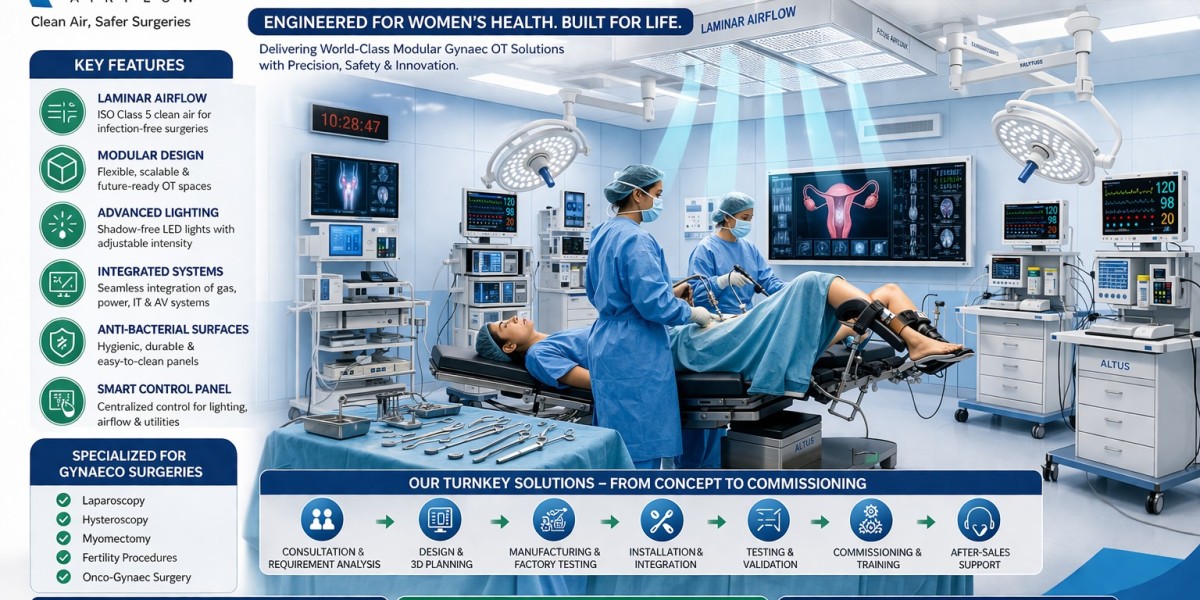

Introduction
Reliable production quality is essential when developing a specialized operating theatre. Modular Gynaec OT Manufacturers must ensure that every component meets the approved design, material specifications, dimensional requirements, and installation expectations before it reaches the hospital site. Quality checks should cover the complete manufacturing process, from raw material inspection and panel fabrication to surface finishing, electrical integration, and final product testing.
A modular gynaecology operating theatre brings together wall panels, ceiling systems, doors, flooring interfaces, service panels, and provisions for HVAC, lighting, and medical equipment. Since these components work as part of one clinical environment, a defect in one area can affect installation accuracy, hygiene, system coordination, or long-term maintenance.
A structured quality assurance process helps manufacturers identify defects early, maintain consistency between components, and deliver products that are ready for coordinated installation. It also gives hospitals greater confidence that the supplied materials and assemblies match the approved project requirements.
1. How Should Raw Materials Be Inspected?
Raw material inspection is the first stage of production quality control. Manufacturers should verify that the materials received from suppliers match the approved specifications, drawings, and purchase documentation.
For modular OT panels, inspection may include checking the selected metal sheets, core materials, surface coatings, reinforcement components, sealants, and supporting framework. The material grade, thickness, finish, and compatibility with the intended application should be confirmed before production begins.
Manufacturers should also inspect materials for visible defects such as scratches, dents, corrosion, uneven surfaces, coating damage, and deformation. Materials that do not meet the specified requirements should be identified and segregated rather than being used in production.
Supplier certificates, material identification records, and inspection reports should be maintained where applicable. These records support traceability and make it easier to investigate quality issues if a component fails during installation or service.
2. Why Is Dimensional Accuracy Important in Panel Manufacturing?
Dimensional accuracy directly affects how modular panels fit together at the project site. Incorrect measurements can create gaps, alignment problems, uneven joints, and difficulties when integrating doors, windows, electrical outlets, or service panels.
Manufacturers should inspect panel length, width, thickness, squareness, edge alignment, and cut-out dimensions against approved engineering drawings. Special attention should be given to openings for electrical switches, control panels, medical gas outlets, observation windows, and other integrated components.
Production teams should use suitable measuring instruments and documented inspection procedures. Measurements should be checked at defined stages rather than only after the complete panel has been manufactured.
Consistent dimensional checks help ensure that components can be assembled according to the planned room layout. They also reduce unnecessary cutting, adjustments, and rework at the hospital site.
3. How Should Panel Surface Finishing Be Checked?
The surface finish of modular OT panels is important because operating theatres require interiors that support routine cleaning and disinfection. Manufacturers should inspect surfaces for smoothness, coating consistency, visible imperfections, and damage.
Checks should identify scratches, bubbles, peeling, discoloration, dents, sharp edges, and irregular coating thickness where relevant to the specified finish. Panel corners and edges should also be examined to ensure that they are properly finished and do not create avoidable cleaning difficulties.
The selected finish should be compatible with the cleaning and disinfection procedures expected in the hospital. Manufacturers should provide product information and relevant material documentation rather than making unsupported claims about chemical resistance or antimicrobial performance.
Joints and connection details should receive particular attention. Poorly finished edges or inconsistent joint profiles can affect the final appearance and may create areas that are difficult to clean after installation.
4. What Structural and Mechanical Checks Should Be Performed?
Modular OT components must remain stable and correctly aligned when installed. Manufacturers should therefore inspect the structural integrity of panels, frames, supports, brackets, and connecting components.
Checks may include:
Verification of frame dimensions and alignment.
Inspection of welds, fasteners, and mechanical joints.
Confirmation of reinforcement at specified mounting locations.
Inspection for deformation or damage during fabrication.
Verification of door and window frame compatibility.
Review of component strength against the approved design requirements.
Where ceiling systems or equipment supports are involved, load-related requirements should be confirmed through the approved engineering design. Manufacturers should not assume that a standard panel or ceiling assembly can support heavy surgical lights, pendants, or other equipment without the specified structural reinforcement.
These checks help reduce the possibility of alignment issues, loose connections, and installation difficulties.
5. How Should Doors, Windows, and Access Panels Be Tested?
Doors and access panels are important parts of the modular OT assembly. They should be manufactured and inspected for accurate dimensions, smooth operation, proper alignment, and compatibility with the room design.
Door inspection should include frame alignment, hinge operation, locking arrangements, handles, seals, and closing performance. Where automatic or interlocking door systems are specified, their relevant components should undergo functional testing.
Observation windows should be checked for correct dimensions, secure installation, surface quality, and proper sealing. Access panels should fit accurately and allow authorized maintenance personnel to reach the intended services.
Manufacturers should also verify that these components do not interfere with planned equipment movement, patient transfer, or the hospital's environmental control requirements.
6. What HVAC Compatibility Checks Are Necessary?
Modular OT panels and ceiling systems must be compatible with the HVAC and filtration design. Manufacturers should verify the dimensions and positions of openings for air supply terminals, return air grilles, HEPA filter housings, pressure monitoring devices, and other ventilation components.
Ceiling panel fabrication should match the approved HVAC layout. Incorrect openings or poorly positioned cut-outs can complicate installation and affect coordination with the ventilation contractor.
Where laminar airflow systems are included in the project, the ceiling assembly should be checked for compatibility with the specified airflow arrangement. Manufacturers should coordinate the dimensions and mounting provisions with the HVAC engineering team.
It is important to distinguish manufacturing checks from HVAC performance validation. A correctly fabricated ceiling panel does not by itself prove that the installed ventilation system will achieve its intended airflow or filtration performance. Final system testing must be performed through the appropriate commissioning process after installation.
7. What Electrical and Medical Gas Component Checks Are Required?
Electrical and medical gas provisions must be manufactured or integrated according to the approved technical drawings and the responsibilities defined in the project scope. Quality checks should confirm that panels, cut-outs, mounting plates, conduits, outlet supports, and access arrangements are suitable for the specified services.
For electrical components, manufacturers should verify the dimensions and positions of outlet openings, switch panels, control units, cable routes, and mounting provisions. Where electrical assemblies are supplied as part of the package, appropriate inspection and testing should be completed by qualified personnel.
For medical gas integration, the manufacturer should check the alignment and compatibility of mounting provisions and outlet panels with the specified medical gas equipment. Gas pipeline installation, pressure testing, purity verification, and commissioning should be performed by qualified specialists under the relevant procedures.
The purpose of manufacturing inspection is to ensure that the modular structure accommodates these services accurately. Final safety and functional performance must be verified as part of the integrated installation and commissioning process.
8. How Should Manufacturing Joints, Seals, and Connections Be Inspected?
Panel joints and connections have an important role in the overall quality of a modular operating theatre. Poorly fabricated joints can lead to uneven surfaces, visible gaps, alignment problems, and difficult cleaning conditions.
Manufacturers should check joint profiles, connection details, sealant compatibility, corner finishing, and the consistency of panel interfaces. Components should be assembled or trial-fitted where practical to confirm that the joints align with the approved design.
Sealing materials should be selected according to the intended application and the manufacturer's technical specifications. Their compatibility with cleaning agents, environmental conditions, and adjoining materials should be reviewed before use.
Special attention should be given to interfaces around doors, windows, service openings, ceiling panels, and floor junctions. These areas should be designed to create cleanable transitions and avoid unnecessary gaps.
9. What Checks Should Be Performed for Equipment Integration?
A gynaecology OT may require several specialized systems, including surgical lights, operating tables, anesthesia workstations, laparoscopic equipment, monitors, and medical gas outlets. The modular structure must accommodate these systems without compromising the approved layout.
Manufacturers should verify the dimensions and positions of mounting plates, equipment openings, support frames, and service access points. If ceiling-mounted equipment is included, the specified support structure and load requirements should be confirmed against the approved engineering drawings.
A Modular Gynaec OT Manufacturers quality programme should also include coordination checks between the modular panels and the equipment suppliers' technical requirements. This is particularly important when multiple suppliers are responsible for different parts of the OT installation.
Trial assembly, dimensional verification, and interface reviews can help identify conflicts before delivery. The final installation should then be checked against the approved equipment layout and mounting details.
10. How Should Components Be Tested Before Dispatch?
Before components leave the manufacturing facility, they should undergo a final inspection to confirm that they meet the approved specifications and are suitable for transportation and installation.
Pre-dispatch checks may include dimensional verification, surface inspection, component identification, joint compatibility, hardware checks, and review of required accessories. Where a complete assembly or functional component is supplied, relevant operational checks should also be performed.
Manufacturers should confirm that all components are labelled according to room location, drawing reference, or assembly sequence. This makes it easier for installation teams to identify each item and reduces the risk of incorrect placement at the hospital.
Packaging quality is also important. Panels, doors, glass components, and finished surfaces should be protected against scratches, moisture, impact, and deformation during storage and transportation. A dispatch checklist should confirm that the correct components, accessories, and supporting documents are included.
11. Why Are Documentation and Traceability Important?
Quality inspection is more effective when every important check is supported by records. Manufacturers should maintain documentation that connects the supplied components with their specifications, production stages, and inspection results.
Useful records may include approved drawings, material certificates, incoming inspection reports, dimensional checklists, surface inspection records, assembly reports, non-conformance reports, and final dispatch approvals.
If a component does not meet the specified requirement, it should be recorded and evaluated. Corrective action may involve repair, replacement, rework, or rejection, depending on the nature of the defect and the approved quality procedure. Reworked components should be inspected again before release.
Traceability also helps manufacturers investigate complaints and identify whether a problem originated during material procurement, fabrication, finishing, packaging, transportation, or installation.
12. How Do Quality Standards and Inspection Procedures Improve Manufacturing?
A documented quality management system helps manufacturers establish consistent procedures for procurement, production, inspection, corrective action, and record keeping. ISO 9001 is a widely used quality management system standard that can provide a framework for controlling these processes.
However, a quality management certification does not automatically demonstrate that every modular OT component meets its project-specific technical requirements. Manufacturers should still maintain product specifications, inspection criteria, approved drawings, and test evidence relevant to the actual project.
Where the project includes specialized ventilation or controlled-environment requirements, manufacturers should coordinate their work with the relevant engineering specialists. NABH's published OT air-conditioning guidance and national infection prevention guidance provide useful reference points for understanding operating theatre environmental requirements.
Quality procedures should also identify who is responsible for each inspection. For example, panel dimensional checks may be handled by the manufacturing quality team, while HVAC performance validation and medical gas commissioning require the relevant technical specialists.
13. What Should Hospitals Evaluate When Selecting a Modular OT Manufacturer?
Hospitals should evaluate more than the appearance of the finished modular panels. The manufacturer's ability to maintain production consistency, follow approved drawings, document inspections, and coordinate with other technical teams is equally important.
Before finalizing a manufacturer, hospitals should review the following areas:
Experience in manufacturing modular healthcare interiors.
Availability of documented production and inspection procedures.
Material specifications and supporting supplier records.
Dimensional accuracy and consistency of finished panels.
Quality of joints, coatings, edges, and surface finishes.
Compatibility with HVAC, electrical, medical gas, and equipment layouts.
Packaging, transportation, and installation coordination.
Availability of technical documentation and after-sales support.
Hospitals should also clarify the division of responsibilities between the modular panel manufacturer, HVAC contractor, electrical contractor, medical gas specialist, and equipment suppliers. This avoids confusion during installation and commissioning.
A manufacturer that follows a structured quality process can help reduce production defects, improve installation coordination, and support a more predictable project handover.
Conclusion
Production quality checks are essential for ensuring that modular gynaecology OT components meet the required technical and functional specifications. From raw material inspection and dimensional accuracy to surface finishing, structural checks, HVAC compatibility, and pre-dispatch verification, every stage contributes to the reliability of the final installation.
Manufacturers should combine documented inspection procedures with skilled production teams, appropriate testing methods, and effective coordination with engineering specialists. Proper traceability and corrective action processes further help maintain consistent quality across projects.
With careful manufacturing, quality assurance, and technical coordination, Altus Airflow supports the development of modular operating theatre environments designed around hospital requirements and specialized surgical workflows.
Frequently Asked Questions
1. What production quality checks should Modular Gynaec OT Manufacturers perform?
Modular Gynaec OT Manufacturers should perform raw material verification, dimensional inspections, surface finish checks, structural assessments, joint and seal inspections, door and window testing, HVAC compatibility checks, equipment integration reviews, and final pre-dispatch inspections. They should also maintain quality records and traceability documentation.
2. Why is dimensional accuracy important in modular OT manufacturing?
Dimensional accuracy ensures that panels, doors, ceiling systems, and service openings fit the approved room layout. It helps reduce installation gaps, alignment problems, unnecessary modifications, and delays at the hospital site.
3. How do manufacturers check the quality of modular OT panels?
Manufacturers inspect panel thickness, dimensions, surface finish, coating consistency, edges, joints, reinforcement, and structural condition. They should compare the finished components with approved drawings and material specifications.
4. Why should HVAC compatibility be checked during production?
HVAC compatibility checks help ensure that ceiling panels, air supply openings, filter housings, return grilles, and monitoring provisions match the approved ventilation layout. Final airflow and filtration performance must still be verified after installation.
5. What documents should a modular OT manufacturer provide?
Relevant documents may include approved drawings, material specifications, supplier certificates, inspection reports, dimensional checklists, test records, non-conformance reports, component identification details, and installation or maintenance information.
6. How does quality control improve the installation of a modular gynaecology OT?
Quality control helps identify fabrication defects before dispatch, confirms component compatibility, and reduces the need for on-site adjustments. It supports accurate installation, better coordination between technical teams, and a more organized commissioning process.
Read Our previous Blog------>What infrastructure is needed for a Gynaec Modular Operation Theatre?